 뒤로
뒤로Chapter 1: The Human Body – An Orientation (Anatomy & Physiology Study Notes)
스터디 가이드 - 스마트 노트
 자료에 맞춘 맞춤형 노트, 핵심 정의, 예시, 맥락을 확장해 제공합니다.
Introduction to Anatomy & Physiology
Anatomy and physiology are foundational sciences in understanding the structure and function of the human body. Anatomy focuses on the body's structures and their relationships, while physiology explains how these structures work together to sustain life.
Anatomy
Definition and Branches
Anatomy: The study of the structure of the human body and the relationships among its parts.
Gross (Macroscopic) Anatomy: Study of large, easily observable structures (e.g., organs).
Microscopic Anatomy (Histology): Study of structures too small to be seen with the naked eye, such as cells and tissues.
Example: Anatomy of the Stomach
Chief cells: Release pepsinogen, an inactive enzyme that is activated in the stomach.
Parietal cells: Produce hydrochloric acid (HCl), which creates a highly acidic environment (pH ~1) and can contribute to acid reflux.
Physiology
Definition and Principles
Physiology: The study of how the body and its parts function.
Form determines function: The structure of a body part is closely related to its function (e.g., thin walls of the lungs facilitate gas exchange).
Examples of physiological processes: Neurophysiology (electrical currents in nerves), Cardiac physiology (blood pressure regulation).
Levels of Structural Organization
The human body is organized into a hierarchy of structural levels:
Atoms: Basic units of matter, combine to form molecules.
Cells: Smallest units of living things, specialized for various functions.
Tissues: Groups of similar cells performing a common function (e.g., muscle tissue, epithelial tissue).
Organs: Structures composed of at least two tissue types, performing specific functions (e.g., heart, stomach).
Organ Systems: Groups of organs working together to perform complex functions.
Organism: The complete living being (human).
Overview of Organ Systems
Integumentary System: Skin, hair, nails; protects body, regulates temperature, produces vitamin D, contains sensory receptors.
Skeletal System: Bones, cartilage, ligaments, joints; supports body, protects organs, forms blood cells, stores minerals.
Muscular System: Muscles; enables movement by contracting or shortening.
Nervous System: Brain, spinal cord, nerves, sensory receptors; fast-acting control system, responds to stimuli.
Endocrine System: Glands (pituitary, thyroid, adrenal, etc.); secretes hormones regulating growth, reproduction, metabolism.
Cardiovascular System: Heart, blood vessels; transports blood, nutrients, gases, and wastes.
Lymphatic System: Lymph nodes, lymphatic vessels; returns fluid to blood, involved in immunity.
Respiratory System: Nasal cavity, pharynx, trachea, bronchi, lungs; supplies blood with oxygen, removes carbon dioxide.
Digestive System: Oral cavity, esophagus, stomach, intestines, liver, gallbladder; breaks down food, absorbs nutrients, eliminates waste.
Urinary System: Kidneys, ureters, bladder, urethra; eliminates waste, regulates water and pH balance.
Reproductive System: Ovaries, testes, and associated organs; produces offspring.
Homeostasis
Homeostasis is the body's ability to maintain a stable internal environment despite changes in external conditions.
Negative Feedback: Reduces the effect of a stimulus to maintain equilibrium (e.g., body cooling down when overheated).
Positive Feedback: Enhances the effect of a stimulus (e.g., increased milk production during breastfeeding).
Anatomical Position and Directional Terms
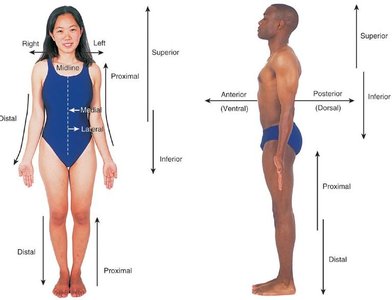
The anatomical position is a standardized way of observing or describing the body, standing upright, facing forward, arms at the sides, and palms facing forward. Directional terms are used to describe the locations of structures relative to other structures or locations in the body.
Anterior (Ventral): Front of the body
Posterior (Dorsal): Back of the body
Superior: Toward the head or upper part
Inferior: Away from the head or toward the lower part
Medial: Toward the midline
Lateral: Away from the midline
Proximal: Closer to the origin of the body part or point of attachment
Distal: Farther from the origin or point of attachment
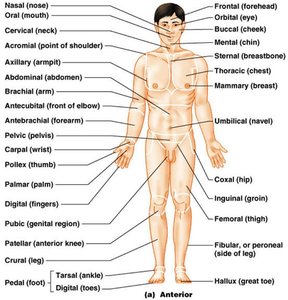
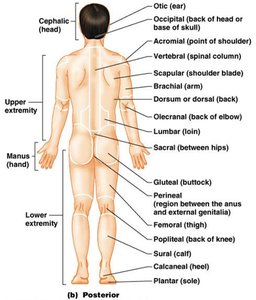
Body Regions (Anterior and Posterior)
Specific terms are used to describe regions of the body for clarity in anatomy.
Body Planes
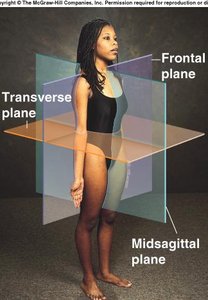
Body planes are imaginary lines used to divide the body into sections for anatomical study:
Midsagittal (Median) Plane: Divides the body into equal right and left halves.
Transverse (Horizontal) Plane: Divides the body into superior (upper) and inferior (lower) parts.
Frontal (Coronal) Plane: Divides the body into anterior (front) and posterior (back) parts.
Body Cavities
The body contains several cavities that house and protect vital organs:
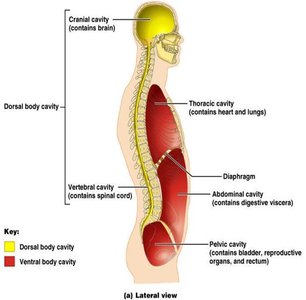
Dorsal Cavity: Includes the cranial cavity (brain) and vertebral cavity (spinal cord).
Ventral Cavity: Includes the thoracic cavity (heart and lungs), abdominal cavity (digestive organs), and pelvic cavity (bladder, reproductive organs, rectum). The diaphragm separates the thoracic and abdominal cavities.
Abdominopelvic Regions
The abdominopelvic cavity is divided into nine regions for anatomical reference:
Umbilical (center)
Epigastric (above the umbilical)
Hypogastric (below the umbilical)
Right and Left Iliac (lower sides)
Right and Left Lumbar (middle sides)
Right and Left Hypochondriac (upper sides)
