 뒤로
뒤로Chapter 1: The Human Body – An Orientation (Anatomy & Physiology Study Guide)
스터디 가이드 - 스마트 노트
 자료에 맞춘 맞춤형 노트, 핵심 정의, 예시, 맥락을 확장해 제공합니다.
The Human Body: An Orientation
Introduction to Anatomy & Physiology
Anatomy and physiology are foundational sciences for understanding the structure and function of the human body. Anatomy focuses on the body's structure, while physiology explores how those structures function. Mastery of anatomical terminology is essential for clear communication in health sciences.
Topics of Anatomy
Gross (Macroscopic) Anatomy: Study of large, visible structures. Includes regional, system, and surface anatomy.
Microscopic Anatomy: Study of structures too small to be seen with the naked eye. Includes cytology (cells) and histology (tissues).
Developmental Anatomy: Study of anatomical and physiological development throughout life, including embryology (before birth).
Skills for Studying Anatomy: Observation, manipulation, palpation, and auscultation.
Topics of Physiology
Subdivisions: Based on organ systems (e.g., renal, cardiovascular physiology).
Cellular and Molecular Focus: Examines how body functions depend on chemical reactions in cells.
Principles: Requires understanding of physical (electrical currents, pressure, movement) and chemical principles.
Complementarity of Structure and Function
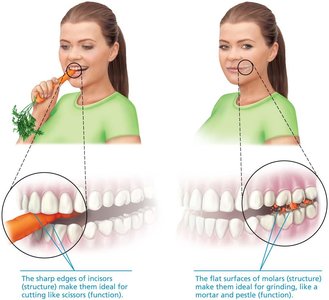
Anatomy and physiology are inseparable; function always reflects structure. This is known as the principle of complementarity. For example, the sharp edges of incisors are ideal for cutting, while the flat surfaces of molars are suited for grinding.
Levels of Structural Organization
Hierarchical Organization of the Human Body
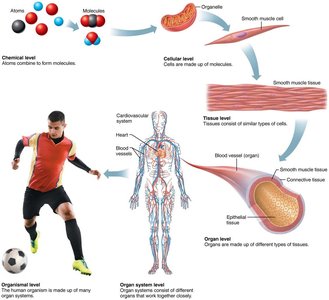
The human body is organized from the smallest chemical level to the whole organism. Each level builds upon the previous, creating increasing complexity.
Chemical Level: Atoms combine to form molecules.
Cellular Level: Cells are made up of molecules.
Tissue Level: Groups of similar cells form tissues.
Organ Level: Organs contain two or more types of tissues.
Organ System Level: Organs work closely together in systems.
Organismal Level: All organ systems combine to make the whole organism.
The Body’s Organ Systems and Their Major Functions
Overview of Organ Systems
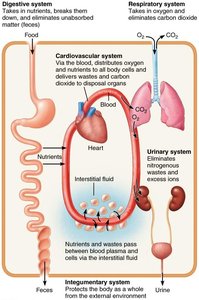
There are 11 organ systems in the human body, each with specific functions that contribute to overall health and homeostasis.
Integumentary System: Protects the body from external environment.
Skeletal System: Provides support and protection.
Muscular System: Enables movement.
Nervous System: Controls and coordinates body activities.
Endocrine System: Regulates processes via hormones.
Cardiovascular System: Transports blood, nutrients, gases, and wastes.
Lymphatic System: Defends against infection and disease.
Respiratory System: Facilitates gas exchange.
Digestive System: Breaks down food and absorbs nutrients.
Urinary System: Eliminates waste and regulates water balance.
Reproductive System: Produces offspring.
Necessary Life Functions
Essential Functions for Life
To maintain life, the body must perform several essential functions:
Maintaining Boundaries: Separation between internal and external environments (e.g., skin, plasma membranes).
Movement: Muscular system enables movement of body parts and substances.
Responsiveness: Ability to sense and respond to stimuli (e.g., withdrawal reflex).
Digestion: Breakdown and absorption of food.
Metabolism: All chemical reactions in body cells, including catabolism and anabolism.
Excretion: Removal of wastes (e.g., urea, CO2, feces).
Reproduction: Cellular division for growth/repair and production of offspring.
Growth: Increase in size of body part or organism.
Survival Needs
Factors Required for Survival
Humans require several factors for survival, each in appropriate amounts:
Nutrients: Carbohydrates, proteins, fats, minerals, and vitamins.
Oxygen: Essential for energy release from food.
Water: Most abundant chemical; necessary for chemical reactions.
Normal Body Temperature: Chemical reactions are temperature-dependent (optimal at 37°C).
Appropriate Atmospheric Pressure: Required for breathing and gas exchange.
Homeostasis
Definition and Importance
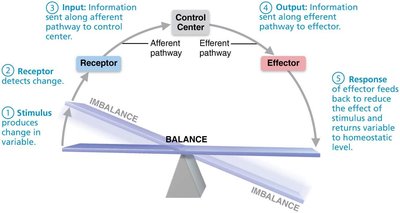
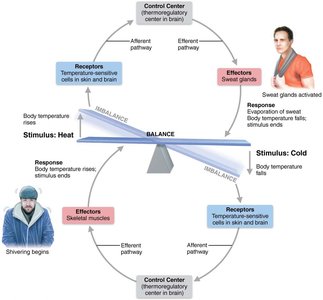
Homeostasis is the maintenance of stable internal conditions despite external changes. It is a dynamic equilibrium, maintained by all organ systems.
Homeostatic Controls
Homeostatic control involves three main components:
Receptor: Monitors environment and responds to stimuli.
Control Center: Determines set point and appropriate response.
Effector: Provides means to respond, reducing or enhancing the stimulus.
Negative Feedback
Most homeostatic mechanisms are negative feedback, where the response reduces or shuts off the original stimulus. Examples include regulation of body temperature and blood glucose.
Positive Feedback
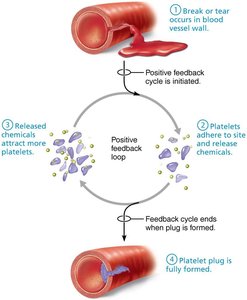
Positive feedback enhances the original stimulus, often in a cascade effect. It usually controls infrequent events, such as labor contractions and blood clotting.
Homeostatic Imbalance
Disturbances in homeostasis increase disease risk and contribute to aging. If negative feedback is overwhelmed, destructive positive feedback may occur (e.g., heart failure).
Anatomical Terms
Anatomical Position and Directional Terms
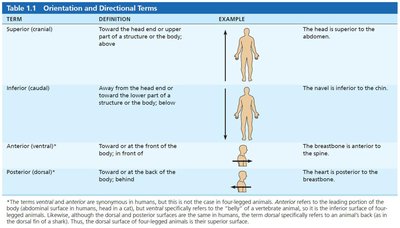
The standard anatomical position is body erect, feet slightly apart, palms forward, thumbs away from body. Directional terms describe the location of one structure relative to another, always based on this position.
Term | Definition | Example |
|---|---|---|
Superior (cranial) | Toward the head or upper part of a structure | The head is superior to the abdomen. |
Inferior (caudal) | Away from the head or toward the lower part | The navel is inferior to the chin. |
Anterior (ventral) | Toward the front of the body | The breastbone is anterior to the spine. |
Posterior (dorsal) | Toward the back of the body | The heart is posterior to the spine. |
Regional Terms
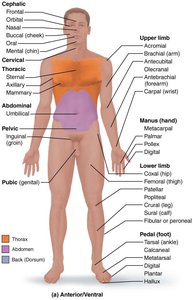
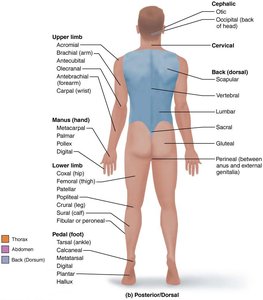
The body is divided into axial (head, neck, trunk) and appendicular (limbs) regions. Regional terms designate specific areas within these divisions.
Body Cavities and Membranes
Major Body Cavities
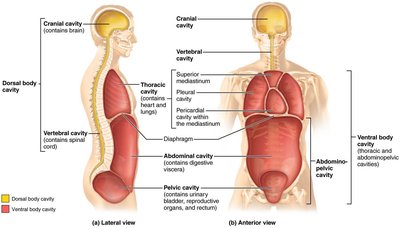
The body contains internal cavities that protect organs. There are two main sets:
Dorsal Body Cavity: Cranial (brain) and vertebral (spinal cord).
Ventral Body Cavity: Thoracic (lungs, heart) and abdominopelvic (digestive, urinary, reproductive organs).
Serous Membranes
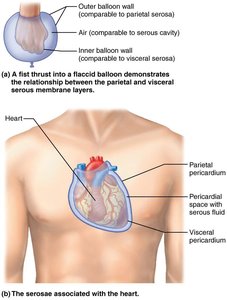
Serous membranes (serosa) are thin, double-layered membranes covering surfaces in the ventral cavity. The parietal serosa lines cavity walls, while the visceral serosa covers organs. The pericardium, pleurae, and peritoneum are specific serous membranes for the heart, lungs, and abdominopelvic cavity, respectively.
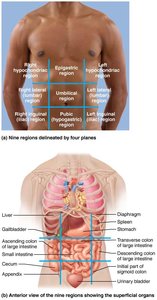
Abdominopelvic Quadrants and Regions
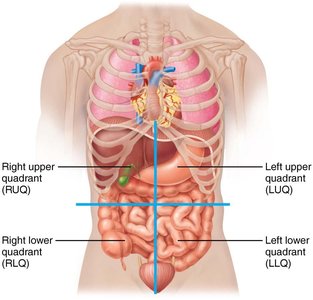
The abdominopelvic cavity is divided into four quadrants (RUQ, LUQ, RLQ, LLQ) and nine regions for clinical and anatomical reference.
Other Body Cavities
Additional cavities include oral, nasal, orbital, middle ear (exposed to environment), and synovial (joint cavities, not exposed).
Summary Table: Levels of Structural Organization
Level | Description |
|---|---|
Chemical | Atoms and molecules |
Cellular | Cells made of molecules |
Tissue | Groups of similar cells |
Organ | Two or more tissue types |
Organ System | Organs working together |
Organismal | All organ systems combined |
Additional info: These notes expand on brief points from the slides, providing definitions, examples, and context for each topic. All images included are directly relevant to the adjacent explanations, reinforcing key concepts visually.
