 뒤로
뒤로Chapter 1: The Human Body – An Orientation (Anatomy & Physiology Study Guide)
스터디 가이드 - 스마트 노트
 자료에 맞춘 맞춤형 노트, 핵심 정의, 예시, 맥락을 확장해 제공합니다.
The Human Body: An Orientation
Introduction to Anatomy & Physiology
Anatomy and physiology are foundational sciences that provide a framework for understanding the structure and function of the human body. This chapter introduces key concepts, terminology, and organizational principles essential for further study in Anatomy & Physiology.
Anatomy: The study of the structure of body parts and their relationships to one another.
Physiology: The study of the function of body parts and how they work together to sustain life.
Principle of Complementarity: Structure determines function; what a structure can do depends on its form.
Levels of Structural Organization
The human body is organized in a hierarchical manner, from the simplest chemical level to the complex organism level. Understanding these levels is crucial for grasping how the body functions as a whole.
Chemical Level: Atoms combine to form molecules.
Cellular Level: Cells are made up of molecules and are the basic structural and functional units of life.
Tissue Level: Groups of similar cells form tissues.
Organ Level: Organs are made up of different types of tissues.
Organ System Level: Organ systems consist of different organs that work together.
Organism Level: The human organism is made up of many organ systems working together.
Necessary Life Functions
All living organisms carry out certain vital functions necessary for the maintenance of life. These functions are often referred to as the characteristics of life.
Maintenance of Boundaries: Separates internal environment from external environment.
Digestion: Breakdown of food into absorbable units.
Growth: Increase in size or number of cells.
Excretion: Removal of waste products.
Reproduction: Production of offspring or new cells.
Movement: Motion of the body or substances within it.
Metabolism: All chemical reactions occurring in the body.
Responsiveness: Ability to sense and respond to stimuli.
Organ Systems Overview
The human body consists of multiple organ systems that work together to maintain health and homeostasis. Each system has specific functions and interacts with others.
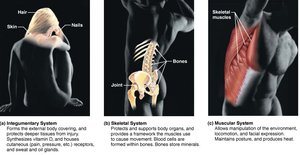
Integumentary System: Protects the body, regulates temperature, and prevents water loss.
Skeletal System: Provides support and protection, stores minerals, and produces blood cells.
Muscular System: Enables movement, maintains posture, and produces heat.
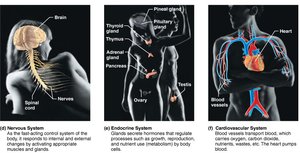
Nervous System: Controls rapid responses to stimuli and coordinates activities.
Endocrine System: Regulates processes via hormones.
Cardiovascular System: Transports nutrients, gases, and wastes.
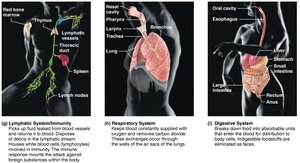
Lymphatic/Immune System: Defends against infection and disease.
Respiratory System: Facilitates gas exchange.
Digestive System: Breaks down food and absorbs nutrients.
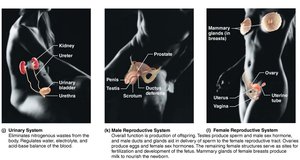
Urinary System: Eliminates waste and maintains fluid balance.
Reproductive System: Produces offspring.
Survival Needs
For survival, the human body requires several essential factors:
Atmospheric Pressure: Necessary for proper breathing and gas exchange.
Stable Body Temperature: Required for optimal enzyme function and metabolic processes.
Nutrients: Provide energy and building blocks for cells.
Oxygen: Essential for cellular respiration.
Water: Medium for chemical reactions and transport of substances.

Homeostasis
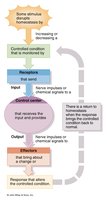
Homeostasis is the maintenance of a stable internal environment despite external changes. All organ systems contribute to homeostasis, which is vital for health and survival.
Definition: The body's ability to maintain relatively stable internal conditions.
Importance: Disruption of homeostasis can lead to disease or death.
Communication: Organ systems communicate to regulate homeostasis.
Feedback Loops in Homeostasis
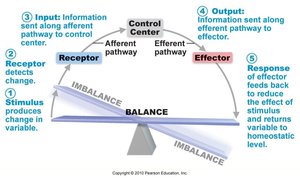
Feedback loops are mechanisms used by the body to maintain homeostasis. They involve communication between different components to monitor and adjust physiological variables.
Components: Receptor (sensor), Control Center (integrator), Effector (response).
Negative Feedback: Reverses a change to restore balance. Most common in the body.
Positive Feedback: Intensifies a change, moving further from balance. Rare and usually self-limiting.
Examples of Feedback Loops
Negative Feedback Example: Blood pressure regulation. Pressure receptors detect changes, the brain (control center) processes input, and effectors (heart and blood vessels) restore normal pressure.
Positive Feedback Example: Childbirth contractions. Hormones intensify contractions until delivery occurs.
Imbalances in Homeostasis
Imbalances can lead to disorders, diseases, or death. Understanding signs and symptoms is crucial for diagnosis.
Disorder: Abnormality in structure or function.
Disease: Specific illness resulting from homeostatic disturbance.
Death: Ultimate failure of homeostasis.
Signs: Observable indicators by medical professionals.
Symptoms: Subjective experiences reported by patients.
Summary Table: Levels of Structural Organization
Level | Description |
|---|---|
Chemical | Atoms and molecules form the basis of life |
Cellular | Cells are basic units of structure and function |
Tissue | Groups of similar cells performing a function |
Organ | Structures composed of multiple tissue types |
Organ System | Groups of organs working together |
Organism | The complete living being |
Summary Table: Necessary Life Functions
Function | Description |
|---|---|
Maintenance of Boundaries | Separates internal and external environments |
Digestion | Breakdown and absorption of nutrients |
Growth | Increase in size or number of cells |
Excretion | Removal of waste products |
Reproduction | Production of offspring or new cells |
Movement | Motion of body or substances |
Metabolism | Chemical reactions in the body |
Responsiveness | Sensing and responding to stimuli |
Summary Table: Feedback Loop Components
Component | Role |
|---|---|
Receptor | Detects changes in environment |
Control Center | Processes information and decides response |
Effector | Acts to restore balance |
Key Equations
Homeostasis Feedback Loop (Generalized):
Negative Feedback Example (Blood Pressure):
Positive Feedback Example (Childbirth):
Additional info: Academic context was added to clarify definitions, examples, and the structure of feedback loops, as well as to provide summary tables for organizational clarity.
