 뒤로
뒤로Chapter 1: The Human Body – An Orientation (Anatomy & Physiology Study Notes)
스터디 가이드 - 스마트 노트
 자료에 맞춘 맞춤형 노트, 핵심 정의, 예시, 맥락을 확장해 제공합니다.
Introduction to Human Anatomy and Physiology
Human anatomy and physiology is the scientific study of the structure and function of the human body. Understanding these concepts is essential for students pursuing careers in health sciences, as it provides the foundation for understanding how the body operates in health and disease.
Topics of Anatomy
Subdivisions of Anatomy
Gross (Macroscopic) Anatomy: Study of large, visible structures.
Regional Anatomy: Examines all structures in a specific area of the body.
System Anatomy: Focuses on one organ system at a time (e.g., cardiovascular, nervous).
Surface Anatomy: Studies internal structures as they relate to the overlying skin.
Microscopic Anatomy: Study of structures too small to be seen with the naked eye.
Cytology: Study of cells.
Histology: Study of tissues.
Developmental Anatomy: Study of anatomical and physiological development throughout life.
Embryology: Study of development before birth.
To study anatomy, one must use anatomical terminology and be able to observe, manipulate, palpate, and auscultate.
Topics of Physiology
Subdivisions of Physiology
Based on organ systems (e.g., renal physiology, cardiovascular physiology).
Often focuses on cellular and molecular levels, examining how the body's abilities depend on chemical reactions in individual cells.
Requires understanding of basic physical and chemical principles (e.g., electrical currents, pressure, movement).
Complementarity of Structure and Function
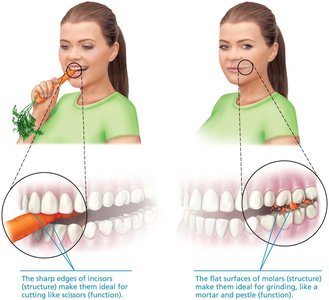
Anatomy and physiology are inseparable; function always reflects structure. This is known as the principle of complementarity of structure and function: what a structure can do depends on its specific form.
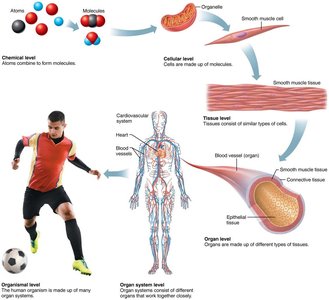
Levels of Structural Organization
The human body is organized from the smallest chemical level to the whole organism level:
Chemical Level: Atoms combine to form molecules.
Cellular Level: Cells are made up of molecules.
Tissue Level: Tissues consist of similar types of cells.
Organ Level: Organs are made up of different types of tissues.
Organ System Level: Organ systems consist of different organs that work together closely.
Organismal Level: The human organism is made up of many organ systems.
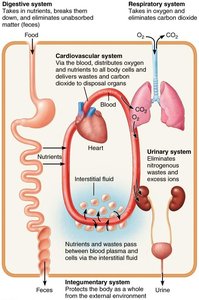
The Body’s Organ Systems and Their Major Functions
There are 11 organ systems in the human body, each with specific functions that contribute to the maintenance of life. Examples include:
Integumentary System: Protects the body as a whole from the external environment.
Digestive System: Takes in nutrients, breaks them down, and eliminates unabsorbed matter (feces).
Cardiovascular System: Distributes oxygen and nutrients to all body cells and delivers wastes and carbon dioxide to disposal organs.
Respiratory System: Takes in oxygen and eliminates carbon dioxide.
Urinary System: Eliminates nitrogenous wastes and excess ions.
Necessary Life Functions
To maintain life, the body must perform several essential functions:
Maintaining Boundaries: Separation between internal and external environments (e.g., plasma membranes, skin).
Movement: Muscular system allows movement of body parts and substances.
Responsiveness: Ability to sense and respond to stimuli (e.g., withdrawal reflex, control of breathing rate).
Digestion: Breakdown of ingested food and absorption of simple molecules into the blood.
Metabolism: All chemical reactions in body cells, including catabolism (breakdown) and anabolism (synthesis).
Excretion: Removal of wastes from metabolism and digestion (e.g., urea, carbon dioxide, feces).
Reproduction: Cellular division for growth or repair; production of offspring at the organismal level.
Growth: Increase in size of a body part or the organism.
Survival Needs
Humans require several factors for survival, each in appropriate amounts:
Nutrients: Chemicals for energy and cell building (carbohydrates, proteins, fats, vitamins, minerals).
Oxygen: Essential for energy release from foods.
Water: Most abundant chemical in the body; provides environment for chemical reactions.
Normal Body Temperature: Necessary for proper rates of chemical reactions (around 37°C).
Appropriate Atmospheric Pressure: Required for adequate breathing and gas exchange in the lungs.
Homeostasis
Homeostasis is the maintenance of relatively stable internal conditions despite continuous changes in the environment. It is a dynamic state of equilibrium, maintained by all organ systems.
Homeostatic Controls
Homeostatic control involves three main components:
Receptor (Sensor): Monitors the environment and responds to stimuli.
Control Center: Determines the set point and appropriate response.
Effector: Provides the means to respond, reducing or enhancing the stimulus.
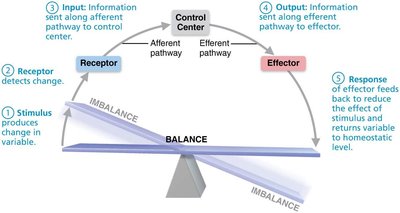
Negative Feedback
Most homeostatic control mechanisms are negative feedback systems, where the response reduces or shuts off the original stimulus. Examples include regulation of body temperature and blood glucose levels.
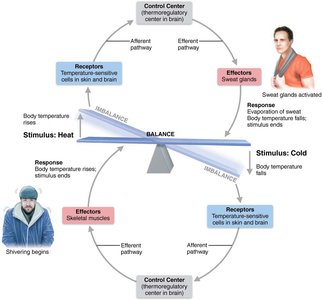
Positive Feedback
Positive feedback mechanisms enhance or exaggerate the original stimulus, often controlling infrequent events (e.g., labor contractions, blood clotting).
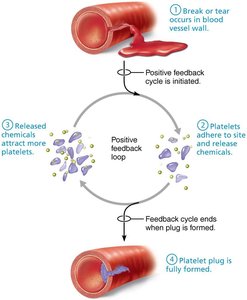
Homeostatic Imbalance
Disturbance of homeostasis increases risk of disease and contributes to aging.
If negative feedback mechanisms are overwhelmed, destructive positive feedback may occur (e.g., heart failure).
Anatomical Terms
Anatomical Position and Directional Terms
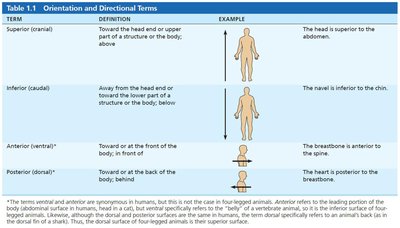
The standard anatomical position is body erect, feet slightly apart, palms facing forward. Directional terms describe the location of one body structure relative to another.
Term | Definition | Example |
|---|---|---|
Superior (cranial) | Toward the head or upper part of a structure | The head is superior to the abdomen. |
Inferior (caudal) | Away from the head or toward the lower part | The navel is inferior to the chin. |
Anterior (ventral) | Toward or at the front of the body | The breastbone is anterior to the spine. |
Posterior (dorsal) | Toward or at the back of the body | The heart is posterior to the breastbone. |
Regional Terms
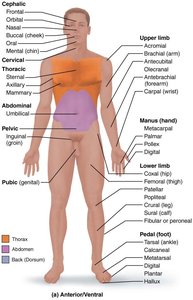
The body is divided into two major regions:
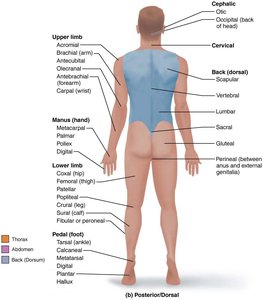
Axial: Head, neck, and trunk.
Appendicular: Limbs (arms and legs).
Body Cavities and Membranes
Major Body Cavities
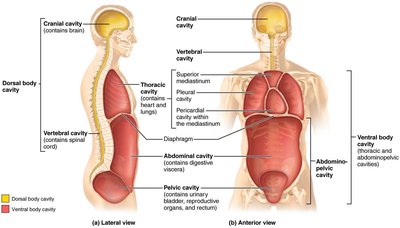
Dorsal Body Cavity: Protects the nervous system; includes cranial and vertebral cavities.
Ventral Body Cavity: Houses internal organs (viscera); includes thoracic and abdominopelvic cavities.
Ventral Body Cavity Subdivisions
Thoracic Cavity: Contains pleural cavities (lungs), mediastinum (heart, esophagus, trachea), and pericardial cavity (heart).
Abdominopelvic Cavity: Contains abdominal (digestive organs) and pelvic (urinary bladder, reproductive organs, rectum) cavities.
Serous Membranes
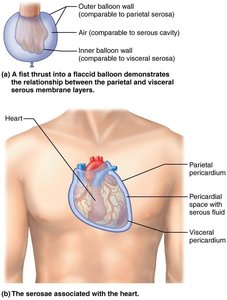
Serous membranes (serosa) are thin, double-layered membranes covering surfaces in the ventral body cavity. The parietal serosa lines cavity walls, while the visceral serosa covers organs. Serous fluid between layers reduces friction.
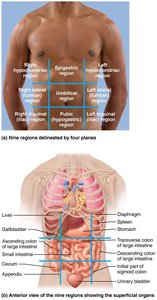
Abdominopelvic Quadrants and Regions
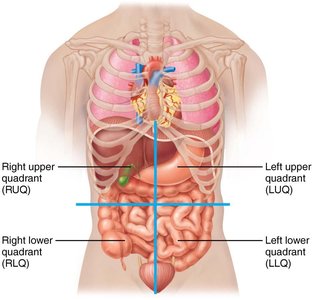
The abdominopelvic cavity is divided for clinical and anatomical purposes:
Four Quadrants: Right upper (RUQ), left upper (LUQ), right lower (RLQ), left lower (LLQ).
Nine Regions: Right/left hypochondriac, epigastric, right/left lumbar, umbilical, right/left iliac (inguinal), hypogastric.
Other Body Cavities
Exposed to environment: Oral, digestive, nasal, orbital, and middle ear cavities.
Not exposed: Synovial (joint) cavities.
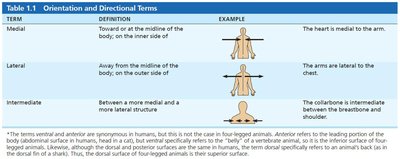
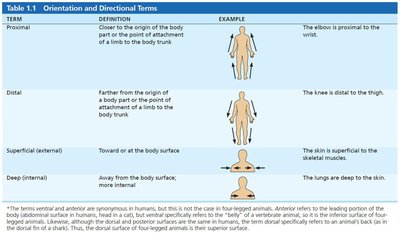
Summary Table: Orientation and Directional Terms
Term | Definition | Example |
|---|---|---|
Medial | Toward or at the midline of the body | The heart is medial to the arm. |
Lateral | Away from the midline of the body | The arms are lateral to the chest. |
Intermediate | Between a more medial and a more lateral structure | The collarbone is intermediate between the breastbone and shoulder. |
Proximal | Closer to the origin of the body part or point of attachment | The elbow is proximal to the wrist. |
Distal | Farther from the origin of a body part or point of attachment | The knee is distal to the thigh. |
Superficial (external) | Toward or at the body surface | The skin is superficial to skeletal muscles. |
Deep (internal) | Away from the body surface; more internal | The lungs are deep to the skin. |
Key Equations and Concepts
Homeostatic Control System (Generalized):
\text{Stimulus} \rightarrow \text{Receptor} \rightarrow \text{Afferent Pathway} \rightarrow \text{Control Center} \rightarrow \text{Efferent Pathway} \rightarrow \text{Effector} \rightarrow \text{Response} \$
Negative Feedback Example (Blood Glucose):
\text{Increased Blood Glucose} \rightarrow \text{Pancreas Secretes Insulin} \rightarrow \text{Cells Absorb Glucose} \rightarrow \text{Blood Glucose Decreases} \$
Positive Feedback Example (Blood Clotting):
\text{Break in Blood Vessel Wall} \rightarrow \text{Platelets Adhere and Release Chemicals} \rightarrow \text{More Platelets Attracted} \rightarrow \text{Platelet Plug Forms} \$
Additional info: These notes provide a comprehensive overview of the foundational concepts in human anatomy and physiology, focusing on the organization, terminology, and regulatory mechanisms essential for understanding the human body.
