 뒤로
뒤로Chapter 1: The Human Body—An Orientation (Essentials of Human Anatomy & Physiology)
스터디 가이드 - 스마트 노트
 자료에 맞춘 맞춤형 노트, 핵심 정의, 예시, 맥락을 확장해 제공합니다.
Introduction to Anatomy and Physiology
Anatomy and physiology are foundational sciences in understanding the structure and function of the human body. Anatomy focuses on the body's structures, while physiology explains how these structures function to sustain life.
Anatomy
Definition and Branches
Anatomy: The study of the structure and shape of the body and its parts, and their relationships to one another.
Gross Anatomy: Examines large, easily observable structures, such as organs and organ systems.
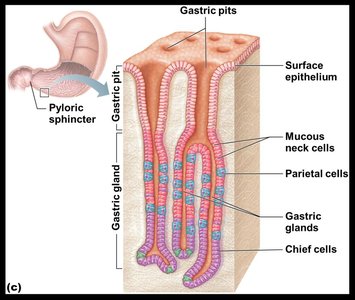
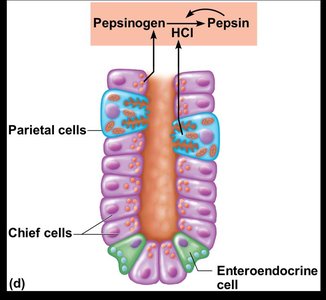
Microscopic Anatomy: Studies structures too small to be seen with the naked eye, such as cells and tissues, using a microscope.
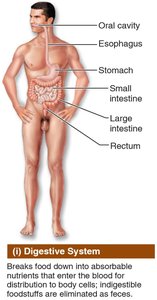
Example: Gross anatomy can be illustrated by examining the organs of the digestive system, while microscopic anatomy focuses on the cellular structure of the stomach.
Physiology
Definition and Principles
Physiology: The study of how the body and its parts work or function.
Structure determines function: The specific structure of a body part enables its particular function (e.g., thin walls of lung air sacs allow for efficient gas exchange).
Levels of Structural Organization
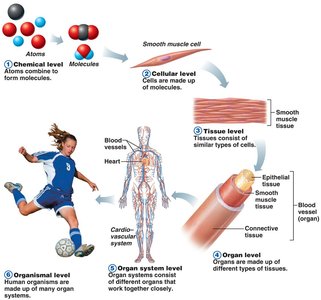
The human body is organized into six hierarchical levels, each building upon the previous one:
Chemical Level: Atoms combine to form molecules.
Cellular Level: Cells are made up of molecules.
Tissue Level: Tissues consist of similar types of cells.
Organ Level: Organs are made up of different types of tissues.
Organ System Level: Organ systems consist of different organs that work together closely.
Organismal Level: The human organism is made up of many organ systems.
Organ System Overview
The human body contains eleven major organ systems, each with specific functions essential for maintaining life.
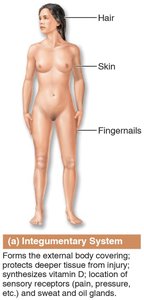
Integumentary System
Forms the external body covering (skin), includes hair and fingernails.
Protects deeper tissues, synthesizes vitamin D, and regulates body temperature.
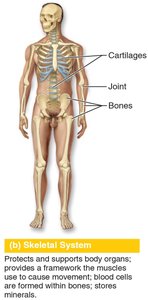
Skeletal System
Composed of bones, cartilages, ligaments, and joints.
Provides support, protection, and is the site of blood cell formation.
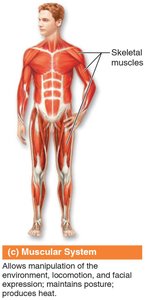
Muscular System
Consists of skeletal muscles that contract to produce movement.
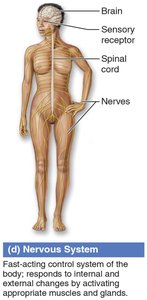
Nervous System
Fast-acting control system including the brain, spinal cord, nerves, and sensory receptors.
Responds to internal and external stimuli.
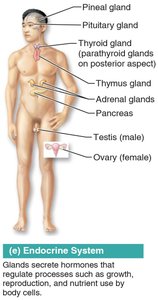
Endocrine System
Secretes hormones that regulate growth, reproduction, and metabolism.
Includes glands such as the pituitary, thyroid, adrenals, pancreas, ovaries, and testes.
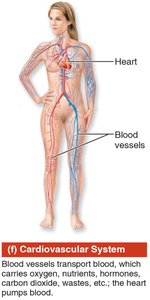
Cardiovascular System
Composed of the heart and blood vessels.
Transports oxygen, nutrients, hormones, and waste products.
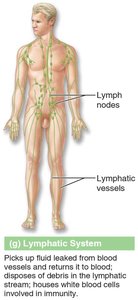
Lymphatic System
Returns leaked fluids to the bloodstream and houses white blood cells for immunity.
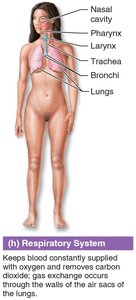
Respiratory System
Supplies blood with oxygen and removes carbon dioxide through gas exchange in the lungs.
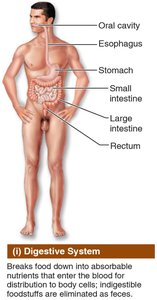
Digestive System
Breaks down food into absorbable units and eliminates indigestible material as feces.
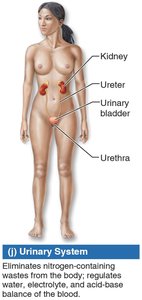
Urinary System
Eliminates nitrogenous wastes and regulates water, electrolyte, and acid-base balance.
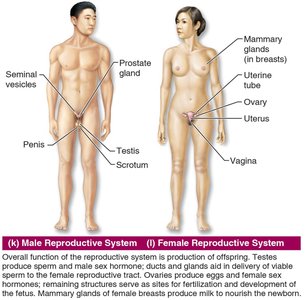
Reproductive System
Produces offspring; testes produce sperm in males, ovaries produce eggs in females.
Necessary Life Functions
Maintaining Boundaries: Separation of internal and external environments (e.g., skin).
Movement: Locomotion and movement of substances within the body.
Responsiveness: Ability to sense and respond to stimuli.
Digestion: Breakdown and absorption of nutrients.
Metabolism: All chemical reactions in the body, including catabolism and anabolism. Regulated by hormones.
Excretion: Removal of metabolic wastes (urine, feces, sweat).
Reproduction: Cellular (growth and repair) and organismal (offspring) levels.
Growth: Increase in size and number of cells, regulated by hormones.
Survival Needs
Nutrients: Carbohydrates, proteins, lipids, vitamins, and minerals for energy and cell building.
Oxygen: Essential for cellular respiration and energy production.
Water: Most abundant chemical in the body; necessary for metabolic processes.
Normal Body Temperature: 37°C (98.6°F); required for proper metabolic reactions.
Atmospheric Pressure: Necessary for adequate gas exchange in the lungs.
The Language of Anatomy
Anatomical Position and Terminology
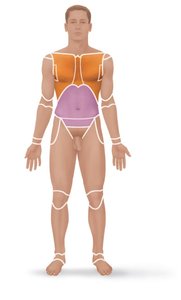
Anatomical Position: Standard reference position—standing erect, feet parallel, arms at sides with palms facing forward.
Specialized terminology is used to describe body positions, directions, regions, and structures to avoid confusion.
Directional Terms
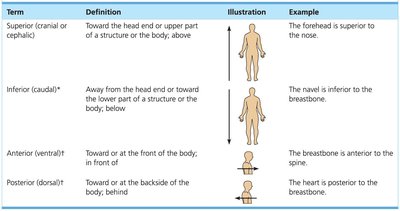
Directional terms describe the location of one body part relative to another. Common terms include:
Term | Definition | Example |
|---|---|---|
Superior (cranial) | Toward the head or upper part; above | The forehead is superior to the nose. |
Inferior (caudal) | Away from the head or toward the lower part; below | The navel is inferior to the breastbone. |
Anterior (ventral) | Toward or at the front; in front of | The breastbone is anterior to the spine. |
Posterior (dorsal) | Toward or at the back; behind | The heart is posterior to the breastbone. |
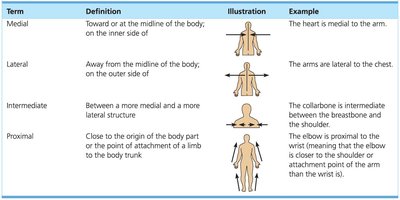
Term | Definition | Example |
|---|---|---|
Medial | Toward the midline; on the inner side | The heart is medial to the arm. |
Lateral | Away from the midline; on the outer side | The arms are lateral to the chest. |
Intermediate | Between a more medial and a more lateral structure | The collarbone is intermediate between the breastbone and the shoulder. |
Proximal | Close to the origin of the body part or point of attachment | The elbow is proximal to the wrist. |
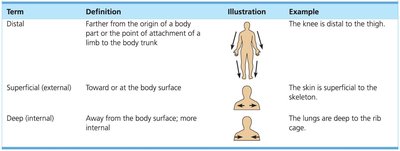
Term | Definition | Example |
|---|---|---|
Distal | Farther from the origin or point of attachment | The knee is distal to the thigh. |
Superficial (external) | Toward or at the body surface | The skin is superficial to the skeleton. |
Deep (internal) | Away from the body surface; more internal | The lungs are deep to the rib cage. |
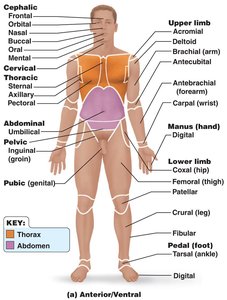
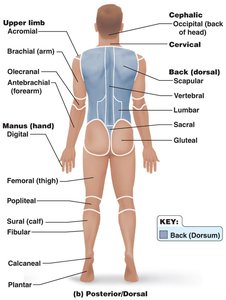
Regional Terms
Regional terms specify areas within major body divisions (anterior/ventral and posterior/dorsal landmarks).
Body Planes and Sections
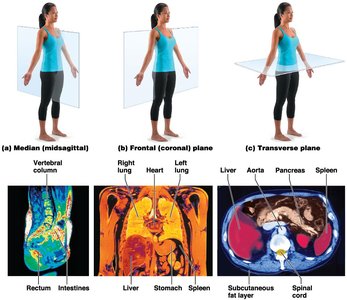
Sagittal Plane: Divides the body into left and right parts.
Midsagittal (Median) Plane: Divides the body into equal left and right halves.
Frontal (Coronal) Plane: Divides the body into anterior and posterior parts.
Transverse (Cross) Plane: Divides the body into superior and inferior parts.
Body Cavities
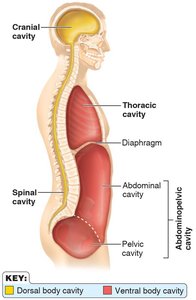
Major Body Cavities
Dorsal Body Cavity: Includes the cranial cavity (houses the brain) and spinal cavity (houses the spinal cord).
Ventral Body Cavity: Includes the thoracic cavity (houses heart and lungs) and abdominopelvic cavity (houses digestive, urinary, and reproductive organs).
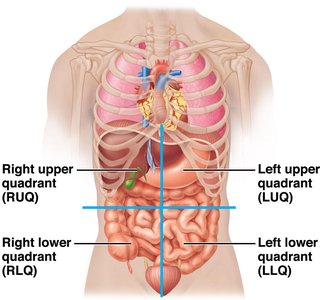
Abdominopelvic Cavity Subdivisions
Divided into four quadrants and nine regions for anatomical reference.
Homeostasis
Definition and Importance
Homeostasis: The maintenance of relatively stable internal conditions despite changes in the external environment.
Controlled primarily by the nervous and endocrine systems.
Homeostatic imbalance can lead to disease.
Homeostatic Control Mechanisms
Three essential components: Receptor (detects change), Control Center (processes information and determines response), and Effector (carries out response).
Information flows from receptor to control center (afferent pathway) and from control center to effector (efferent pathway).
Feedback Mechanisms
Negative Feedback: Most common; reduces or shuts off the original stimulus (e.g., body temperature regulation).
Positive Feedback: Rare; increases the original stimulus (e.g., blood clotting, labor contractions).
Additional info: Understanding these foundational concepts is essential for further study in anatomy and physiology, as they provide the framework for exploring the structure and function of all body systems.
