 뒤로
뒤로Chapter 1: The Human Body—An Orientation (Anatomy & Physiology Study Notes)
스터디 가이드 - 스마트 노트
 자료에 맞춘 맞춤형 노트, 핵심 정의, 예시, 맥락을 확장해 제공합니다.
Chapter 1: The Human Body—An Orientation
1.1 Form and Function of Anatomy & Physiology
Anatomy and physiology are foundational sciences in understanding the human body. Anatomy focuses on the structure of body parts, while physiology explores their functions. The two are closely linked, as the structure of a body part determines its function.
Anatomy: Study of the structure of body parts and their relationships to one another. Subdivided into:
Gross (macroscopic) anatomy: Structures visible to the naked eye (e.g., regional, systemic, surface anatomy).
Microscopic anatomy: Structures too small to be seen without a microscope (e.g., cytology, histology).
Developmental anatomy: Structural changes throughout the lifespan (e.g., embryology).
Physiology: Study of the function of body parts; how they work to carry out life-sustaining activities. Subdivisions include renal, cardiovascular, and neurophysiology.
Pathology: Study of abnormal function.
Principle of Complementarity: Function always reflects structure; what a structure can do depends on its specific form.
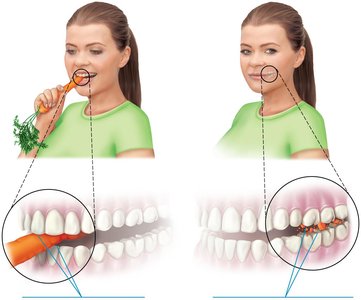
Example: The sharp edges of incisors are ideal for cutting, while the flat surfaces of molars are suited for grinding food.
1.2 Structural Organization of the Human Body
The human body is organized into hierarchical levels, from the smallest chemical components to the entire organism.
Chemical level: Atoms combine to form molecules.
Cellular level: Cells are made up of molecules.
Tissue level: Tissues consist of similar types of cells.
Organ level: Organs are made up of different types of tissues.
Organ system level: Organ systems consist of different organs that work together closely.
Organismal level: The human organism is made up of many organ systems.
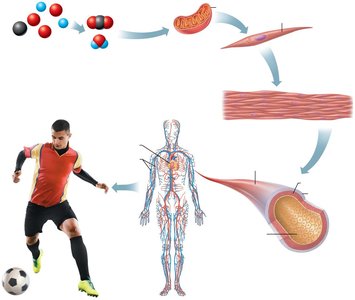
Example: The cardiovascular system includes the heart and blood vessels, which transport blood throughout the body.
1.3 Requirements for Life
To maintain life, the human body must perform several essential functions and meet certain survival needs.
Necessary Life Functions:
Maintaining boundaries
Movement
Responsiveness
Digestion
Metabolism
Excretion
Reproduction
Growth
Survival Needs:
Nutrients: Chemicals for energy and cell building
Oxygen: Required for energy release from foods
Water: Provides environment for chemical reactions
Normal body temperature: Ensures efficient chemical reactions
Appropriate atmospheric pressure: Required for breathing and gas exchange
1.4 Homeostasis
Homeostasis is the maintenance of relatively stable internal conditions despite continuous changes in the environment. It is a dynamic state of equilibrium, maintained by all organ systems.
Components of Homeostatic Control:
Receptor (sensor): Monitors environment and responds to stimuli.
Control center: Determines set point, receives input, and determines response.
Effector: Receives output and provides the means to respond (reduces or enhances stimulus).
Negative Feedback: Most common; response reduces or shuts off original stimulus (e.g., regulation of body temperature, blood glucose).
Positive Feedback: Response enhances original stimulus (e.g., labor contractions, blood clotting).
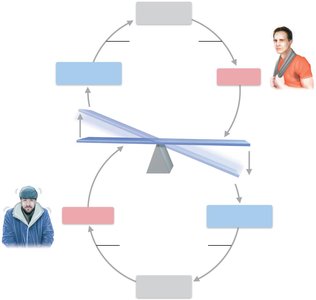
Example: Body temperature regulation is a negative feedback mechanism. When body temperature rises, sweat glands are activated to cool the body; when it falls, shivering generates heat.
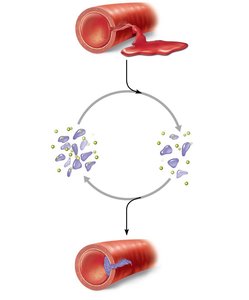
Example: Platelet plug formation during blood clotting is a positive feedback loop.
1.5 Anatomical Terms
Standard anatomical position and directional terms are used to describe the location of body parts relative to each other.
Anatomical Position: Body upright, feet slightly apart, palms facing forward, thumbs pointing away from body.
Directional Terms: Describe one body structure in relation to another (e.g., superior/inferior, anterior/posterior, medial/lateral).
Regional Terms: Designate specific areas within body divisions (axial: head, neck, trunk; appendicular: limbs).
1.6 Body Planes, Sections, Cavities, and Membranes
Body planes and sections are used for anatomical study, while body cavities and membranes protect and compartmentalize organs.
Body Planes:
Sagittal plane: Divides body into right and left parts (midsagittal = midline; parasagittal = off-center).
Frontal (coronal) plane: Divides body into anterior and posterior parts.
Transverse (horizontal) plane: Divides body into superior and inferior parts.
Oblique section: Cuts at angles other than 90° to vertical plane.
Body Cavities:
Dorsal cavity: Cranial and vertebral cavities (protects nervous system).
Ventral cavity: Thoracic and abdominopelvic cavities (houses viscera).
Other cavities: Oral, nasal, orbital, middle ear, synovial (joint) cavities.
Membranes:
Serosa (serous membrane): Thin, double-layered membranes in ventral body cavity.
Parietal serosa: Lines cavity walls.
Visceral serosa: Covers organs.
Serous fluid between layers reduces friction.
Abdominopelvic Quadrants: Used by medical personnel to describe locations (RUQ, LUQ, RLQ, LLQ).
Summary Table: Major Organ Systems and Their Functions
Organ System | Main Organs | Primary Functions |
|---|---|---|
Integumentary | Skin, hair, nails | Protection, vitamin D synthesis, sensory reception |
Skeletal | Bones, joints | Support, movement, blood cell formation, mineral storage |
Muscular | Skeletal muscles | Movement, posture, heat production |
Nervous | Brain, spinal cord, nerves | Control system, response to stimuli |
Endocrine | Glands (e.g., pituitary, thyroid) | Hormone secretion, regulation of growth, metabolism |
Cardiovascular | Heart, blood vessels | Transport of blood, nutrients, gases, wastes |
Lymphatic/Immune | Lymph nodes, spleen, thymus | Fluid return, immunity |
Respiratory | Lungs, trachea | Gas exchange (O2/CO2) |
Digestive | Stomach, intestines, liver | Breakdown and absorption of food, waste elimination |
Urinary | Kidneys, bladder | Elimination of wastes, water/electrolyte balance |
Male Reproductive | Testes, penis | Production of sperm, delivery to female tract |
Female Reproductive | Ovaries, uterus, mammary glands | Production of eggs, support of fetus, nourishment of newborn |
Additional info: The chapter also introduces the concept of situs inversus (a rare condition where organ positions are mirrored) and emphasizes the importance of anatomical terminology for clear communication in health sciences.
