 뒤로
뒤로Chapter 16: The Endocrine System – Study Notes
스터디 가이드 - 스마트 노트
 자료에 맞춘 맞춤형 노트, 핵심 정의, 예시, 맥락을 확장해 제공합니다.
Chapter 16: The Endocrine System
Overview of the Endocrine System
The endocrine system is a major regulatory system of the body, responsible for maintaining homeostasis through the secretion of hormones. Hormones are chemical messengers released into the bloodstream by endocrine glands, affecting target cells throughout the body.
Endocrine glands: Ductless glands that secrete hormones directly into the blood.
Exocrine glands: Glands that release their products through ducts to the surface or into body cavities (e.g., sweat, salivary glands).
Target cells: Cells with specific receptors for a hormone, enabling them to respond to hormonal signals.
Paracrines (local hormones): Chemical messengers that act locally on nearby cells, such as histamine in tissues or hormones in the pancreas and GI tract.
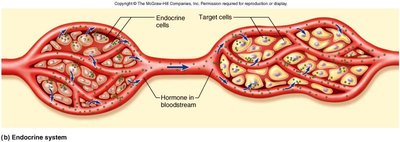
Hormones: Chemical Messengers
Hormones are essential for regulating physiological processes, including growth, metabolism, reproduction, and stress responses. They are produced by various endocrine glands and travel through the bloodstream to exert effects on distant target organs.
Hormone types: Amino acid-based (proteins, peptides) and steroid hormones (derived from cholesterol).
Mechanism of action: Hormones bind to specific receptors on or within target cells, triggering cellular responses.
Example: Insulin from the pancreas lowers blood glucose by promoting uptake in target cells.
Major Endocrine Glands and Their Locations
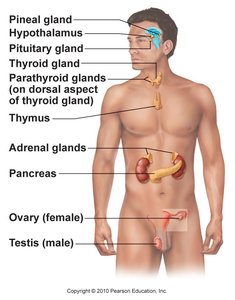
The human body contains several key endocrine glands, each with distinct functions and hormone products. Understanding their locations and roles is fundamental to anatomy and physiology.
Pineal gland: Located in the brain; secretes melatonin.
Hypothalamus: Brain region controlling pituitary gland; integrates nervous and endocrine functions.
Pituitary gland: Master gland beneath the hypothalamus; releases multiple hormones affecting other glands.
Thyroid gland: Neck region; regulates metabolism.
Parathyroid glands: On dorsal aspect of thyroid; regulate calcium balance.
Thymus: Chest; involved in immune function.
Adrenal glands: Above kidneys; produce stress hormones (cortisol, adrenaline).
Pancreas: Abdomen; regulates blood glucose.
Ovary (female): Pelvic region; produces estrogen and progesterone.
Testis (male): Scrotal region; produces testosterone.
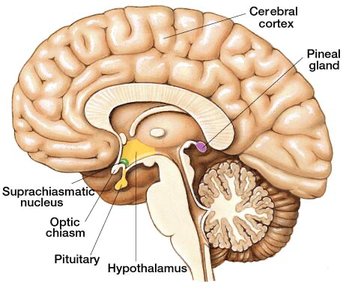
The Hypothalamus
The hypothalamus is a crucial brain structure that forms the floor and walls of the third ventricle. It acts as a link between the nervous and endocrine systems, controlling many bodily functions through its influence on the pituitary gland.
Shape: Flattened funnel.
Functions: Regulates body temperature, hunger, thirst, circadian rhythms, and emotional responses.
Connection to pituitary: Releases hormones that stimulate or inhibit pituitary hormone secretion.
Pituitary Gland (Hypophysis)
The pituitary gland, also known as the hypophysis, is often referred to as the "master gland" because it controls other endocrine glands. It is divided into two main parts: the anterior pituitary (adenohypophysis) and the posterior pituitary (neurohypophysis).
Anterior pituitary: Produces hormones such as growth hormone (GH), thyroid-stimulating hormone (TSH), adrenocorticotropic hormone (ACTH), and gonadotropins (FSH, LH).
Posterior pituitary: Stores and releases hormones produced by the hypothalamus, including antidiuretic hormone (ADH) and oxytocin.
Role: Regulates growth, metabolism, stress response, and reproductive functions.
Comparison: Endocrine vs. Exocrine Glands
Understanding the distinction between endocrine and exocrine glands is fundamental in anatomy and physiology.
Feature | Endocrine Glands | Exocrine Glands |
|---|---|---|
Secretion | Hormones | Non-hormonal substances (e.g., sweat, saliva) |
Delivery | Directly into bloodstream | Through ducts to surface or cavity |
Examples | Pituitary, thyroid, adrenal | Salivary, sweat, mammary |
Key Hormone Concepts and Equations
Hormone concentration and action depend on several factors, including rate of release, speed of removal, and receptor sensitivity.
Hormone concentration equation:
Receptor-hormone interaction: The effect of a hormone depends on the number of receptors and the affinity of the hormone for its receptor.
Additional info: The endocrine system works in concert with the nervous system to regulate and coordinate complex physiological processes. Disorders of the endocrine system can lead to significant health issues, such as diabetes mellitus, thyroid dysfunction, and growth abnormalities.
