뒤로
뒤로Chapter 16: The Endocrine System – Study Notes
스터디 가이드 - 스마트 노트
 자료에 맞춘 맞춤형 노트, 핵심 정의, 예시, 맥락을 확장해 제공합니다.
The Endocrine System
Overview of the Endocrine System
The endocrine system is a chemical communication network that regulates physiological processes through the release of hormones. Endocrine glands secrete hormones into the bloodstream, allowing them to reach distant target cells that possess specific receptors. This system is essential for maintaining homeostasis, regulating growth, metabolism, reproduction, water balance, blood glucose, calcium levels, and responses to stress.
Hormone: Chemical messenger released by endocrine glands.
Target cell: Cell with receptors specific to a hormone.
Feedback: Mechanism that adjusts hormone secretion based on physiological changes.
Endocrine vs. Nervous System Communication
Nervous system: Uses fast electrical signals and neurotransmitters for rapid, short-term responses.
Endocrine system: Uses hormones for slower, longer-lasting regulation.
Endocrine vs. Exocrine Glands
Endocrine glands: Ductless; secrete hormones directly into the blood (e.g., pituitary, thyroid).
Exocrine glands: Use ducts to deliver products to body surfaces or cavities (e.g., sweat, salivary glands).
Hormone Action and Regulation
Target Cells & Receptors
Only cells with the appropriate receptor for a hormone will respond to its signal. The presence of a receptor determines a cell's sensitivity to a hormone.
Hormone = message
Receptor = determines who can hear the message
Hormone Chemistry and Receptor Location
Water-soluble hormones: Cannot cross the plasma membrane; bind to membrane receptors and activate intracellular signaling cascades.
Lipid-soluble hormones: Cross the plasma membrane; bind to intracellular receptors and often influence gene expression.
Hormone Transport, Half-Life, and Concentration
Water-soluble hormones: Circulate freely in plasma.
Lipid-soluble hormones: Require carrier proteins for transport.
Half-life: The time required for half the hormone to be removed from circulation.
Signal Amplification
A single hormone molecule can trigger a large cellular response through a signaling cascade, amplifying the original signal.
One hormone signal → signaling cascade → large cellular response
Control of Hormone Secretion
Hormone release is regulated by three major types of stimuli:
Humoral stimulus: Changes in blood levels of ions or nutrients (e.g., blood calcium).
Hormonal stimulus: One hormone stimulates another endocrine gland.
Neural stimulus: Nervous system activity triggers hormone release.
Negative Feedback
Negative feedback reduces hormone secretion once the desired effect is achieved, maintaining homeostasis.
Stimulus → hormone released → target responds → original disturbance decreases → hormone secretion decreases
Major Endocrine Glands and Hormones
Hypothalamus and Pituitary Gland
The hypothalamus links the nervous and endocrine systems and controls the pituitary gland.
Anterior pituitary: Receives hypothalamic hormones via portal vessels; produces and releases six major hormones.
Posterior pituitary: Stores and releases hormones made in the hypothalamus (ADH and oxytocin).
Anterior Pituitary Hormones
GH (Growth hormone): Stimulates tissue growth and metabolism.
TSH (Thyroid-stimulating hormone): Stimulates thyroid hormone production.
ACTH (Adrenocorticotropic hormone): Stimulates the adrenal cortex.
FSH & LH: Regulate reproductive functions.
PRL (Prolactin): Prepares mammary glands for milk production.
Posterior Pituitary Hormones
ADH (Antidiuretic hormone): Promotes water reabsorption in kidneys.
Oxytocin: Stimulates uterine contractions and milk ejection.
Thyroid and Parathyroid Glands
Thyroid hormones (T3, T4): Regulate metabolism; require iodine.
Calcitonin: Lowers blood calcium.
PTH (Parathyroid hormone): Raises blood calcium.
Adrenal Glands
Adrenal cortex: Produces aldosterone (sodium retention), cortisol (stress adaptation), and androgens.
Adrenal medulla: Produces epinephrine and norepinephrine for rapid stress response (fight-or-flight).
Pancreas
Insulin: Lowers blood glucose.
Glucagon: Raises blood glucose.
Somatostatin and pancreatic polypeptide: Fine-tune pancreatic activity.
Other Endocrine Organs and Hormones
Pineal gland: Melatonin (sleep-wake cycle).
Thymus: Thymic hormones (T-lymphocyte development).
Kidneys: Erythropoietin (red blood cell production).
Heart: ANP (reduces blood volume and pressure).
Adipose tissue: Leptin (regulates appetite and energy balance).
Digestive tract: GI hormones (coordinate digestion).
Placenta: Hormonal support during pregnancy.
Blood Glucose Regulation
Blood glucose rises → Insulin rises → Blood glucose falls
Blood glucose falls → Glucagon rises → Blood glucose rises
Insulin and glucagon act as opposing hormones to maintain glucose homeostasis.
Stress Response
The body coordinates a rapid (adrenal medulla) and sustained (adrenal cortex) hormonal response to stress, maintaining blood pressure, blood volume, and energy availability.
Summary of Endocrine Regulation
Physiological variable changes → Endocrine gland stimulated → Hormone secreted → Hormone travels in blood → Target cells respond → Variable changes → Feedback adjusts secretion
Endocrine regulation = Communication + Coordination + Feedback → Homeostasis
Common Disorders: Diabetes Mellitus
Diabetes mellitus: Inadequate insulin action leads to hyperglycemia.
Symptoms: Polyuria (increased urination), polydipsia (increased thirst), polyphagia (increased hunger).
Chronic hyperglycemia affects multiple organ systems.
Review Questions
How do nervous-system and endocrine communication differ?
What is the difference between an endocrine and exocrine gland?
What makes a cell a target cell?
How does hormone chemistry determine receptor location?
What are the three major types of stimuli for hormone secretion?
How does negative feedback control hormone secretion?
What are the major anterior pituitary hormones?
How do insulin and glucagon work together to maintain homeostasis?
Why can diabetes cause polyuria, polydipsia, and polyphagia?
Name several organs or tissues with endocrine functions besides the major glands.
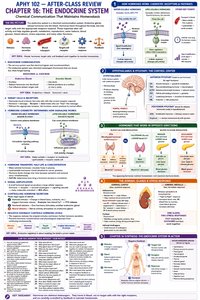
Visual Summary: Endocrine System Overview
The following image provides a comprehensive visual summary of the major glands, hormones, and regulatory pathways discussed in this chapter. It reinforces the relationships between endocrine organs, hormone actions, and feedback mechanisms.