 뒤로
뒤로Lecture PP-Chapter 2: Basic Chemistry – Essentials of Human Anatomy & Physiology Study Notes
스터디 가이드 - 스마트 노트
 자료에 맞춘 맞춤형 노트, 핵심 정의, 예시, 맥락을 확장해 제공합니다.
Basic Chemistry for Anatomy & Physiology
Matter and Energy
Understanding matter and energy is fundamental to the study of anatomy and physiology, as all biological processes depend on chemical interactions.
Matter: Anything that occupies space and has mass. Exists in three states:
Solid: Definite shape and volume
Liquid: Definite volume, takes shape of container
Gas: Neither definite shape nor volume
Physical changes: Do not alter the basic nature of a substance (e.g., change of state)
Chemical changes: Alter the chemical composition of a substance
Energy: The ability to do work; has no mass and does not take up space
Kinetic energy: Energy in action
Potential energy: Stored energy
Forms of energy:
Chemical energy: Stored in chemical bonds
Electrical energy: Movement of charged particles
Mechanical energy: Directly involved in moving matter
Radiant energy: Travels in waves (electromagnetic spectrum)
ATP (Adenosine Triphosphate): Traps chemical energy of food in its bonds for cellular use
Composition of Matter
All living things are composed of elements and atoms, which are the building blocks of matter.
Elements: Fundamental units of matter; 96% of the human body is made from four elements:
Oxygen (O): 65% of body mass
Carbon (C)
Hydrogen (H)
Nitrogen (N)
Atoms: Smallest units of elements; differ from one another; represented by atomic symbols
Common Elements in the Human Body
Element | Atomic Symbol | Percentage of Body Mass | Role |
|---|---|---|---|
Oxygen | O | 65.0 | Major component of molecules; essential for ATP production |
Carbon | C | 18.5 | Primary element in organic molecules |
Hydrogen | H | 9.5 | Component of organic molecules; influences pH |
Nitrogen | N | 3.2 | Component of proteins and nucleic acids |
Calcium | Ca | 1.5 | Bone/teeth structure; muscle contraction, neural transmission |
Phosphorus | P | 1.0 | Bone/teeth structure; ATP, nucleic acids |
Potassium | K | 0.4 | Major intracellular cation; nerve impulses, muscle contraction |
Sulfur | S | 0.3 | Component of proteins |
Sodium | Na | 0.2 | Major extracellular cation; water balance, nerve impulses |
Chlorine | Cl | 0.2 | Major extracellular anion |
Magnesium | Mg | 0.1 | Bone structure; enzyme cofactor |
Iodine | I | 0.1 | Thyroid hormone production |
Iron | Fe | 0.1 | Hemoglobin, enzymes |
Atomic Structure
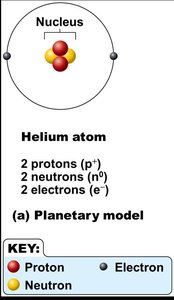
Atoms consist of subatomic particles: protons, neutrons, and electrons.
Protons (p+): Positively charged, located in nucleus
Neutrons (n0): Neutral, located in nucleus
Electrons (e-): Negatively charged, orbit nucleus
Atoms are electrically neutral: number of protons equals number of electrons
Ions: Atoms that have lost or gained electrons
Subatomic Particles Table
Particle | Position in Atom | Mass (amu) | Charge |
|---|---|---|---|
Proton | Nucleus | 1 | + |
Neutron | Nucleus | 1 | 0 |
Electron | Orbits nucleus | 1/2000 | - |
Identifying Elements
Each element is identified by its atomic number, mass number, and atomic weight.
Atomic number: Number of protons
Atomic mass number: Sum of protons and neutrons
Atomic weight: Approximate mass of the most abundant isotope
Isotopes and Radioactivity
Isotopes are atoms of the same element with different numbers of neutrons. Some isotopes are radioactive and used in medical tracing.
Isotopes: Same atomic number, different atomic mass
Radioisotopes: Unstable, decompose to stable forms, emit radioactivity
Molecules and Compounds
Molecules are formed when atoms combine chemically. Compounds are molecules made of different elements.
Molecule: Two or more atoms of the same element
Compound: Two or more atoms of different elements
Example: (water)
Chemical Bonds and Reactions
Chemical bonds are energy relationships involving electrons. Chemical reactions occur when atoms combine or dissociate.
Electron shells: Energy levels where electrons reside
Shell 1: 2 electrons; Shell 2: 8 electrons; Shell 3: 18 electrons
Valence shell: Outermost shell; bonding occurs here
Rule of eights: Atoms are stable with 8 electrons in valence shell (except shell 1)
Types of Chemical Bonds
Ionic bonds: Electrons are transferred; forms ions (anions and cations)
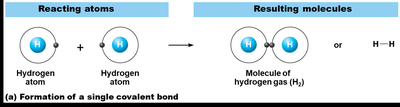
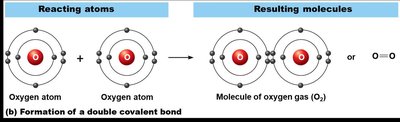
Covalent bonds: Electrons are shared; can be single or double bonds
Nonpolar covalent: Electrons shared equally
Polar covalent: Electrons shared unequally; molecule has poles
Hydrogen bonds: Weak bonds; important in water and protein structure

Patterns of Chemical Reactions
Chemical reactions in the body follow specific patterns.
Synthesis reaction: Atoms/molecules combine to form larger molecules; energy absorbed (anabolic)
Decomposition reaction: Molecule broken down; energy released (catabolic)
Exchange reaction: Bonds are made and broken; parts switch
Most reactions are reversible; indicated by double arrows
Factors Increasing Rate of Chemical Reactions
Factor | Mechanism |
|---|---|
Increasing temperature | Increases kinetic energy and collision force |
Increasing concentration | More collisions due to more particles |
Decreasing particle size | Smaller particles move faster, more collisions |
Presence of catalysts | Decreases energy needed for reaction |
Biochemistry: Chemical Composition of Living Matter
Biochemistry distinguishes between inorganic and organic compounds.
Inorganic compounds: Lack carbon; small, simple molecules (water, salts, acids, bases)
Organic compounds: Contain carbon; large, covalent molecules (carbohydrates, lipids, proteins, nucleic acids)
Inorganic Compounds
Water: Most abundant; high heat capacity, polarity, chemical reactivity, cushioning
Salts: Ionic compounds; dissociate in water; vital for nerve impulses
Acids: Release H+ ions; proton donors
Bases: Release OH- ions; proton acceptors
Neutralization: Acids and bases react to form water and salt
pH: Measures H+ concentration; scale 0–14; buffers regulate pH
Organic Compounds
Polymers: Chains of monomers; formed by dehydration synthesis, broken by hydrolysis
Carbohydrates: Contain C, H, O; sugars and starches; classified as monosaccharides, disaccharides, polysaccharides
Lipids: Triglycerides, phospholipids, steroids; insoluble in water
Proteins: Construction materials, enzymes, hormones, antibodies; built from amino acids
Nucleic acids: DNA and RNA; built from nucleotides; store and transmit genetic information
ATP: Energy currency of cells; composed of ribose, adenine, and three phosphate groups
Representative Lipids Table
Lipid Type | Location/Function |
|---|---|
Triglycerides | Fat deposits; energy storage |
Phospholipids | Cell membranes; lipid transport |
Steroids | Cholesterol, hormones, vitamin D |
Other lipid-based substances | Fat-soluble vitamins, prostaglandins, lipoproteins, glycolipids |
Representative Functional Proteins Table
Functional Class | Role(s) in the Body |
|---|---|
Antibodies | Immune response; inactivate foreign substances |
Hormones | Regulate growth and development |
Transport proteins | Transport oxygen, iron, cholesterol |
Enzymes | Catalyze biochemical reactions |
Summary
This chapter provides foundational knowledge of chemistry as it applies to human anatomy and physiology, including the structure and function of atoms, elements, molecules, and compounds, as well as the importance of chemical reactions and biological molecules in the human body.
