뒤로
뒤로Chapter 2: Chemistry Comes Alive – Foundations for Anatomy & Physiology
스터디 가이드 - 스마트 노트
 자료에 맞춘 맞춤형 노트, 핵심 정의, 예시, 맥락을 확장해 제공합니다.
Chemistry Comes Alive
Introduction to Chemistry in Physiology
Chemistry is fundamental to all physiological processes in the human body, underlying essential functions such as movement, digestion, heart function, and nervous system activity. The study of chemistry in anatomy and physiology is divided into basic chemistry and biochemistry, both of which are crucial for understanding how the body operates at the molecular level.
Composition of Matter
States and Properties of Matter
Matter: Anything that has mass and occupies space; can be seen, smelled, or felt.
States of Matter:
Solid: Defined shape and volume.
Liquid: Defined volume, undefined shape.
Gas: Undefined shape and volume.
Weight: Mass plus the effect of gravity (9.8 m/s2).
Energy and Its Forms
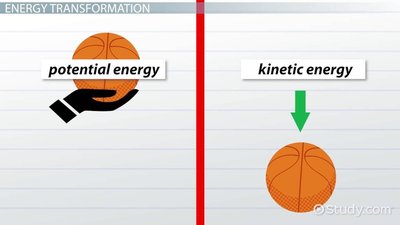
Energy is the capacity to do work or put matter into motion. The greater the work, the more energy is used. Energy exists in two main forms:
Kinetic Energy: Energy in action.
Potential Energy: Stored (inactive) energy.
Energy can be transformed from potential to kinetic, such as when stored energy is released to perform an action.
Forms of Energy in the Body
Chemical Energy: Stored in chemical bonds; released during ATP production.
Electrical Energy: Movement of ions; essential for nerve impulses.
Mechanical Energy: Directly involved in moving matter.
Radiant/Electromagnetic Energy: Travels in waves (e.g., light).
Energy conversion is inefficient; some energy is always lost as heat.
Elements and Atoms
Elements: Fundamental substances that cannot be broken down by ordinary chemical means. 96% of the human body is made of carbon, oxygen, hydrogen, and nitrogen.
Atoms: Smallest units of elements, consisting of protons (+), neutrons (0), and electrons (−).
Atomic Number: Number of protons; defines the element.
Mass Number: Protons + neutrons.
Isotopes: Atoms with the same number of protons but different numbers of neutrons.
Radioisotopes: Unstable isotopes that decay, releasing radiation.
How Molecules Combine
Molecules, Compounds, and Mixtures
Molecule: Two or more atoms bonded together (e.g., O2).
Compound: Molecule with two or more different elements (e.g., H2O).
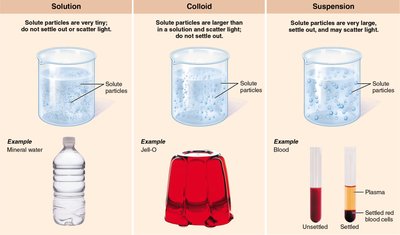
Mixtures: Physical combinations of substances; include solutions, colloids, and suspensions.
Types of Mixtures
Solutions: Homogeneous mixtures; solute particles are very small and do not settle out (e.g., mineral water).
Colloids: Heterogeneous mixtures; larger particles than solutions, do not settle out, often cloudy (e.g., Jell-O).
Suspensions: Heterogeneous mixtures; large particles that settle out (e.g., blood).
Chemical Bonding
Role of Electrons and the Octet Rule
Electrons in the outermost shell (valence shell) are involved in bonding.
The octet rule states that atoms are most stable with 8 electrons in their valence shell.
Types of Chemical Bonds
Covalent Bonds: Atoms share electron pairs; can be single, double, or triple bonds. Strongest bond type.
Ionic Bonds: Electrons are transferred from one atom to another, creating charged ions (cations and anions) that attract each other. Most ionic compounds are salts (e.g., NaCl).
Hydrogen Bonds: Weak attractions between hydrogen and electronegative atoms; important in water and maintaining protein/DNA structure.
Chemical Reactions
Types and Energy Changes
Chemical reactions involve the formation, rearrangement, or breaking of bonds.
Exergonic Reactions: Release energy (e.g., breakdown of glucose).
Endergonic Reactions: Absorb energy (e.g., synthesis of molecules).
The rate of chemical reactions is influenced by temperature, concentration, particle size, and catalysts (enzymes).
Biochemistry: Inorganic and Organic Compounds
Inorganic Compounds
Water: Most abundant inorganic compound; high heat capacity, high heat of vaporization, polarity (universal solvent), reactivity, and cushioning properties.
Salts: Ionic compounds that dissociate in water to form electrolytes (e.g., NaCl, CaCO3).
Acids and Bases: Electrolytes that release H+ (acids) or OH− (bases) in solution. pH scale measures H+ concentration (0–14).
Organic Compounds
Organic compounds contain carbon, hydrogen, and oxygen. Major classes include carbohydrates, lipids, proteins, and nucleic acids.
Carbohydrates
Structure and Function
Major source of cellular energy.
Three classes:
Monosaccharides: Simple sugars (3–7 carbons), general formula (CH2O)n.
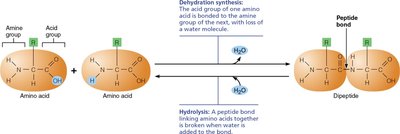
Disaccharides: Double sugars, formed by dehydration synthesis of two monosaccharides.
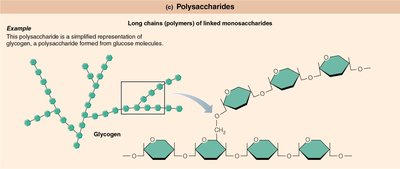
Polysaccharides: Long chains of monosaccharides; storage forms (e.g., starch in plants, glycogen in animals).
Lipids
Types and Functions
Triglycerides: Three fatty acids bonded to glycerol; energy storage, insulation, protection. Can be saturated (solid, single bonds) or unsaturated (liquid, double bonds).
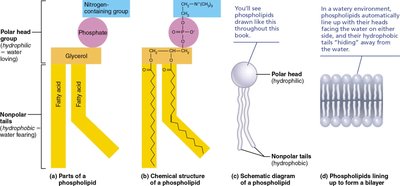
Phospholipids: Modified triglycerides with two fatty acids and a phosphate group; form cell membranes (hydrophilic head, hydrophobic tails).
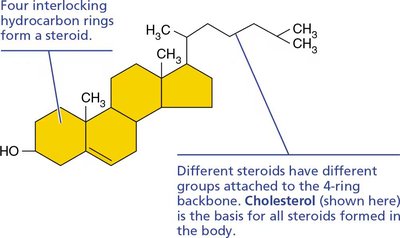
Steroids: Four interlocking hydrocarbon rings; cholesterol is the most important steroid, serving as a precursor for vitamin D, hormones, and bile salts.
Proteins
Structure and Organization
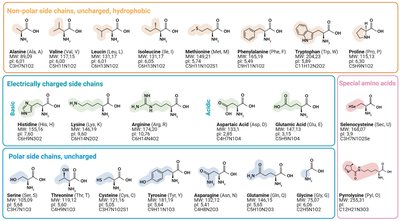
Composed of amino acids (20 types) linked by peptide bonds.
Levels of structure:
Primary: Sequence of amino acids.
Secondary: Alpha-helix or beta-pleated sheet (hydrogen bonds).
Tertiary: 3D folding of secondary structures.
Quaternary: Multiple polypeptide chains combined.
Types and Functions of Proteins
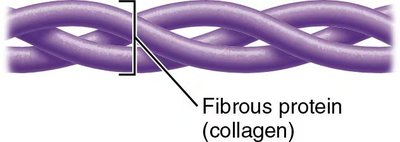
Fibrous Proteins: Structural, insoluble, stable (e.g., collagen).
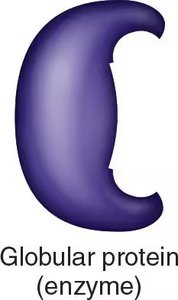
Globular Proteins: Functional, water-soluble, chemically active (e.g., enzymes).
Enzymes and Protein Denaturation
Denaturation: Loss of protein structure and function due to pH or temperature changes; can be reversible or irreversible.
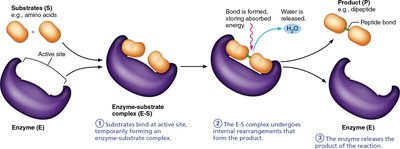
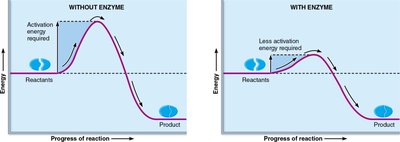
Enzymes: Biological catalysts that lower activation energy and speed up reactions without being consumed.
Enzyme action steps:
Substrate binds to enzyme's active site (enzyme-substrate complex forms).
Substrate is rearranged to form product.
Product is released; enzyme is unchanged.
Nucleic Acids
DNA and RNA
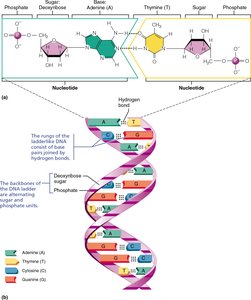
Nucleic acids are polymers of nucleotides (nitrogen base, pentose sugar, phosphate group).
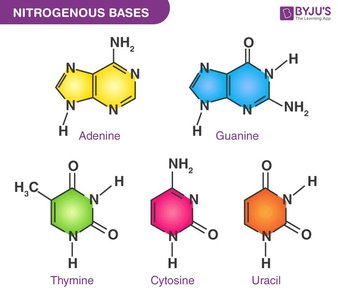
DNA: Double-stranded helix, genetic blueprint, located in the nucleus. Bases: adenine (A), guanine (G), cytosine (C), thymine (T).
RNA: Single-stranded, involved in protein synthesis, located in the cytoplasm. Bases: adenine (A), guanine (G), cytosine (C), uracil (U).
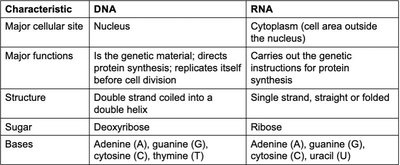
Characteristic | DNA | RNA |
|---|---|---|
Major cellular site | Nucleus | Cytoplasm |
Major functions | Genetic material, directs protein synthesis | Carries out genetic instructions for protein synthesis |
Structure | Double strand, helix | Single strand |
Sugar | Deoxyribose | Ribose |
Bases | A, G, C, T | A, G, C, U |
ATP: The Energy Currency of the Cell
Structure and Function
ATP (Adenosine Triphosphate): Immediate, usable energy source for cells.
Composed of adenine, ribose, and three phosphate groups.
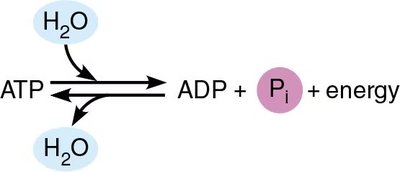
Energy is released when the terminal phosphate bond is broken (hydrolysis):
ATP can be regenerated by adding a phosphate group back to ADP or AMP.