 뒤로
뒤로Chapter 3: The Cell – Structure, Function, and Division
스터디 가이드 - 스마트 노트
 자료에 맞춘 맞춤형 노트, 핵심 정의, 예시, 맥락을 확장해 제공합니다.
Development of the Cell Theory
Overview of Cell Theory
The cell theory is a foundational concept in biology, describing the properties and significance of cells in living organisms.
Cytology is the scientific study of cells.
All organisms are composed of cells and cell products.
The cell is the simplest structural and functional unit of life.
An organism’s structure and functions are due to the activities of its cells.
Cells arise only from preexisting cells.
Common Cell Shapes
Types of Cell Morphology
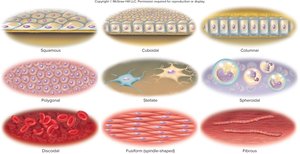
Cells in the human body exhibit a variety of shapes, each adapted to specific functions.
Squamous: Thin, flat cells, often found lining surfaces for diffusion.
Cuboidal: Cube-shaped cells, common in glands and ducts.
Columnar: Tall, column-like cells, specialized for absorption and secretion.
Polygonal: Irregularly angular shapes, often seen in transitional epithelium.
Stellate: Star-shaped, typical of nerve cells.
Spheroidal: Round or oval, such as white blood cells.
Discoid: Disc-shaped, characteristic of red blood cells.
Fusiform: Spindle-shaped, seen in smooth muscle cells.
Fibrous: Long, thread-like, typical of skeletal muscle cells.
The Plasma Membrane
Structure and Components
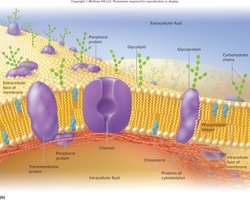
The plasma membrane, also known as the cell membrane, is a selectively permeable barrier that surrounds the cell, maintaining the internal environment and mediating communication with the external environment.
Phospholipids: Form the bilayer structure, making up 50-75% of the membrane.
Proteins: Integral and peripheral proteins serve as channels, pumps, and receptors.
Glycocalyx: Carbohydrate-rich area on the cell surface, composed of glycoproteins and glycolipids, important for cell recognition, immune response, and tissue compatibility.
Organelles
Major Cell Structures and Their Functions
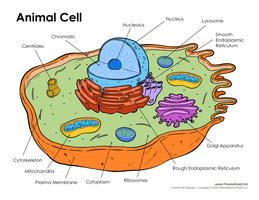
Organelles are specialized structures within cells that perform distinct processes necessary for cellular function.
Cell Membrane: Regulates entry and exit of substances.
Cytoplasm: Fluid matrix containing organelles.
Cytosol: The liquid portion of the cytoplasm.
Cytoskeleton: Provides structural support and facilitates movement.
Nucleus: Stores genetic material (DNA).
Ribosomes: Sites of protein synthesis.
Golgi Body: Modifies, packages, and transports proteins and lipids.
Mitochondria: Produce ATP through cellular respiration.
Extensions of the Cell Surface
Specialized Structures
Some cells possess surface extensions that enhance their function.
Microvilli: Increase surface area for absorption, especially in the small intestine.
Cilia: Move mucus, trap particles, and serve sensory roles; abundant in the respiratory tract.
Flagellum: Provides motility; in humans, only sperm cells have a functional flagellum.
Membrane Transport Mechanisms
Selective Permeability and Transport Types
Cell membranes are selectively permeable, allowing certain substances to pass while restricting others. Transport can be passive or active.
Passive Mechanisms: Do not require ATP; substances move from high to low concentration (includes filtration, simple diffusion, osmosis).
Active Mechanisms: Require ATP; substances move from low to high concentration (includes active transport, endocytosis, exocytosis).
Passive Transport
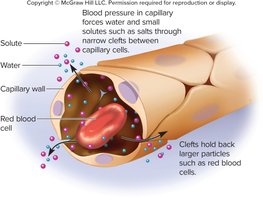
Filtration: Movement of particles through a membrane by physical pressure, important in capillary exchange and kidney function.
Simple Diffusion: Movement of molecules from high to low concentration due to random motion.
Facilitated Diffusion: Diffusion assisted by protein channels; still does not require ATP.
Osmosis
Osmosis is the net movement of water across a selectively permeable membrane from an area of low solute concentration to high solute concentration. Aquaporins facilitate rapid water movement.
Osmotic imbalances can cause clinical conditions such as diarrhea, constipation, and edema.
IV fluids are used medically to correct osmotic imbalances.
Osmolarity and Tonicity
Osmolarity: The concentration of solute particles per liter of solution.
Tonicity: The ability of a solution to affect cell volume and pressure, depending on the concentration of nonpermeating solutes.
Tonicity Types
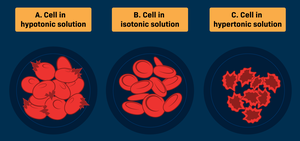
Hypotonic Solution: Lower solute concentration outside the cell; water enters, cell swells and may burst (lyse).
Hypertonic Solution: Higher solute concentration outside the cell; water leaves, cell shrivels (crenates).
Isotonic Solution: Equal solute concentration; no net water movement, cell volume remains stable.
DNA Structure and Function
Genetic Material
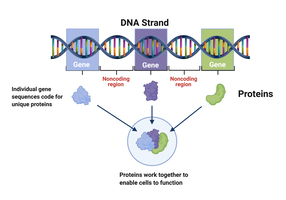
Deoxyribonucleic acid (DNA) is the hereditary material in humans and most organisms. It encodes instructions for protein synthesis.
DNA is a double helix composed of nucleotides.
Humans have 46 DNA molecules (chromosomes) in most cells.
A gene is a segment of DNA that codes for a specific protein.
Humans have about 20,000 genes.
RNA Structure and Function
Types of RNA and Their Roles
Ribonucleic acids (RNAs) are involved in protein synthesis and gene regulation.
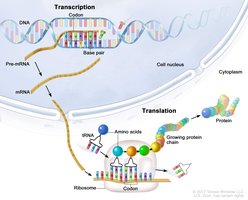
Messenger RNA (mRNA): Carries genetic code from DNA to ribosomes (transcription).
Ribosomal RNA (rRNA): Forms ribosomes, reads mRNA (translation).
Transfer RNA (tRNA): Brings amino acids to ribosomes, assembles proteins according to mRNA code.
The Cell Cycle
Phases of the Cell Cycle
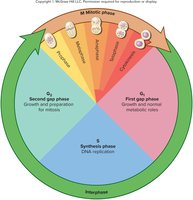
The cell cycle describes the sequence of events in the life of a cell, including growth, DNA replication, and division.
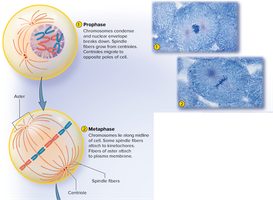
Interphase: Cell grows, replicates DNA, and prepares for division (includes G1, S, and G2 phases).
Mitotic Phase (Mitosis): Division of the nucleus and cytoplasm to form two daughter cells.
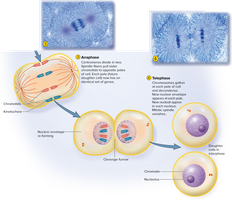
Stages of Mitosis
Prophase: Chromosomes condense, nuclear envelope breaks down.
Metaphase: Chromosomes align at the cell's equator.
Anaphase: Sister chromatids separate and move to opposite poles.
Telophase: Nuclear envelopes reform around separated chromosomes.
Cytokinesis: Division of the cytoplasm, resulting in two new cells.
DNA Replication and Mutations
DNA Replication
Before cell division, DNA must be precisely duplicated to ensure each daughter cell receives a complete set of genetic instructions.
DNA replication occurs during the S phase of interphase.
Errors in replication can lead to mutations, which may be harmless, harmful, or beneficial.
Mutations
Caused by replication errors or environmental factors (radiation, chemicals, viruses).
Can result in cell death, cancer, or genetic disorders.
Regulation of the Cell Cycle (Checkpoints)
Cell Cycle Control
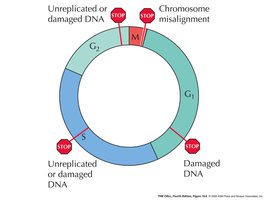
The cell cycle is tightly regulated by checkpoints that ensure proper division and prevent the propagation of damaged DNA.
Checkpoints monitor cell size, DNA integrity, and attachment to the spindle apparatus.
Cells with errors may undergo repair or programmed cell death (apoptosis).
Cancer
Causes and Characteristics
Cancer is a disease of uncontrolled cell growth, often resulting from mutations in genes that regulate the cell cycle.
Caused by mutations during DNA replication or exposure to carcinogens (radiation, chemicals, viruses).
Benign tumors: Non-cancerous, localized growths.
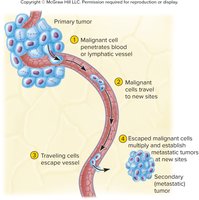
Malignant tumors: Cancerous, invasive, and capable of metastasis (spreading to other tissues).
Metastasis
Metastasis is the process by which cancer cells spread from the original tumor to distant sites in the body, often via the circulatory or lymphatic systems.
Effects of Cancer
Replaces functional tissue in organs, disrupts normal function.
Invades blood vessels, lungs, brain, and other tissues.
Weakens immunity, increasing susceptibility to infections.
Classification of Cancers
Carcinomas: Originate in epithelial tissue.
Lymphomas: Originate in lymphatic tissue.
Melanomas: Originate in pigment cells (melanocytes).
Leukemias: Originate in blood-forming tissues.
Sarcomas: Originate in bone, connective tissue, or muscle.
Oncology is the medical specialty focused on the study and treatment of tumors.
