 뒤로
뒤로Chemistry Comes Alive: Essential Concepts for Anatomy & Physiology
스터디 가이드 - 스마트 노트
 자료에 맞춘 맞춤형 노트, 핵심 정의, 예시, 맥락을 확장해 제공합니다.
Chapter 2A: Chemistry Comes Alive
Introduction to Chemistry in Physiology
Chemistry forms the foundation of all physiological processes in the human body, including movement, digestion, heart function, and nervous system activity. Understanding the chemical basis of life is essential for comprehending how the body operates at the molecular level.
Atoms and Elements
Elements: Basic Building Blocks
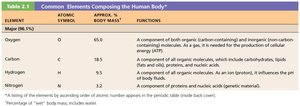
All matter is composed of elements, which are substances that cannot be broken down into simpler substances by ordinary chemical methods. Four elements—Carbon (C), Oxygen (O), Hydrogen (H), and Nitrogen (N)—make up 96% of the human body. Elements are represented by atomic symbols, often derived from Latin names (e.g., Na for sodium, K for potassium).
Atomic Symbol: One or two letters representing an element.
Major Elements: Oxygen, Carbon, Hydrogen, Nitrogen.
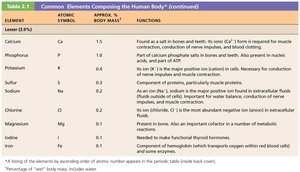
Lesser Elements: Calcium, Phosphorus, Potassium, Sulfur, Sodium, Chlorine, Magnesium, Iodine, Iron.
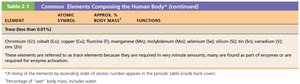
Trace Elements: Required in tiny amounts; often part of enzymes or necessary for enzyme activation.
Element | Atomic Symbol | Approx. % Body Mass | Function |
|---|---|---|---|
Oxygen | O | 65.0 | Component of organic and inorganic molecules; needed for cellular energy production. |
Carbon | C | 18.5 | Component of all organic molecules; includes carbohydrates, lipids, proteins, nucleic acids. |
Hydrogen | H | 9.5 | Component of organic molecules; as ion (H+), influences pH. |
Nitrogen | N | 3.2 | Component of proteins and nucleic acids (genetic material). |
Element | Atomic Symbol | Approx. % Body Mass | Function |
|---|---|---|---|
Calcium | Ca | 1.5 | Found in bones and teeth; required for muscle contraction, nerve impulses, blood clotting. |
Phosphorus | P | 1.0 | Part of calcium phosphate salts in bones and teeth; forms part of ATP. |
Potassium | K | 0.4 | Major positive ion in cells; necessary for nerve impulse transmission and muscle contraction. |
Sulfur | S | 0.3 | Component of proteins, especially muscle proteins. |
Sodium | Na | 0.2 | Major positive ion in extracellular fluids; important for water balance, nerve impulses, muscle contraction. |
Chlorine | Cl | 0.2 | Most abundant negative ion in extracellular fluids. |
Magnesium | Mg | 0.1 | Present in bones; important for enzyme activity. |
Iodine | I | 0.1 | Needed to make thyroid hormones. |
Iron | Fe | 0.1 | Component of hemoglobin (transports oxygen). |
Element | Function |
|---|---|
Chromium, Cobalt, Copper, Fluorine, Manganese, Molybdenum, Selenium, Silicon, Vanadium, Zinc | Required in tiny amounts; often part of enzymes or required for enzyme activation. |
Structure of Atoms
Subatomic Particles
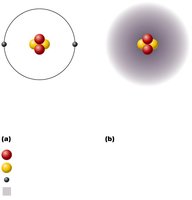
Atoms are composed of three subatomic particles:
Protons: Positive charge (+), 1 atomic mass unit (amu).
Neutrons: No charge (0), 1 amu.
Electrons: Negative charge (−), virtually no weight (0 amu).
Protons and neutrons are located in the nucleus, while electrons orbit around the nucleus. The number of protons equals the number of electrons in a neutral atom.
Atomic Structure of Smallest Atoms
Different elements contain different numbers of subatomic particles. For example:
Hydrogen: 1 proton, 0 neutrons, 1 electron
Helium: 2 protons, 2 neutrons, 2 electrons
Lithium: 3 protons, 4 neutrons, 3 electrons
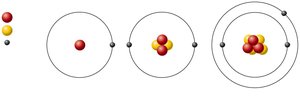
Isotopes
Isotopes are structural variations of the same element, differing in the number of neutrons. For example, hydrogen has three isotopes: protium (1H), deuterium (2H), and tritium (3H). Tritium is radioactive and used in research.
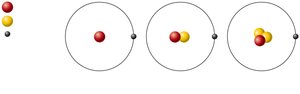
Identifying Elements
Atomic Number and Mass Number
Atomic Number: Number of protons in the nucleus; unique for each element.
Mass Number: Total number of protons and neutrons in the nucleus; represents the atom's mass.
Radioisotopes
Definition and Applications
Radioisotopes are isotopes that decompose to more stable forms, emitting particles and energy (radioactivity). They are used in biological research, medical diagnosis, and treatment, but can also damage living tissue.
Combining Matter: Molecules and Compounds
Molecules and Compounds
Most atoms combine to form molecules (two or more atoms bonded together) or compounds (molecules with two or more different kinds of atoms). For example, glucose (C6H12O6) is a compound, while O2 is a molecule.
Solutions
Components of Solutions
Solute: Substance dissolved in a solvent (can be gas, liquid, or solid).
Solvent: Liquid in which the solute is dissolved; water is the main solvent in the body.
Solution: Homogeneous mixture of solute and solvent.
Example: In a sodium chloride solution, sodium chloride is the solute and water is the solvent.
Chemical Bonds
Role of Electrons in Chemical Bonding
Electrons occupy energy levels (shells) around the nucleus. The shell closest to the nucleus is filled first. The outermost shell is called the valence shell, and its electrons are involved in chemical reactions.
Shell 1: 2 electrons
Shell 2: up to 8 electrons
Shell 3: up to 18 electrons (8 is stable)
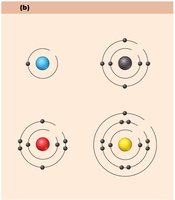
Octet Rule
Atoms are stable when their outermost electron shell is full (2 for small atoms, 8 for others). Inert atoms (e.g., helium, neon) have full valence shells and do not form bonds. Most atoms form bonds to achieve stability.
Types of Chemical Bonds
Ionic Bonds
Ionic bonds are formed when electrons are transferred from one atom to another, resulting in charged ions. Anions have a negative charge (gain electrons), while cations have a positive charge (lose electrons). The attraction between oppositely charged ions forms an ionic bond.
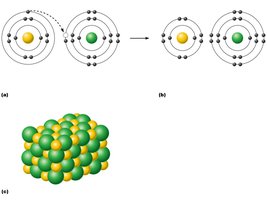
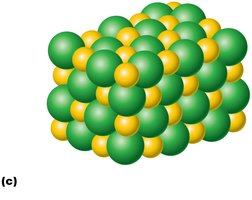
Covalent Bonds
Covalent bonds involve the sharing of electrons between atoms. There are two main types:
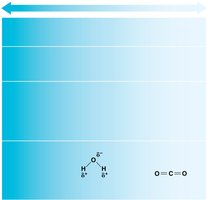
Nonpolar Covalent Bonds: Equal sharing of electrons; molecule is electrically neutral (e.g., methane, carbon dioxide).
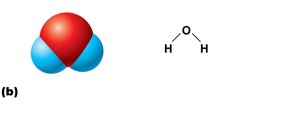
Polar Covalent Bonds: Unequal sharing of electrons; results in electrically polar molecules (e.g., water).
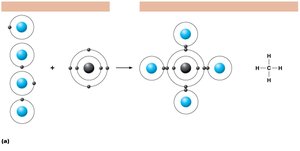
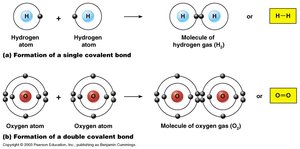
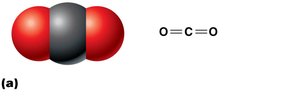
Hydrogen Bonds
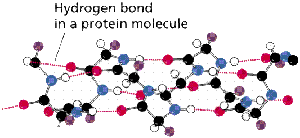
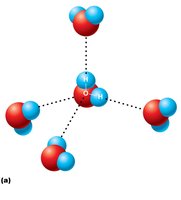
Hydrogen bonds are weak bonds formed between an electropositive hydrogen atom and an electronegative atom of another molecule. They are important for:
Properties of water
Maintaining protein structure
Holding DNA strands together
Chemical Equations
Representation of Chemical Reactions
Chemical reactions involve the formation, breaking, or rearrangement of chemical bonds. They are represented as chemical equations:
Reactants: Substances entering the reaction
Products: Resulting chemical end products
Example equations:
(Hydrogen gas)
(Methane)
Subscripts indicate the number of atoms joined by bonds; prefixes indicate the number of unjoined atoms.
Patterns of Chemical Reactions
Synthesis and Decomposition
Synthesis Reaction: Atoms or molecules combine to form a larger molecule; energy is absorbed (anabolic).
Decomposition Reaction: Molecule is broken down into smaller components; energy is released (catabolic).
General equations:
Synthesis:
Decomposition:
Biochemistry: Organic and Inorganic Compounds
Organic Compounds
Organic compounds contain carbon (and hydrogen) and are mostly covalently bonded. Examples include carbohydrates, proteins, and fats/lipids.
Inorganic Compounds
Inorganic compounds lack carbon and include water, salts, acids, and bases. Water is the main solvent in the body, making up 60–80% of cell volume.
Examples of organic molecules: carbohydrates, proteins, fats/lipids
Examples of inorganic molecules: sodium chloride, water, oxygen
