뒤로
뒤로Chemistry Foundations for Anatomy & Physiology: Atoms, Bonds, and Macromolecules
스터디 가이드 - 스마트 노트
 자료에 맞춘 맞춤형 노트, 핵심 정의, 예시, 맥락을 확장해 제공합니다.
Introduction to Chemistry in Anatomy & Physiology
The Importance of Chemistry in Human Physiology
Understanding the chemical level of organization is essential for grasping how the human body functions. Chemistry is the physical science that studies the properties of matter, which is anything that takes up space and has mass. Matter exists in three states: solids, liquids, and gases.
Principle Elements of the Body
Atoms and Subatomic Particles
Atom: The smallest unit of matter, composed of subatomic particles.
Protons (p+): Positively charged particles found in the nucleus.
Neutrons (n): Electrically neutral particles also found in the nucleus.
Electrons (e-): Negatively charged particles orbiting the nucleus in electron shells.
Atomic Structure
Nucleus: Central part of the atom containing protons and neutrons.
Electron Cloud: Region where electrons orbit the nucleus.
Atomic Number and Atomic Mass
Atomic Number: Number of protons in the nucleus (also equals the number of electrons in a neutral atom).
Atomic Mass: Total number of protons and neutrons in the nucleus.
Electron Shells
Electrons are arranged in shells around the nucleus:
1st shell: Maximum 2 electrons
2nd shell: Maximum 8 electrons
3rd shell: Maximum 8 electrons
Valence Electrons and Chemical Behavior
Valence Electrons: Electrons in the outermost shell determine an atom’s chemical properties and reactivity.
Elements and Ions
Inert and Reactive Elements
Inert Elements: Have filled outer electron shells and do not react (e.g., noble gases).
Reactive Elements: Have unfilled valence shells and tend to gain, lose, or share electrons to achieve stability.
Ions: Cations and Anions
Cation: Atom that has lost electrons, resulting in a positive charge (e.g., Na+).
Anion: Atom that has gained electrons, resulting in a negative charge (e.g., Cl-).
Chemical Bonds
Types of Chemical Bonds
Covalent Bonds: Atoms share electrons.
Non-Polar Covalent Bonds: Electrons are shared equally (e.g., O2, H2).
Polar Covalent Bonds: Electrons are shared unequally, creating partial charges (e.g., H2O).
Ionic Bonds: Formed by electrical attraction between cations and anions (e.g., NaCl).
Hydrogen Bonds: Weak attractions between the positive charge on hydrogen (in a polar molecule) and a negative charge on another atom (e.g., between water molecules).
Water and Its Properties
Importance of Water
Water is essential for all bodily functions and exists in all three states of matter.
Hydrogen Bonds in Water
Hydrogen bonds are responsible for water’s unique properties, such as cohesion, surface tension, and its role as a solvent.
Surface Tension
Water’s surface tension allows small objects to float and acts as a barrier at the water’s surface.
Water as the Universal Solvent
Solution: A mixture of solute (dissolved substance) and solvent (dissolving agent; water is the universal solvent).
Solubility: The degree to which a molecule dissolves in water.
Ionization/Dissociation: Water can break apart chemical bonds, allowing ions to disperse.
Electrolytes and pH
Electrolytes
Inorganic substances whose ions conduct electrical currents in water, essential for muscle and neuron function.
pH Scale
The pH scale is logarithmic; a change of 1 unit equals a tenfold change in [H+].
Normal blood plasma pH: 7.35–7.45.
Acidosis: pH below 7.35 (can cause CNS depression and coma).
Alkalosis: pH above 7.45 (can cause uncontrollable muscle contractions).
Macromolecules
Organic and Inorganic Compounds
Organic Compounds: Contain large amounts of carbon and hydrogen (e.g., sugars, fats, proteins).
Inorganic Compounds: Generally lack large amounts of carbon and hydrogen (e.g., water, salts, CO2).
Macromolecules and Monomers
Macromolecules: Large molecules made of repeating subunits (monomers).
Dehydration Synthesis: Forms polymers by removing water to create bonds.
Hydrolysis: Breaks polymers into monomers by adding water.
Lipids
Triglycerides
Composed of one glycerol and three fatty acids.
Functions: Energy storage, insulation, and protection of organs.
Fatty Acid Structure
Hydrophilic Head: Carboxyl group, water-attracting.
Hydrophobic Tail: Hydrocarbon chain, water-repelling.
Saturated vs. Unsaturated Fatty Acids
Saturated: No double bonds, solid at room temperature.
Unsaturated: One or more double bonds, liquid at room temperature.
Other Lipids
Eicosanoids: Signaling molecules (e.g., inflammation, pain).
Steroids: Involved in hormone synthesis.
Phospholipids: Main component of cell membranes.
Carbohydrates
Types of Carbohydrates
Monosaccharides: Simple sugars (e.g., glucose).
Disaccharides: Two monosaccharides joined together.
Polysaccharides: Long chains of monosaccharides (e.g., glycogen).
Glycogen
Storage form of glucose in the liver and skeletal muscle; broken down via hydrolysis to release glucose for energy.
Nucleic Acids
Structure and Function
Nucleic Acids: Long chains of nucleotides; DNA stores genetic information, RNA is involved in protein synthesis.
Nucleotide Structure: Nitrogenous base (purines: A, G; pyrimidines: C, T, U), 5-carbon sugar, phosphate group.
Proteins
Structure and Function
Proteins are polymers of amino acids and account for ~20% of body weight.
The structure of a protein determines its function.
Levels of Protein Structure
Primary: Sequence of amino acids.
Secondary: Local folding (e.g., alpha helices, beta sheets).
Tertiary: Overall 3D shape.
Quaternary: Arrangement of multiple polypeptide chains.
Protein-Ligand Binding
Specificity: Ability of a protein to bind a particular ligand.
Affinity: Strength of the binding between protein and ligand.
Saturation: Fraction of binding sites occupied by ligand.
Competition: Ligands compete for binding; antagonists inhibit binding.
Law of Mass Action
In a chemical reaction, if the concentration of reactants or products changes, the reaction shifts to restore equilibrium.
Protein Activation and Modulation
Some proteins require activation (e.g., by cofactors or proteolytic cleavage).
Protein function can be modulated by chemical (allosteric modulators) or physical factors (pH, temperature).
Up-regulation: Increases protein synthesis.
Down-regulation: Decreases protein synthesis.
Allosteric Modulation
Allosteric modulators bind to regulatory sites, altering protein activity.
Activators increase activity; inhibitors decrease activity.
Physical Modulators
Extreme temperature, pH, or salt concentration can denature proteins, causing loss of function.
Table: Comparison of Macromolecules
Macromolecule | Monomer | Function |
|---|---|---|
Carbohydrates | Monosaccharides | Energy storage, structure |
Lipids | Fatty acids, glycerol | Energy storage, membranes, signaling |
Proteins | Amino acids | Catalysis, structure, transport, signaling |
Nucleic Acids | Nucleotides | Genetic information, protein synthesis |
Example: Molecular Structure and Function
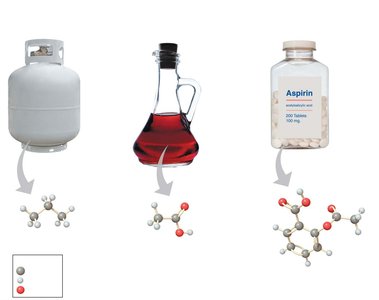
Chemical compounds such as propane (fuel), acetic acid (vinegar), and acetylsalicylic acid (aspirin) illustrate the diversity of molecular structures and their roles in daily life and medicine.