 뒤로
뒤로Connective Tissues: Structure, Types, and Functions
스터디 가이드 - 스마트 노트
 자료에 맞춘 맞춤형 노트, 핵심 정의, 예시, 맥락을 확장해 제공합니다.
Connective Tissue Overview
Definition and Importance
Connective tissue is the most abundant and widely distributed of the primary tissues in the human body. It plays a crucial role in supporting, protecting, and binding other tissues together. The four main classes of connective tissue are: Connective tissue proper, Cartilage, Bone, and Blood.
Support: Provides structural framework for organs and tissues.
Protection: Cushions and protects organs.
Transport: Blood transports nutrients, gases, and wastes.
Storage: Stores energy (fat) and minerals (bone).
Main Classes of Connective Tissue
Connective tissues are classified based on their structure and function. The main classes include:
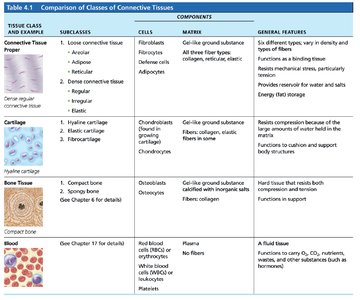
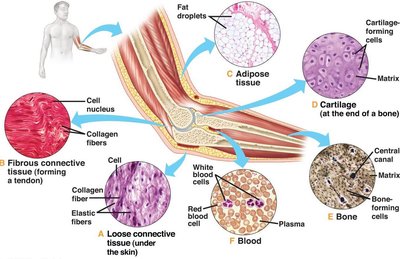
Connective tissue proper: Includes loose (areolar, adipose, reticular) and dense (regular, irregular, elastic) types.
Cartilage: Hyaline, elastic, and fibrocartilage.
Bone: Compact and spongy bone.
Blood: Fluid tissue for transport.
Characteristics of Connective Tissue
General Features
Connective tissues have several distinguishing characteristics:
Vascularity: Varies from highly vascular (bone) to avascular (cartilage).
Extracellular Matrix: Composed of ground substance and fibers, separates cells and allows tissue to bear weight and withstand tension.
Three Main Elements:
Ground substance: Unstructured material filling space between cells.
Fibers: Collagen, elastic, and reticular fibers provide support.
Cells: Different types depending on tissue (fibroblasts, chondrocytes, osteocytes, etc.).
Connective Tissue Fibers
Three types of fibers provide structural support:
Collagen fibers: Strongest and most abundant, provide high tensile strength.
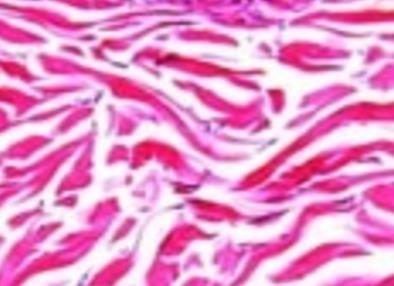
Elastic fibers: Networks of long, thin elastin fibers that allow for stretch and recoil.
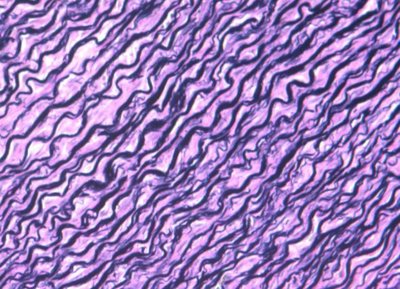
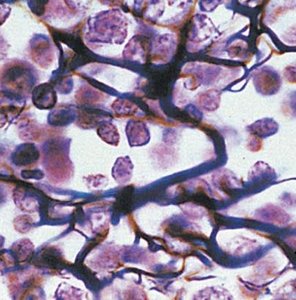
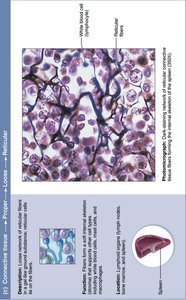
Reticular fibers: Short, fine, highly branched collagenous fibers, form networks that offer more "give".
Connective Tissue Cells
Each connective tissue type has specialized cells:
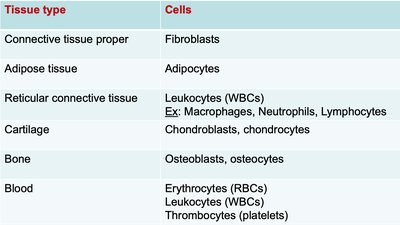
Fibroblasts: Produce fibers and ground substance in connective tissue proper.
Adipocytes: Store fat in adipose tissue.
Chondroblasts/Chondrocytes: Produce and maintain cartilage matrix.
Osteoblasts/Osteocytes: Produce and maintain bone matrix.
Blood cells: Erythrocytes (RBCs), leukocytes (WBCs), thrombocytes (platelets).
Connective Tissue Proper
Loose Connective Tissue
Loose connective tissue is characterized by a loose arrangement of fibers and abundant ground substance. Types include:
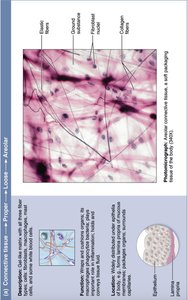
Areolar: Supports and binds other tissues, holds body fluids, defends against infection.
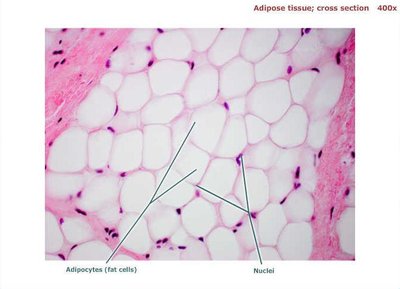
Adipose: Stores fat, insulates, and cushions organs.
Reticular: Forms a soft internal skeleton for lymphoid organs.
Dense Connective Tissue
Dense connective tissue contains closely packed fibers and less ground substance. Types include:
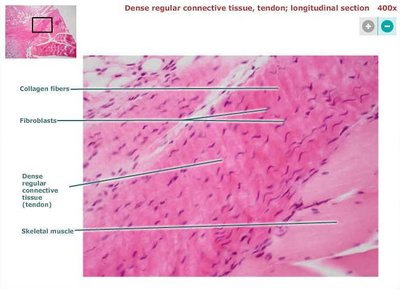
Dense regular: Parallel collagen fibers, found in tendons and ligaments.
Dense irregular: Irregularly arranged fibers, found in dermis and organ capsules.
Elastic: High proportion of elastic fibers, found in large arteries.
Cartilage
Structure and Types
Cartilage is a tough yet flexible tissue, lacking nerve fibers and being avascular. It receives nutrients from the perichondrium. The main cell types are chondroblasts (produce matrix) and chondrocytes (maintain matrix). Types include:
Hyaline cartilage: Most common, provides support with flexibility.
Elastic cartilage: Contains more elastic fibers, maintains shape.
Fibrocartilage: Strongest, resists compression and tension.
Bone (Osseous Tissue)
Structure and Function
Bone tissue supports and protects body structures, stores fat, and synthesizes blood cells. It is richly vascularized and contains more collagen than cartilage, along with inorganic calcium salts. The main cells are osteoblasts (produce matrix) and osteocytes (maintain matrix). The structural unit is the osteon (Haversian system).
Compact bone: Dense, provides strength and support.
Spongy bone: Less dense, found at ends of bones.
Blood
Structure and Function
Blood is a fluid connective tissue composed of cells suspended in plasma. It functions in transport of gases, nutrients, wastes, and other substances. The main cell types are:
Erythrocytes (RBCs): Transport oxygen and carbon dioxide.
Leukocytes (WBCs): Defend against infection.
Thrombocytes (platelets): Aid in blood clotting.
Summary Table: Classes of Connective Tissues
The following table summarizes the main classes, subclasses, cells, matrix components, and general features of connective tissues:
Key Points and Applications
Connective tissues are essential for structural integrity, protection, and metabolic functions in the body.
Each type has specialized cells and matrix components suited to its function.
Understanding histological features is crucial for identifying tissue types in laboratory settings.
Example: Tendon Structure
Tendons are composed of dense regular connective tissue, with parallel collagen fibers and fibroblasts, providing high tensile strength for muscle-to-bone attachment.
Example: Adipose Tissue
Adipose tissue stores fat in adipocytes, insulates the body, and cushions organs.
Example: Bone Structure
Compact bone contains osteons, central canals, lamellae, osteocytes in lacunae, and canaliculi, providing strength and support.
Example: Blood Components
Blood contains erythrocytes, leukocytes, and thrombocytes, each with distinct functions in transport and defense.
Formulas and Equations
While connective tissue does not involve many direct equations, the following formula is relevant for understanding osmotic balance in blood:
Additional info: Academic context was added to clarify histological features and functions of each tissue type, as well as to provide examples and applications for exam preparation.
