 뒤로
뒤로Critical Chemistry Equations in Anatomy & Physiology
스터디 가이드 - 스마트 노트
 자료에 맞춘 맞춤형 노트, 핵심 정의, 예시, 맥락을 확장해 제공합니다.
Four Critical Chemistry Equations in Anatomy & Physiology
ATP: The Cellular Currency
ATP (adenosine triphosphate) is the primary energy carrier in cells, essential for driving biochemical reactions. The breakdown and synthesis of ATP are central to cellular metabolism.
Synthesis:
Two or more smaller molecules react to form one or more larger molecules.
Decomposition:
One or more larger molecules break down into two or more smaller molecules.
Adding and removing water:
Hydration:water added to create something --> synthesis
CO₂ + H₂O ↔ H₂CO₃
Hydrolosis: water added to breakdown something --> decomposition
+ energy
Dehydration: remove water from molecule --> can either result in synthesis or decompisition
(dehydration synthesis)
H₂CO₃ ↔ CO₂ + H₂O (dehyrdration decomposition)
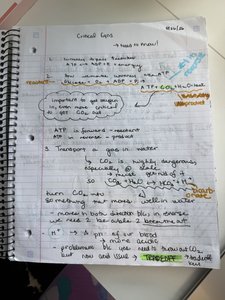
ATP Hydrolysis: ATP is broken down to ADP (adenosine diphosphate), inorganic phosphate (Pi), and energy.
Equation 1:
ATP in forward is reactant
ATP in reverse is product
ATP Synthesis: ATP is produced from glucose, oxygen, ADP, and Pi during cellular respiration.
Equation 2:
Reactant:
Product:
Importance: Oxygen intake is critical for ATP production; removal of CO2 is equally important to prevent toxicity.
Directionality: ATP acts as a reactant in energy-consuming processes and as a product in energy-releasing processes.
Example: Muscle contraction requires ATP hydrolysis to provide energy for movement.
Transport of Carbon Dioxide in Water
Carbon dioxide (CO2) is a waste product of cellular respiration and must be efficiently transported and removed from the body. In blood, CO2 is converted to bicarbonate for safe transport.
CO₂ + H₂O ↔ H₂CO₃ ↔ HCO₃⁻ + H⁺
In tissues, the reaction moves right: CO₂ is converted into water-soluble bicarbonate for transport in the blood.
In the lungs, it moves left: bicarbonate is converted back into CO₂ to be exhaled.
H₂CO₃ (carbonic acid) is the short-lived unstable intermediate in both directions that quickly breaks down. It is responsible for the fiz in carbonated drinks!
Removing CO₂ produces more H⁺, lowering blood p H (more acidic); increasing CO₂ raises pH (less acidic)--> TRADEOFF
Carbonic anhydrase rapidly speeds up this reversible reaction.
CO2 Conversion: CO2 reacts with water to form carbonic acid, which dissociates into bicarbonate and hydrogen ions.
Equation 3:
Bicarbonate (HCO3-): The main form in which CO2 is transported in blood.
Acid-Base Balance: The production of H+ lowers blood pH, making it more acidic. This is a physiological tradeoff: removing CO2 can affect acid-base balance.
Tradeoff: Adjusting one aspect of physiology (CO2 removal) can impact another (blood pH).
Example: During intense exercise, increased CO2 production can lead to acidosis if not properly managed.
Ideal Gas Law in Physiology
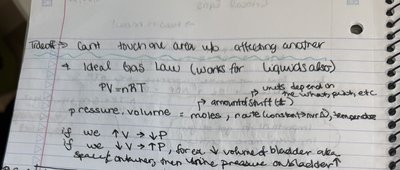
The Ideal Gas Law describes the relationship between pressure, volume, temperature, and the amount of gas. It is applicable to both gases and liquids in physiological contexts, such as respiratory and urinary systems.
Equation 4:
P: Pressure
V: Volume
n: Amount of substance (moles)
R: Rate constant (depends on units)
T: Temperature
Physiological Application: Changes in volume affect pressure. For example, decreasing the volume of the bladder or uterus increases the pressure on the bladder.
Example: In respiratory physiology, lung volume changes alter air pressure, facilitating inhalation and exhalation.
Tradeoff in Physiological Systems
Physiological systems are interconnected; modifying one parameter often affects others. This concept is crucial in understanding homeostasis and the balance of bodily functions.
Example: Removing CO from blood helps prevent toxicity but can lead to increased acidity (lower pH).
Application: Medical interventions must consider these tradeoffs to avoid unintended consequences.
