 뒤로
뒤로Electrical Signals in Neurons: Graded and Action Potentials
스터디 가이드 - 스마트 노트
 자료에 맞춘 맞춤형 노트, 핵심 정의, 예시, 맥락을 확장해 제공합니다.
Electrical Signals in Neurons
Membrane Potential Changes
Neurons communicate through changes in their membrane potential, which are generated by the movement of ions across the cell membrane via gated channels. These changes are fundamental to the generation and propagation of electrical signals in the nervous system.
Gated channels open or close in response to specific stimuli, allowing selective ion movement.
Ion movement alters the membrane potential, creating electrical signals.
Types of Gated Channels
There are three main types of gated channels that regulate ion flow in neurons:
Voltage-gated channels: Open or close in response to changes in membrane potential.
Ligand (chemically) gated channels: Open or close when a specific chemical (ligand) binds to the channel.
Mechanically gated channels: Open or close in response to mechanical deformation of the membrane.
Membrane Potential Changes: Key Terms
Membrane potential changes are described using the following terms:
Resting potential: The baseline membrane potential of a neuron, typically around -70 mV.
Depolarization: A decrease in membrane potential (the inside becomes less negative).
Repolarization: Return of the membrane potential to resting value after depolarization.
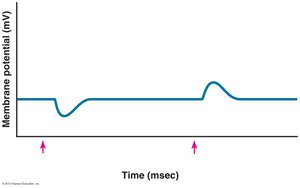
Hyperpolarization: An increase in membrane potential (the inside becomes more negative than the resting potential).
Types of Electrical Signals
Graded Potentials
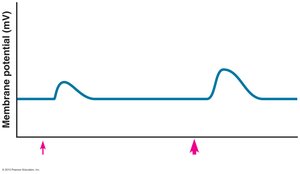
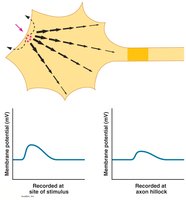
Graded potentials are small, localized changes in membrane potential that occur in response to a stimulus. They are important for short-distance communication within neurons.
Initiated by a stimulus (e.g., neurotransmitter binding).
Magnitude varies with stimulus strength (graded response).
Can be depolarizing or hyperpolarizing.
Spread decrementally—magnitude decreases with distance from the stimulus site.
Summation of Graded Potentials
Temporal summation: Multiple stimuli from the same source in rapid succession.
Spatial summation: Stimuli from different sources occurring simultaneously.
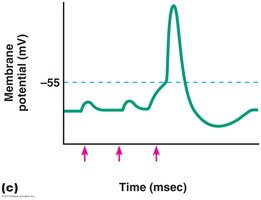
Purpose: Graded potentials determine whether the neuron reaches threshold to trigger an action potential. Depolarizing graded potentials are excitatory, while hyperpolarizing ones are inhibitory.
Action Potentials
Action potentials are large, rapid changes in membrane potential that travel along axons for long-distance communication. They are generated by excitable membranes when threshold is reached.
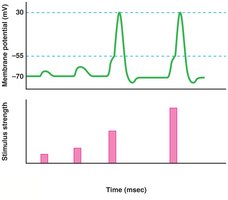
All-or-none response: Only occur if threshold is reached.
Magnitude does not vary with stimulus strength (non-graded).
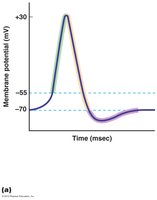
Phases: Depolarization, repolarization, after-hyperpolarization.
Comparison of Graded and Action Potentials
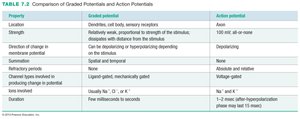
Property | Graded potential | Action potential |
|---|---|---|
Location | Dendrites, cell body, sensory receptors | Axon |
Strength | Varies with stimulus | 100 mV, all-or-none |
Direction of change | Depolarizing or hyperpolarizing | Depolarizing |
Summation | Spatial and temporal | None |
Refractory periods | None | Absolute and relative |
Channels involved | Ligand-gated, mechanically gated | Voltage-gated |
Ions involved | Usually Na+, Cl-, or K+ | Na+ and K+ |
Duration | Few milliseconds to seconds | 1–2 msec (after-hyperpolarization may last 15 msec) |
Ionic Basis of Action Potentials
Voltage-Gated Na+ Channel
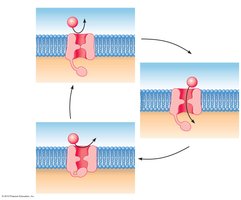
Voltage-gated sodium channels have two gates: an activation gate (opens at threshold) and an inactivation gate (closes during depolarization). Their coordinated action is essential for the rapid depolarization and repolarization phases of the action potential.
Phases of an Action Potential
Depolarization: Voltage-gated Na+ channels open, Na+ influx causes rapid rise in membrane potential.
Repolarization: Na+ channels inactivate, voltage-gated K+ channels open, K+ efflux restores negative potential.
After-hyperpolarization: K+ channels remain open briefly, membrane potential becomes more negative than resting.
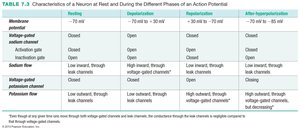
Resting | Depolarization | Repolarization | After-hyperpolarization | |
|---|---|---|---|---|
Membrane potential | ~ -70 mV | ~ -70 mV to +30 mV | ~ +30 mV to -70 mV | ~ -70 mV to -80 mV |
Sodium activation gate | Closed | Open | Open | Closed |
Sodium inactivation gate | Open | Open | Closed | Open |
Sodium channel | Closed | Open | Closed | Closed |
Potassium channel | Closed (leak current) | Closed (leak current) | Open | Open, then closing |
All-or-None Principle
The action potential follows the all-or-none principle: if the threshold is reached, an action potential of fixed magnitude occurs; if not, no action potential is generated. The magnitude of the action potential does not depend on the strength of the stimulus once threshold is surpassed.
Refractory Periods
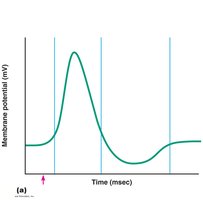
After an action potential, the neuron enters a refractory period during which its ability to generate another action potential is reduced.
Absolute refractory period: No action potential can be generated, regardless of stimulus strength (Na+ channels inactivated).
Relative refractory period: A stronger-than-normal stimulus can generate another action potential (some Na+ channels reset, K+ channels still open).
Propagation of Action Potentials
Unmyelinated Axons
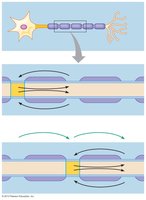
In unmyelinated axons, action potentials propagate by depolarizing adjacent regions of the membrane, resulting in a continuous wave of depolarization.
Myelinated Axons and Saltatory Conduction
In myelinated axons, action potentials jump from one node of Ranvier to the next, a process called saltatory conduction. This greatly increases the speed of signal transmission.
Factors Affecting Propagation Speed
Refractory period: Ensures unidirectional propagation.
Axon diameter: Larger diameter reduces resistance, increasing speed.
Myelination: Myelinated axons conduct action potentials faster due to saltatory conduction.
