 뒤로
뒤로Energy & Cellular Metabolism: Foundations of Cellular Physiology
스터디 가이드 - 스마트 노트
 자료에 맞춘 맞춤형 노트, 핵심 정의, 예시, 맥락을 확장해 제공합니다.
Energy & Cellular Metabolism
Introduction to Energy in Biological Systems
Energy is essential for all cellular processes, enabling cells to perform work, grow, and maintain homeostasis. In physiology, energy is categorized by its form and how it is utilized or transformed within the cell.
Chemical work: Involves metabolism, the sum of all chemical reactions in the body.
Transport work: Movement of substances across membranes via channels, transporters, and concentration gradients.
Mechanical work: Movement at the cellular, tissue, or organismal level (e.g., muscle contraction).
Types of Energy
Cells use and convert different types of energy to sustain life.
Kinetic energy: Energy of motion (e.g., movement of molecules).
Potential energy: Stored energy (e.g., chemical bonds, concentration gradients).
Energy conversions: Cells frequently convert kinetic energy to potential energy and vice versa to drive biological processes.
Chemical Reactions and Energy Changes
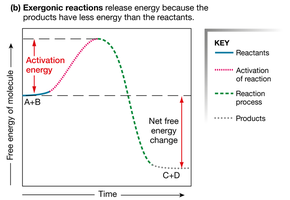
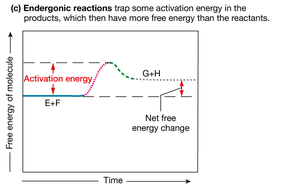
Chemical reactions in cells involve changes in energy, often requiring an initial input called activation energy. The direction and nature of energy change classify reactions as exergonic or endergonic.
Activation energy: The minimum energy required to initiate a chemical reaction.
Exergonic reactions: Release energy; products have less energy than reactants.
Endergonic reactions: Absorb energy; products have more energy than reactants.
Enzymes and Biological Catalysis
Role of Enzymes
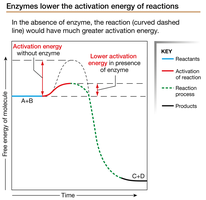
Enzymes are biological catalysts, usually proteins, that accelerate chemical reactions by lowering activation energy. They do not alter the overall energy change of the reaction and cannot make impossible reactions occur.
Enzyme characteristics: Specificity, efficiency, and regulation (see protein properties in Ch. 2).
Effect on activation energy: Enzymes reduce the activation energy required, increasing the reaction rate.
Metabolic Reactions and Pathways
Metabolism Overview
Metabolism encompasses all chemical reactions in the cell, divided into two main types:
Catabolic reactions: Breakdown of molecules, releasing energy (e.g., cellular respiration).
Anabolic reactions: Synthesis of complex molecules, requiring energy (e.g., protein synthesis).
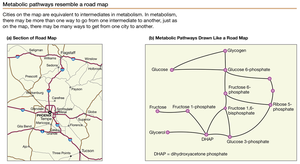
Metabolic pathways are sequences of enzyme-catalyzed reactions, often resembling a road map with multiple routes and intermediates.
Regulation of Metabolic Pathways
Cells regulate metabolism to maintain balance and respond to changing needs. Key regulatory mechanisms include:
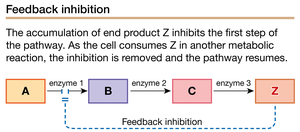
Feedback inhibition: The end product of a pathway inhibits an earlier step, preventing overproduction.
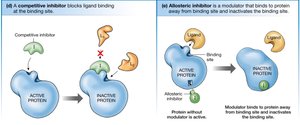
Competitive inhibition: An inhibitor competes with the substrate for the enzyme's active site.
Allosteric (non-competitive) inhibition: A modulator binds to a site other than the active site, altering enzyme activity.
ATP: The Energy Currency of the Cell
ATP Energy Cycle
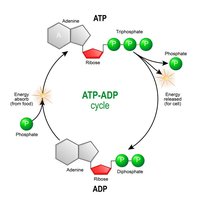
Adenosine triphosphate (ATP) is the primary energy carrier in cells. The ATP-ADP cycle involves the continual conversion between ATP and adenosine diphosphate (ADP) plus inorganic phosphate (Pi), coupling energy-releasing and energy-consuming processes.
ATP synthesis: Endergonic process (requires energy input).
ATP hydrolysis: Exergonic process (releases energy for cellular work).
Equation:
Cellular Respiration
Aerobic Cellular Respiration: Overview
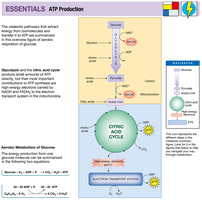
Aerobic respiration is the process by which cells extract energy from glucose in the presence of oxygen, producing ATP, carbon dioxide, and water. It consists of several stages:
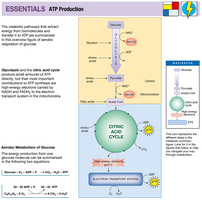
Glycolysis: Glucose is split into two pyruvate molecules in the cytosol, producing 2 ATP and 2 NADH.
Oxidation of pyruvate: Pyruvate is converted to acetyl CoA in the mitochondria, producing 2 NADH and 2 CO2.
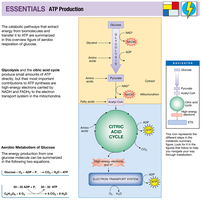
Citric acid cycle (Krebs cycle): Acetyl CoA is oxidized, generating 2 ATP, 6 NADH, 2 FADH2, and 4 CO2.
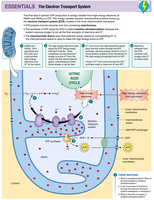
Oxidative phosphorylation: NADH and FADH2 donate electrons to the electron transport chain, driving ATP synthesis (about 28 ATP) via chemiosmosis.
Glycolysis
Glycolysis is the first step of cellular respiration, occurring in the cytosol. It breaks down one glucose molecule into two pyruvate molecules, yielding a net gain of 2 ATP and 2 NADH.
Location: Cytosol
Products: 2 pyruvate, 2 ATP, 2 NADH
Oxidation of Pyruvate
Each pyruvate molecule is transported into the mitochondrion and converted into acetyl CoA, releasing CO2 and generating NADH.
Location: Mitochondrion
Products: 2 acetyl CoA, 2 CO2, 2 NADH
Citric Acid Cycle (Krebs Cycle)
The citric acid cycle completes the oxidation of glucose derivatives, producing ATP, NADH, FADH2, and CO2.
Location: Mitochondrion
Products: 2 ATP, 6 NADH, 2 FADH2, 4 CO2
Oxidative Phosphorylation
Oxidative phosphorylation occurs in the inner mitochondrial membrane, where electrons from NADH and FADH2 pass through the electron transport chain, creating a proton gradient that drives ATP synthesis.
Location: Mitochondrion
Products: 10 NADH → 10 NAD+ + 25 ATP; 2 FADH2 → 2 FAD + 3 ATP
Anaerobic Cellular Respiration
Fermentation
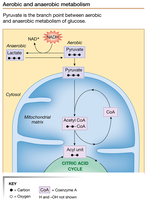
When oxygen is unavailable, cells rely on anaerobic respiration (fermentation) to regenerate NAD+ and produce ATP. Glycolysis proceeds as usual, but pyruvate is converted to lactate.
Location: Cytosol
Products: 2 lactate, 2 ATP (from glycolysis), 2 NAD+ regenerated
Comparison: Anaerobic vs. Aerobic Respiration
Aerobic respiration yields significantly more ATP per glucose molecule than anaerobic respiration.
Process | ATP Yield (per glucose) |
|---|---|
Anaerobic (Fermentation) | 2 ATP |
Aerobic | ~30 ATP |
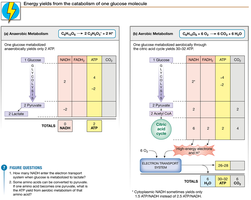
Additional info: The efficiency of aerobic respiration is due to the complete oxidation of glucose and the use of the electron transport chain, while anaerobic pathways are less efficient but essential when oxygen is limited.
