 뒤로
뒤로Epithelial and Connective Tissue Types: Structure and Function
스터디 가이드 - 스마트 노트
 자료에 맞춘 맞춤형 노트, 핵심 정의, 예시, 맥락을 확장해 제공합니다.
Epithelial Tissue
Classification of Epithelial Tissue
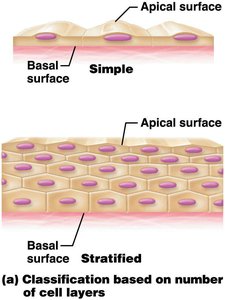
Epithelial tissues are classified based on the number of cell layers and the shape of the cells. These classifications are essential for understanding their functions and locations in the human body.
Simple epithelium: Consists of a single layer of cells, allowing for easy diffusion and absorption.
Stratified epithelium: Composed of multiple layers, providing protection against abrasion and stress.
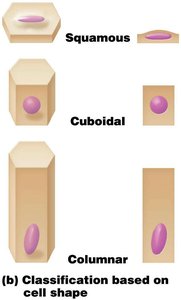
Squamous cells: Flat and thin, specialized for diffusion and filtration.
Cuboidal cells: Cube-shaped, involved in secretion and absorption.
Columnar cells: Tall and column-like, often specialized for absorption and secretion.
Functions of Epithelial Tissue
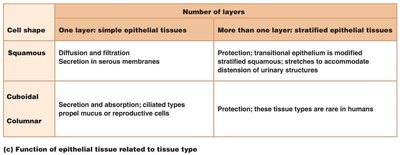
The function of epithelial tissue is closely related to its structure. The following table summarizes the relationship between cell shape, number of layers, and function:
Cell shape | One layer: simple epithelial tissues | More than one layer: stratified epithelial tissues |
|---|---|---|
Squamous | Diffusion and filtration; secretion in serous membranes | Protection; transitional epithelium is modified stratified squamous; stretches to accommodate distension of urinary structures |
Cuboidal | Secretion and absorption; ciliated types propel mucus or reproductive cells | Protection; these tissue types are rare in humans |
Columnar | Secretion and absorption; ciliated types propel mucus or reproductive cells | Protection; these tissue types are rare in humans |
Examples of Epithelial Tissue Types
Simple Squamous Epithelium
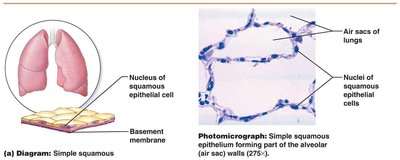
Simple squamous epithelium consists of a single layer of flat cells. It is found in areas where rapid diffusion is required, such as the air sacs of the lungs.
Location: Alveoli of lungs, lining of blood vessels
Function: Diffusion of gases and filtration
Simple Cuboidal Epithelium
Simple cuboidal epithelium is composed of cube-shaped cells and is commonly found in kidney tubules.
Location: Kidney tubules, glands
Function: Secretion and absorption
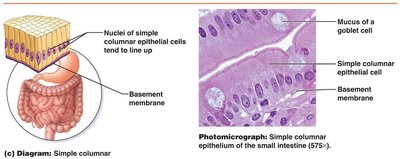
Simple Columnar Epithelium
Simple columnar epithelium consists of tall, column-like cells and lines much of the digestive tract.
Location: Small intestine, stomach
Function: Absorption and secretion of mucus
Pseudostratified Ciliated Columnar Epithelium
Pseudostratified ciliated columnar epithelium appears to have multiple layers due to cell nuclei at different levels, but all cells touch the basement membrane. It is found in the respiratory tract.
Location: Trachea, upper respiratory tract
Function: Secretion and movement of mucus by cilia
Stratified Squamous Epithelium
Stratified squamous epithelium consists of multiple layers of flat cells, providing protection in areas subject to abrasion.
Location: Esophagus, skin, mouth
Function: Protection against mechanical stress
Transitional Epithelium
Transitional epithelium is specialized to stretch and is found lining the urinary bladder.
Location: Urinary bladder, ureters
Function: Allows distension and recoil as the bladder fills and empties
Connective Tissue
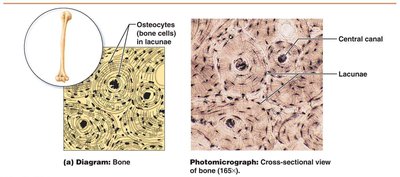
Bone Tissue
Bone tissue is a type of connective tissue characterized by a rigid matrix and the presence of osteocytes in lacunae. It provides structural support and protection for the body.
Location: Skeleton
Function: Support, protection, mineral storage
Cartilage Tissue
Hyaline Cartilage
Hyaline cartilage is a flexible connective tissue found in joints, respiratory tract, and fetal skeleton.
Location: Trachea, ends of long bones, ribs
Function: Support, flexibility, reduces friction
Fibrocartilage
Fibrocartilage contains abundant collagen fibers and is found in intervertebral discs and pubic symphysis.
Location: Intervertebral discs, pubic symphysis
Function: Absorbs shock, provides tensile strength
Dense Regular Fibrous Connective Tissue
Dense regular fibrous connective tissue is composed of parallel collagen fibers and fibroblasts. It forms tendons and ligaments, providing strong attachment between muscles and bones.
Location: Tendons, ligaments
Function: Connects muscles to bones (tendons) and bones to bones (ligaments)
Summary Table: Epithelial Tissue Types and Functions
Type | Location | Function |
|---|---|---|
Simple squamous | Alveoli, blood vessels | Diffusion, filtration |
Simple cuboidal | Kidney tubules, glands | Secretion, absorption |
Simple columnar | Digestive tract | Absorption, secretion |
Pseudostratified ciliated columnar | Trachea | Secretion, movement of mucus |
Stratified squamous | Skin, esophagus | Protection |
Transitional | Bladder | Stretching, distension |
Key Terms
Epithelium: Tissue forming the outer layer of body surfaces and lining internal cavities.
Basement membrane: Thin layer anchoring epithelium to underlying connective tissue.
Osteocyte: Mature bone cell found in lacunae.
Chondrocyte: Cartilage cell found in lacunae.
Fibroblast: Cell that produces collagen fibers in connective tissue.
Additional info:
All images included are directly relevant to the explanation of epithelial and connective tissue types.
Scientific names and terms are italicized where appropriate.
