 뒤로
뒤로Epithelial and Connective Tissues: Structure, Function, and Classification
스터디 가이드 - 스마트 노트
 자료에 맞춘 맞춤형 노트, 핵심 정의, 예시, 맥락을 확장해 제공합니다.
Epithelial and Connective Tissues
Overview of the Four Basic Tissue Types
The human body is composed of four primary tissue types, each with specialized functions essential for maintaining homeostasis and supporting organ structure and function.
Epithelial Tissue: Covers body surfaces, lines cavities, and forms glands. Functions include protection, absorption, secretion, and sensation.
Connective Tissue: Provides support, binds tissues together, stores energy, and participates in immune responses.
Muscle Tissue: Responsible for movement through contraction.
Nervous Tissue: Initiates and transmits electrical impulses for communication and control.
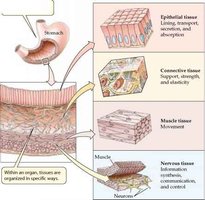
Epithelial Tissue
Characteristics of Epithelial Tissue
Epithelial tissues are specialized for covering surfaces and lining internal passageways. They also form glands and have several defining characteristics:
Physical Protection: Shields underlying tissues from mechanical and chemical stress.
Control Permeability: Regulates the movement of substances into and out of the body or organs.
Provide Sensation: Contains sensory nerve endings for detecting changes in the environment.
Secretion: Forms glands that produce and release substances such as enzymes, hormones, and mucus.
Cellularity: Composed almost entirely of tightly packed cells with minimal extracellular material.
Polarity: Has an apical (free) surface and a basal surface attached to underlying connective tissue.
Avascular: Lacks blood vessels; nutrients diffuse from underlying tissues.
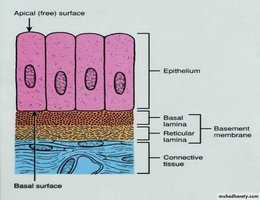
Classification of Epithelial Tissue
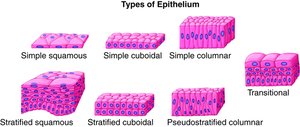
Epithelial tissues are classified based on the number of cell layers and the shape of the cells at the apical surface.
Number of Layers:
Simple: Single layer of cells; allows for absorption and filtration.
Pseudostratified: Appears multilayered but all cells touch the basement membrane.
Stratified: Multiple layers; provides protection against abrasion.
Cell Shape:
Squamous: Flat and thin cells.
Cuboidal: Cube-shaped cells.
Columnar: Tall, column-like cells.
Transitional: Cells that change shape, found in organs that stretch (e.g., bladder).
Glandular Epithelium
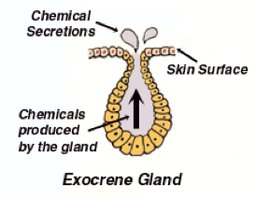
Glandular epithelium forms glands that are specialized for secretion. Glands are classified as either endocrine or exocrine based on their method of secretion and structure.
Endocrine Glands: Release hormones directly into the bloodstream; ductless (e.g., thyroid gland).
Exocrine Glands: Release secretions onto epithelial surfaces via ducts (e.g., sweat glands, salivary glands).
Unicellular Glands: Single-celled glands such as goblet cells that secrete mucus.
Multicellular Glands: Composed of many cells; can be tubular, alveolar (acinar), or branched.
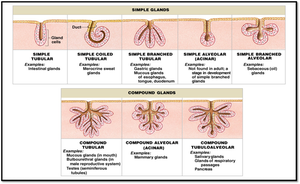
Modes of Secretion in Exocrine Glands
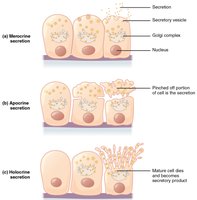
Exocrine glands secrete their products by different mechanisms:
Merocrine Secretion: Secretions are released by exocytosis (e.g., sweat glands).
Apocrine Secretion: A portion of the cell membrane pinches off with the secretion (e.g., mammary glands).
Holocrine Secretion: The entire cell disintegrates to release its contents (e.g., sebaceous glands).
Specializations of Epithelial Cells
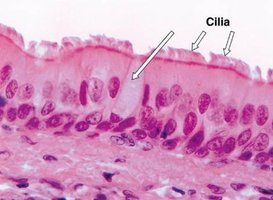
Some epithelial cells possess surface modifications such as cilia or microvilli to enhance their function.
Cilia: Hair-like projections that move substances across the epithelial surface (e.g., respiratory tract).
Microvilli: Increase surface area for absorption (e.g., intestines).
Connective Tissue
General Characteristics of Connective Tissue
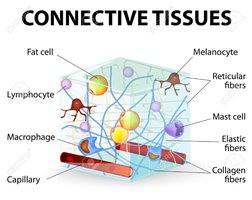
Connective tissues are the most abundant and widely distributed tissues in the body. They provide structural support, store energy, and mediate immune responses.
Specialized Cells: Various cell types depending on the tissue (e.g., fibroblasts, adipocytes, macrophages).
Matrix: Extracellular material composed of protein fibers and ground substance.
High Vascularity: Most connective tissues have a rich blood supply (exceptions: cartilage, tendons).
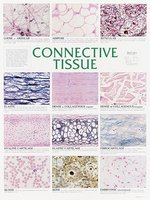
Classification of Connective Tissue
Connective tissues are classified based on their structure and function into three main categories:
Connective Tissue Proper:
Loose: Areolar, adipose, reticular
Dense: Regular, irregular, elastic
Fluid Connective Tissue: Blood and lymph
Supportive Connective Tissue: Bone (spongy, compact) and cartilage (fibrocartilage, hyaline, elastic)
Cells in Connective Tissue
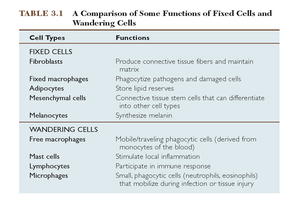
Connective tissue contains a variety of cell types, each with specific functions. These are generally categorized as fixed or wandering cells.
Cell Types | Functions |
|---|---|
Fixed Cells | |
Fibroblasts | Produce connective tissue fibers and maintain matrix |
Fixed macrophages | Phagocytize pathogens and damaged cells |
Adipocytes | Store lipid reserves |
Mesenchymal cells | Connective tissue stem cells that can differentiate into other cell types |
Melanocytes | Synthesize melanin |
Wandering Cells | |
Free macrophages | Mobile/traveling phagocytic cells (derived from monocytes of the blood) |
Mast cells | Stimulate local inflammation |
Lymphocytes | Participate in immune response |
Microphages | Small, phagocytic cells (neutrophils, eosinophils) that mobilize during infection or tissue injury |
Summary Table: Types of Connective Tissue
Type | Examples | Main Functions |
|---|---|---|
Loose Connective Tissue | Areolar, adipose, reticular | Support, cushioning, energy storage |
Dense Connective Tissue | Regular, irregular, elastic | Strength, resistance to stretching |
Fluid Connective Tissue | Blood, lymph | Transport of nutrients, waste, immune cells |
Supportive Connective Tissue | Bone, cartilage | Structural support, protection |
