 뒤로
뒤로Epithelial Tissues: Structure, Classification, and Identification
스터디 가이드 - 스마트 노트
 자료에 맞춘 맞춤형 노트, 핵심 정의, 예시, 맥락을 확장해 제공합니다.
Tissue: The Living Fabric
Introduction to Tissues
Tissues are groups of cells with similar structure and function, forming the fundamental building blocks of organs and systems in the human body. The study of tissues is known as histology. There are four primary tissue types: epithelial, connective, muscle, and nervous tissues.
Epithelial tissue: Covers surfaces, forms boundaries, protects, secretes, absorbs, and filters.
Connective tissue: Supports, protects, and binds other tissues together.
Muscle tissue: Produces movement through contraction.
Nervous tissue: Controls and integrates body functions via internal communication.
Overview of Tissue Functions
Nervous tissue: Internal communication (brain, spinal cord, nerves).
Muscle tissue: Movement (skeletal, cardiac, smooth muscle).
Epithelial tissue: Protection, secretion, absorption, filtration (skin, lining of digestive tract, hollow organs).
Connective tissue: Support and protection (bones, tendons, fat, soft padding tissue).
Epithelial Tissue
Characteristics of Epithelial Tissues
Epithelial tissues possess several unique characteristics that distinguish them from other tissue types:
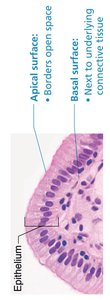
Polarity: Epithelial cells have an apical (upper) surface exposed to the exterior or cavity, and a basal (lower) surface attached to underlying connective tissue. The apical surface may have microvilli (increase surface area, e.g., intestinal lining) or cilia (move substances, e.g., trachea).
Specialized contacts: Adjacent cells are tightly connected by junctions (tight junctions, desmosomes).
Supported by connective tissues: The basement membrane reinforces the epithelial sheet and defines its boundary.
Avascular but innervated: Epithelial tissues lack blood vessels but are supplied by nerve fibers. Nutrients diffuse from underlying connective tissue.
Regeneration: Epithelial cells can rapidly replace lost or damaged cells by cell division.
Classification of Epithelial Tissues
Classification Based on Number of Cell Layers
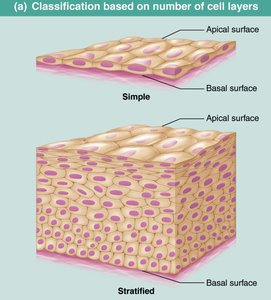
Epithelial tissues are classified by the number of cell layers present:
Simple epithelium: Single layer of cells; functions in absorption, secretion, and filtration.
Stratified epithelium: Two or more layers; functions in protection.
Classification Based on Cell Shape
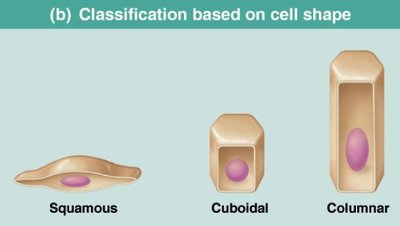
The shape of the cells at the apical surface determines the second part of the epithelial tissue name:
Squamous: Flattened, scale-like cells with a flattened nucleus.
Cuboidal: Box-like cells with a round nucleus.
Columnar: Tall, column-shaped cells with an elongated nucleus.
Types of Epithelial Tissues
Simple Squamous Epithelium
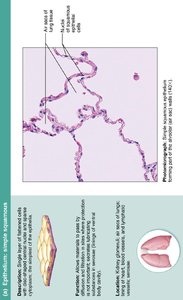
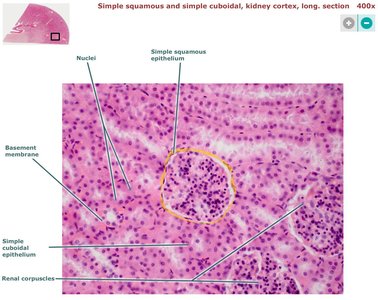
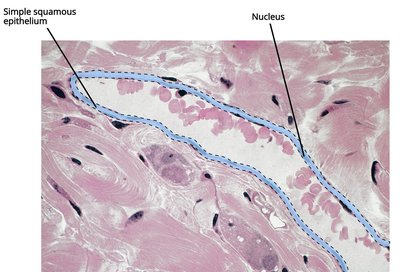
Simple squamous epithelium consists of a single layer of flat cells. It is specialized for rapid diffusion and filtration, found in locations such as alveoli of lungs, lining of blood vessels (endothelium), and kidney glomeruli.
Function: Allows passage of materials by diffusion and filtration.
Location: Air sacs of lungs, lining of heart, blood vessels, lymphatic vessels.
Simple Cuboidal Epithelium
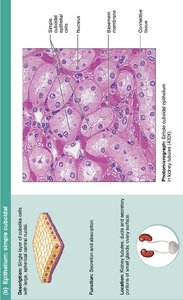
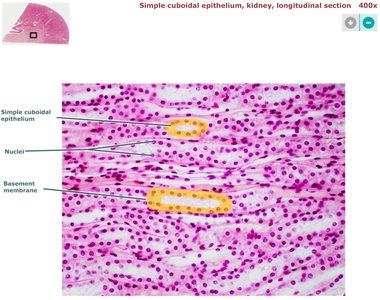
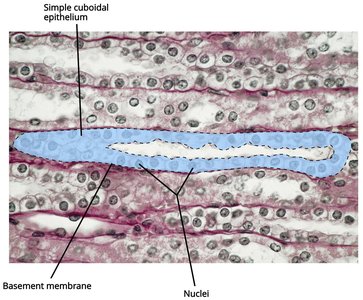
Simple cuboidal epithelium is composed of a single layer of cube-shaped cells. It is involved in secretion and absorption, commonly found in kidney tubules and glandular ducts.
Function: Secretion and absorption.
Location: Kidney tubules, ducts and secretory portions of small glands, ovary surface.
Simple Columnar Epithelium
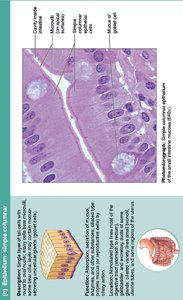
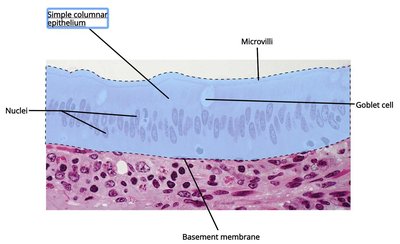
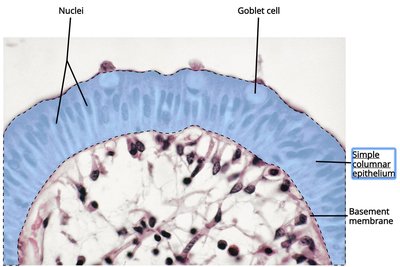
Simple columnar epithelium consists of a single layer of tall, column-shaped cells. It is specialized for absorption and secretion, often containing goblet cells (mucus-secreting) and microvilli. Found in the digestive tract, gallbladder, and some ducts.
Function: Absorption; secretion of mucus, enzymes, and other substances.
Location: Nonciliated type in digestive tract (stomach to rectum), gallbladder; ciliated type in small bronchi, uterine tubes.
Stratified Squamous Epithelium
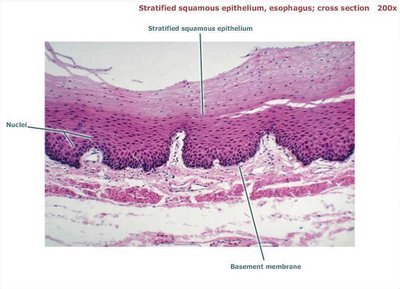
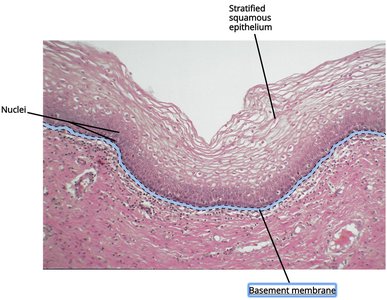
Stratified squamous epithelium is composed of multiple layers of cells, with the apical layer being flat and scale-like. It provides protection against abrasion and is found in areas subject to wear and tear, such as the skin, esophagus, and vagina.
Function: Protects underlying tissues in areas of abrasion.
Location: Nonkeratinized type in esophagus, mouth, vagina; keratinized type in skin (epidermis).
Summary Table: Epithelial Tissue Types
Type | Structure | Function | Location |
|---|---|---|---|
Simple Squamous | Single layer, flat cells | Diffusion, filtration | Alveoli, blood vessels, kidney glomeruli |
Simple Cuboidal | Single layer, cube-shaped cells | Secretion, absorption | Kidney tubules, glands |
Simple Columnar | Single layer, tall cells | Absorption, secretion | Digestive tract, gallbladder |
Stratified Squamous | Multiple layers, flat apical cells | Protection | Skin, esophagus, vagina |
Key Terms and Concepts
Basement membrane: Thin layer separating epithelium from underlying connective tissue.
Microvilli: Finger-like projections increasing surface area for absorption.
Cilia: Hair-like structures aiding movement of substances.
Goblet cells: Specialized cells secreting mucus.
Regeneration: Ability of epithelial cells to rapidly replace lost cells.
Additional info:
In stratified epithelia, classification is based on the shape of cells in the apical layer.
Epithelial tissues are essential for maintaining homeostasis by forming protective barriers and regulating exchange of substances.
