 뒤로
뒤로Fundamentals of Endocrine Signaling and Action
스터디 가이드 - 스마트 노트
 자료에 맞춘 맞춤형 노트, 핵심 정의, 예시, 맥락을 확장해 제공합니다.
Fundamentals of Endocrine Signaling and Action
Principles of Chemical Communication and Cellular Action
The endocrine system is a major regulatory network in the human body, coordinating both rapid and long-term physiological responses. It operates through the secretion of hormones, which are chemical messengers released by ductless glands into the bloodstream, targeting specific cells to maintain homeostasis and drive developmental changes.
Endocrine system: Ductless glands secrete hormones directly into the blood.
Hormones: Chemical messengers transported via blood to distant target cells.
Target cells: Cells with specific receptors for a hormone, ensuring precise effects.
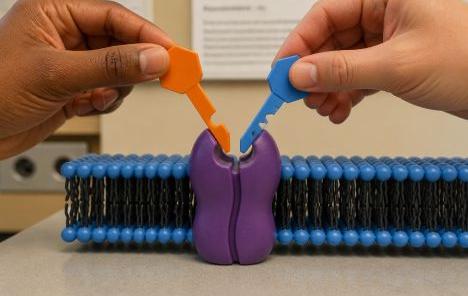
Specificity: Hormone-receptor binding is highly selective, based on molecular shape.
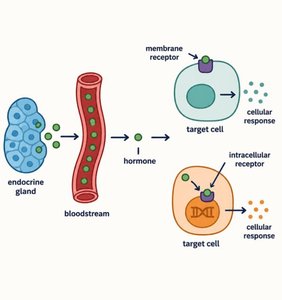
Endocrine vs. Nervous System Communication
The nervous and endocrine systems both regulate body functions, but differ in their signaling mechanisms, speed, duration, and targeting.
Nervous system: Uses electrical and chemical signals; rapid (milliseconds); brief duration; targets neurons, muscles, glands.
Endocrine system: Uses blood-borne hormones; slower (seconds to hours); sustained duration; targets cells with specific receptors.
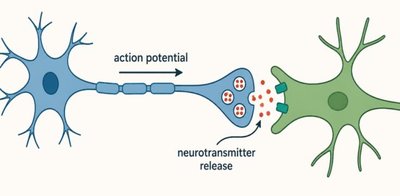
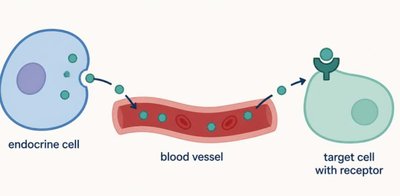
Integration: Nervous System Overrides
While the endocrine system maintains homeostasis, the nervous system can override endocrine control during acute stress. For example, during 'fight-or-flight,' neural inputs trigger the release of epinephrine and suppress insulin, increasing blood glucose for muscle activity.
Example: Sympathetic nerves innervate the adrenal medulla, releasing catecholamines during danger.
CNS override: Stress prioritizes survival over homeostasis.

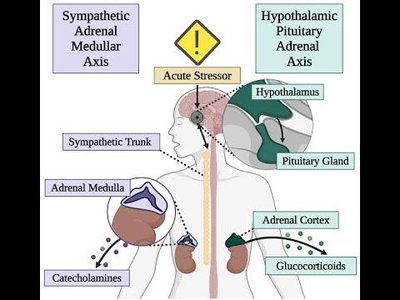
Chemical Classes of Hormones
Classification by Structure and Solubility
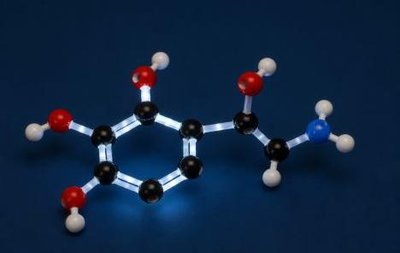
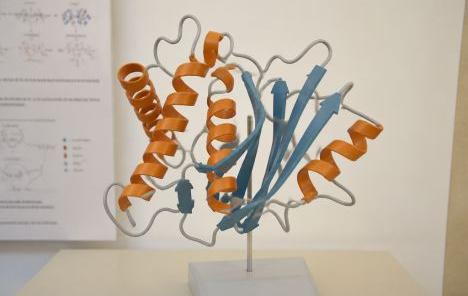
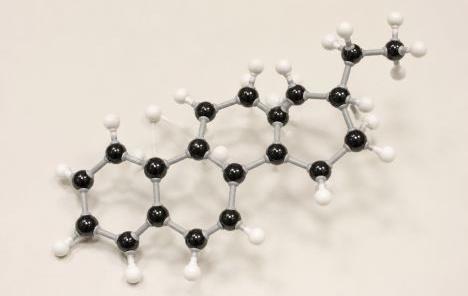
Hormones are classified based on their chemical structure and solubility, which determines their transport, storage, and mechanism of action.
Amine hormones: Derived from tyrosine; includes thyroid hormones and adrenal catecholamines.
Peptide & protein hormones: Chains of amino acids; water-soluble; synthesized in rough ER.
Steroid hormones: Lipid-soluble compounds from cholesterol; includes cortisol, estrogen, testosterone.
Solubility and Hormone Transport
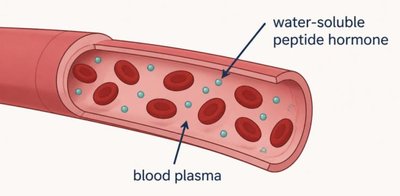
Solubility affects how hormones are transported in the blood and their storage mechanisms.
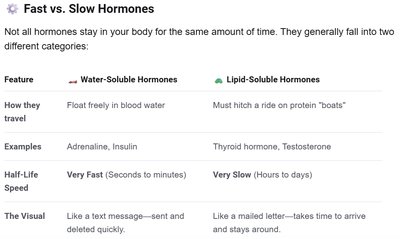
Water-soluble hormones: (e.g., peptides, proteins, epinephrine) dissolve freely in plasma and are stored in vesicles until exocytosis.
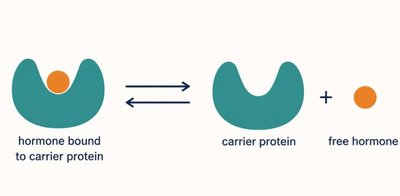
Lipid-soluble hormones: (e.g., steroids, thyroid hormones) require plasma carrier proteins for transport and are synthesized on demand.
Hormone Half-Life Dynamics
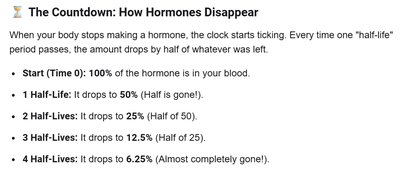
The half-life of a hormone is the time required for its plasma concentration to decrease by 50%. Clearance occurs via renal and hepatic mechanisms. Free hormones are active and degrade rapidly, while bound hormones are protected and degrade slowly.
Free hormones: Short half-life; only free hormones can exit capillaries and bind receptors.
Bound hormones: Long half-life; equilibrium between bound and free states.

Mechanisms of Hormone Action
Gene Activation Mechanism (Lipid-Soluble Hormones)
Lipid-soluble hormones diffuse across cell membranes and bind intracellular receptors, directly altering gene expression.
Passive entry across plasma membrane
Binding to intracellular receptor (cytosol or nucleus)
Hormone-receptor complex binds DNA at Hormone Response Element
Triggers mRNA transcription and new protein synthesis
Second Messenger Systems (Water-Soluble Hormones)
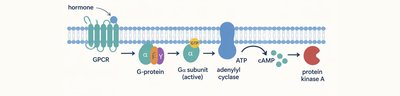
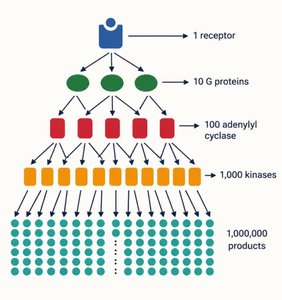
Water-soluble hormones signal via membrane-bound G protein cascades, using second messengers like cAMP to amplify cellular responses.
cAMP: Acts as a second messenger, activating kinases to phosphorylate proteins.
Amplification: Enzyme cascades exponentially increase the response from trace hormone levels.

Endocrine Control and Regulation
Types of Stimuli
Endocrine glands are regulated by three main types of stimuli:
Humoral stimuli: Direct response to blood ion/nutrient changes (e.g., low calcium triggers PTH release).
Neural stimuli: Nerve fibers trigger hormone secretion (e.g., sympathetic input stimulates adrenal epinephrine).
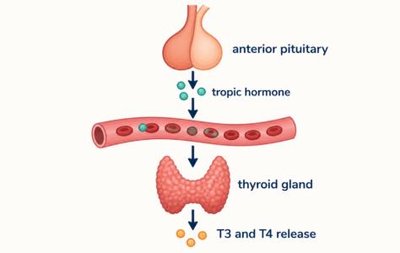
Hormonal stimuli: Hormones stimulate other glands; these are called tropic hormones.
Feedback Control Loops
Feedback mechanisms regulate hormone levels:
Negative feedback: High hormone levels inhibit upstream release, maintaining plasma levels near set points.
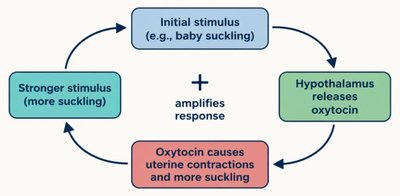
Positive feedback: Response amplifies hormone secretion, driving processes to completion (e.g., oxytocin during childbirth).

Receptor Sensitivity Regulation
Cells adjust their sensitivity to hormones by regulating receptor density:
Up-regulation: Low hormone levels trigger synthesis of more receptors, increasing sensitivity.
Down-regulation: High hormone levels cause internalization or desensitization of receptors, preventing overstimulation (e.g., insulin resistance).

Hormone Interaction Patterns
Permissiveness, Synergism, and Antagonism
Hormones interact in complex ways to regulate physiological processes:
Permissiveness: One hormone enables another to exert full effects (e.g., thyroid hormone permits reproductive maturation).
Synergism: Multiple hormones produce an effect greater than the sum of their individual actions (e.g., glucagon + epinephrine).
Antagonism: One hormone opposes the action of another (e.g., insulin lowers blood glucose; glucagon raises it).

Factors Governing Plasma Concentration
Net Plasma Concentration Balance
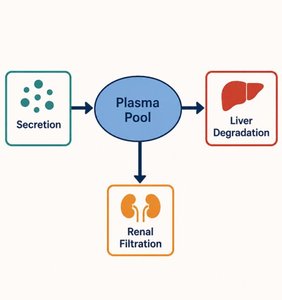
The concentration of hormones in plasma is determined by four factors:
Secretion rate: Speed of hormone synthesis and release.
Metabolic inactivation: Breakdown by the liver.
Renal excretion: Clearance via the kidneys.
Plasma volume: Changes linked to hydration status.
Hypothalamic-Pituitary Integration
Neuroendocrine Interface
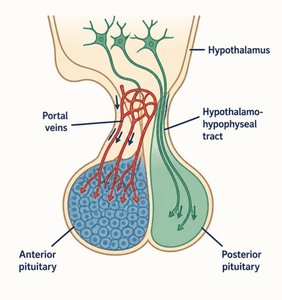
The hypothalamus links neural input to endocrine control, regulating the anterior pituitary via tropic hormones in the hypophyseal portal system. Posterior pituitary hormones are synthesized in hypothalamic neurons and travel via the hypothalamo-hypophyseal tract.
Portal systems: Deliver concentrated tropic signals directly to the anterior pituitary.
Comparative Signaling Analysis
Steroid vs. Peptide Signaling
Steroid and peptide hormones differ in their solubility, receptor site, mechanism, response speed, and duration.
Steroid signaling: Lipid-soluble; intracellular receptors; direct gene activation; slow, long-lasting response.
Peptide signaling: Water-soluble; membrane receptors; second messenger cascade (cAMP); fast, transient response.
Clinical Case: Receptor Resistance
Down-Regulation Pathophysiology
In Type 2 Diabetes, chronic hyperinsulinemia leads to receptor down-regulation, causing target tissues to resist insulin signaling. Despite high insulin levels, cells fail to insert GLUT4 transporters, resulting in elevated blood glucose.
Core Takeaways: Endocrine Action
Solubility: Dictates hormone transport, half-life, and signaling mechanism.
Amplification: Second messengers allow trace hormone levels to trigger robust responses.
Homeostasis: Secretion, binding proteins, feedback, and receptor density interact to regulate hormone action.
