 뒤로
뒤로Hearing and Chemical Senses: Mechanisms and Disorders
스터디 가이드 - 스마트 노트
 자료에 맞춘 맞춤형 노트, 핵심 정의, 예시, 맥락을 확장해 제공합니다.
Mechanism of Hearing
How Sound is Detected in the Ear
The process of hearing involves the conversion of sound waves into electrical signals that are interpreted by the brain. This process relies on specialized structures within the cochlea of the inner ear.
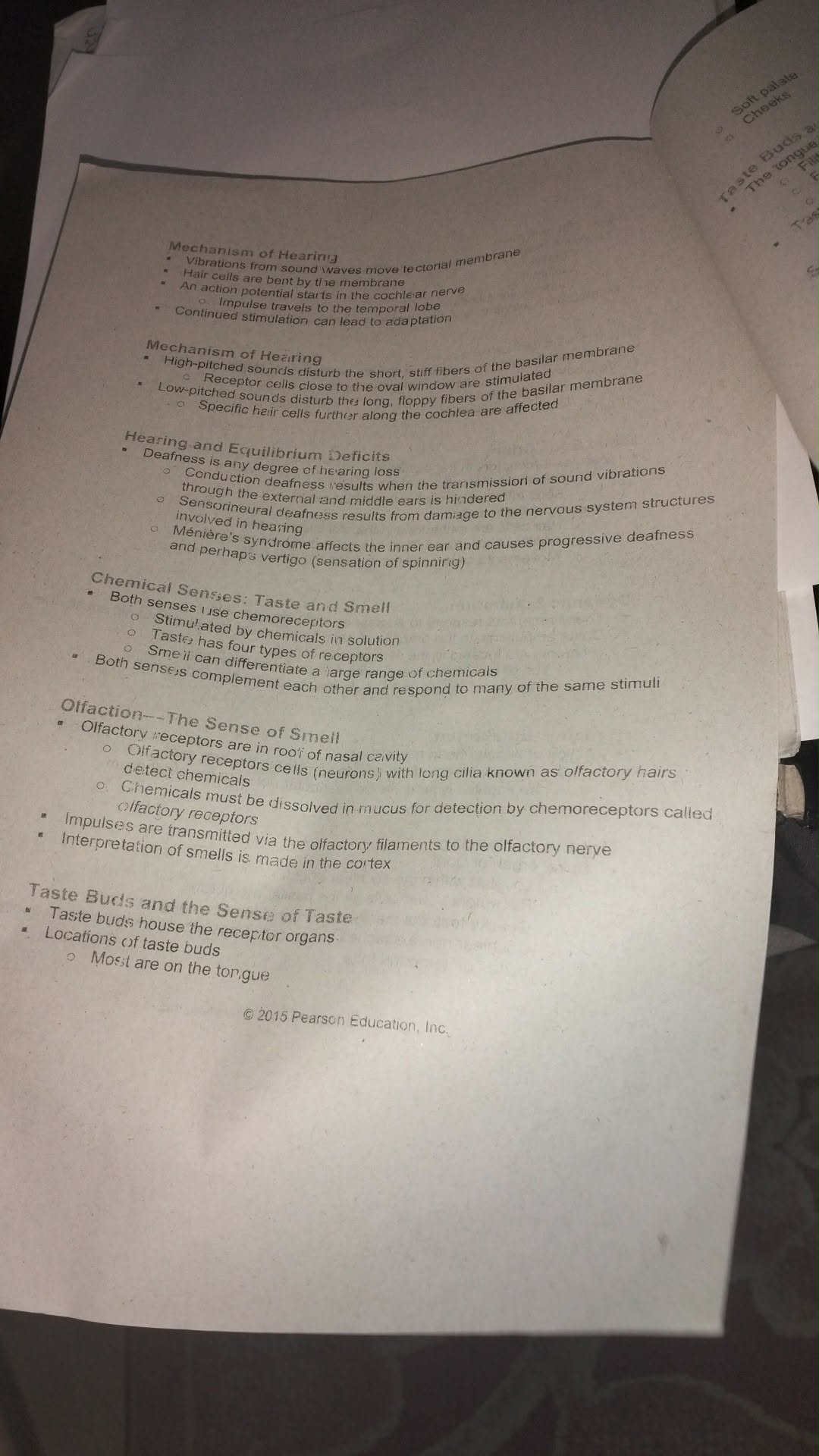
Vibrations from sound waves move the tectorial membrane within the cochlea.
Hair cells are bent by the movement of the membrane, initiating an action potential in the cochlear nerve.
The impulse travels to the temporal lobe of the brain for interpretation.
Continued stimulation can lead to adaptation, where sensitivity to the stimulus decreases over time.
Frequency Detection in the Cochlea
Different frequencies of sound are detected by different regions of the basilar membrane within the cochlea.
High-pitched sounds disturb the short, stiff fibers of the basilar membrane near the oval window.
Low-pitched sounds disturb the long, floppy fibers farther along the cochlea.
Specific hair cells are activated depending on the frequency of the sound.
Hearing and Equilibrium Deficits
Types and Causes of Hearing Loss
Hearing loss can result from problems in the transmission or processing of sound vibrations.
Conduction deafness: Occurs when the transmission of sound vibrations through the external and middle ear is hindered (e.g., due to earwax, infection, or damage to the ossicles).
Sensorineural deafness: Results from damage to the nervous system structures involved in hearing, such as the cochlear nerve or hair cells.
Ménière's syndrome: Affects the inner ear and causes progressive deafness and possibly vertigo (a sensation of spinning).
Chemical Senses: Taste and Smell
Overview of Chemical Senses
The senses of taste and smell are classified as chemical senses because they detect chemicals in solution.
Both senses use chemoreceptors that are stimulated by chemicals dissolved in solution.
Taste has four main types of receptors (sweet, sour, salty, bitter; some sources include umami as a fifth type).
Smell can differentiate a large range of chemicals, allowing for the detection of many odors.
Both senses complement each other and often respond to similar stimuli, enhancing the perception of flavors.
Olfaction – The Sense of Smell
Structure and Function of Olfactory Receptors
Olfactory receptors are specialized neurons located in the roof of the nasal cavity. They are responsible for detecting odor molecules.
Olfactory receptor cells (neurons) have long cilia known as olfactory hairs that extend into the mucus lining the nasal cavity.
Chemicals must be dissolved in mucus for detection by chemoreceptors called olfactory receptors.
Impulses are transmitted via the olfactory filaments to the olfactory nerve.
Interpretation of smells occurs in the cortex of the brain.
Taste Buds and the Sense of Taste
Structure and Location of Taste Buds
Taste buds are the sensory organs responsible for detecting taste stimuli.
Taste buds house the receptor organs for taste.
Most taste buds are located on the tongue, but some are also found on the soft palate and inner surfaces of the cheeks.
Additional info: Taste and smell are closely linked; loss of one can significantly affect the perception of the other. Disorders of hearing and equilibrium often overlap due to the shared anatomy of the inner ear.
