 뒤로
뒤로Homeostasis and Feedback Mechanisms in Anatomy & Physiology
스터디 가이드 - 스마트 노트
 자료에 맞춘 맞춤형 노트, 핵심 정의, 예시, 맥락을 확장해 제공합니다.
Homeostasis
Definition and Importance
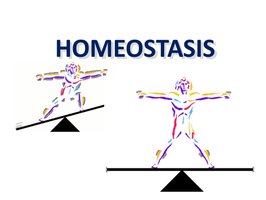
Homeostasis is the tendency of the body to maintain a relatively stable internal environment, despite external changes. This state of dynamic equilibrium is essential for the proper functioning of cells and organs, ensuring that physiological processes occur within optimal ranges.
Dynamic Equilibrium: The internal environment is constantly adjusted to maintain stability.
Relatively Stable: Conditions fluctuate within a narrow range, not fixed at a single value.
Internal Environment of the Body
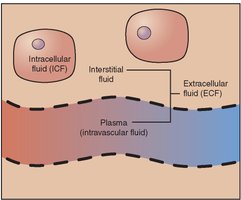
The internal environment refers to the extracellular fluid (ECF) that surrounds cells and determines their access to nutrients and removal of wastes. ECF is divided into two main compartments:
Interstitial Fluid: Fluid between cells.
Plasma: The fluid component of blood (intravascular fluid).
Examples of Homeostatically-Regulated Factors
Several physiological variables are tightly regulated to maintain homeostasis:
Concentration of nutrient molecules (e.g., glucose, amino acids)
Concentration of water, salt, and electrolytes (e.g., sodium, potassium)
Concentration of waste products (e.g., urea, carbon dioxide)
pH: Maintained at approximately 7.35
Blood volume: 4-6 liters; Blood pressure: 120/80 mmHg
Temperature: 37°C
Osmolarity: Balance of solute concentration in ECF and ICF
Feedback Loops
Overview of Feedback Mechanisms
Feedback loops are activated when a change occurs in a homeostatically-regulated factor. They are essential for maintaining internal stability.
Negative Feedback Loops: Reverse the direction of change; most common in the body.
Positive Feedback Loops: Amplify the change; more rare and usually embedded within a larger negative feedback system.
Components of a Feedback Loop
Each feedback loop consists of three main components:
Sensor (Receptor): Measures a factor in the body.
Control Center: Receives input from the sensor and integrates information.
Effector: Receives instructions from the control center and acts to restore normal conditions.
Negative Feedback Example: Room Temperature Control
Negative feedback loops operate to return a variable to its set point. For example, a thermostat regulates room temperature:
Stimulus: Room temperature drops below set point.
Receptor: Thermometer detects change.
Control Center: Thermostat determines temperature is below set point.
Effector: Heater turns on, warming the room.
Return to Set Point: Once set point is reached, heater turns off.
Negative Feedback Example: Body Temperature Regulation
Body temperature is regulated by negative feedback:
Stimulus: Body temperature drops below normal range.
Receptor: Brain receptors detect change.
Control Center: Brain processes information.
Effector: Skeletal muscles shiver to produce heat.
Return to Normal: Shivering stops once temperature is restored.
Positive Feedback Loops
Positive feedback loops amplify the original stimulus, leading to a rapid change until an endpoint is reached. They are less common and often occur in specific physiological processes.
Amplification: Each step increases the response.
Embedded in Negative Feedback: Positive feedback is usually part of a larger negative feedback system to ensure control.
Positive Feedback Example: Blood Clotting
Blood clotting is a classic example of positive feedback:
Stimulus: Injury occurs to blood vessel.
Receptor: Platelets detect vessel damage.
Control Center/Effector: Activated platelets release chemicals to attract more platelets.
Response: Platelets seal the vessel.
End Point: Once vessel is sealed, platelet activity decreases.
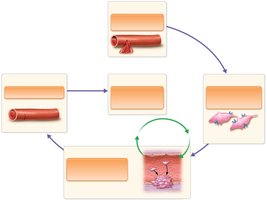
Positive Feedback Example: Childbirth
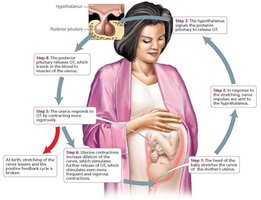
Another example is the release of oxytocin during childbirth, which increases uterine contractions until delivery is complete.
Stimulus: Stretching of the cervix triggers oxytocin release.
Response: Uterine contractions intensify, further stretching the cervix.
End Point: Birth of the baby stops the feedback loop.
Summary Table: Feedback Loop Comparison
Type | Direction of Change | Common Examples |
|---|---|---|
Negative Feedback | Reverses change | Body temperature, blood glucose regulation |
Positive Feedback | Amplifies change | Blood clotting, childbirth |
Key Terms and Concepts
Homeostasis: Maintenance of stable internal conditions
Extracellular Fluid (ECF): Fluid outside cells, includes interstitial fluid and plasma
Feedback Loop: Mechanism for regulating physiological variables
Negative Feedback: Returns variable to set point
Positive Feedback: Amplifies variable until endpoint
Sensor, Control Center, Effector: Components of feedback loop
Relevant Equations
Homeostatic regulation often involves calculations of concentration and osmolarity:
Osmolarity:
Blood Pressure:
Additional info: Academic context was added to clarify feedback loop mechanisms, examples, and key terms for completeness.
