 뒤로
뒤로Homeostasis and Feedback Mechanisms: Study Notes for Anatomy & Physiology
스터디 가이드 - 스마트 노트
 자료에 맞춘 맞춤형 노트, 핵심 정의, 예시, 맥락을 확장해 제공합니다.
Homeostasis
Definition and Importance
Homeostasis is the ability of the body to maintain a stable internal environment despite changes in external conditions. This concept is fundamental to understanding how physiological systems operate to keep variables such as temperature, pH, and fluid balance within narrow limits.
Key Point 1: Homeostasis involves small internal fluctuations to counteract large external changes.
Key Point 2: All organs and cells interact, and are bathed in internal fluid that must remain constant in quantity and quality.
Key Point 3: Claude Bernard, a pioneering physiologist, described homeostasis as the maintenance of the "internal milieu"—the internal environment of the body.


Claude Bernard’s Concept of Homeostasis
Claude Bernard emphasized that all organs interact and that the internal fluid environment must remain constant for proper cellular function.
Key Point 1: Interconnectedness between cells and internal fluid is essential.
Key Point 2: Fluctuations in internal conditions occur within narrow limits.
Osmosis and Fluid Balance
Definition of Osmosis
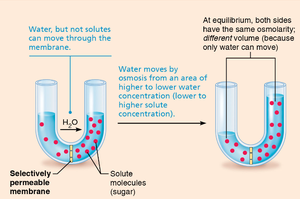
Osmosis is the movement of water across a selectively permeable membrane from an area of lower solute concentration to an area of higher solute concentration. This process is crucial for maintaining cellular and tissue fluid balance.
Key Point 1: Water moves toward the side with a higher solute concentration because solutes "suck" water across the membrane.
Key Point 2: Osmosis helps regulate the internal environment of cells and tissues.
Example: If a cell is placed in a solution with higher solute concentration outside, water will move out of the cell, potentially causing it to shrink.
Feedback Mechanisms
Overview of Feedback Mechanisms
Feedback mechanisms are processes that help maintain homeostasis by responding to changes in the internal environment. There are two main types: negative feedback and positive feedback.
Key Point 1: Negative feedback mechanisms are more common and typically beneficial, as they restore stability close to a set point.
Key Point 2: Positive feedback mechanisms are rare and often amplify changes, which can be destructive or, in some cases, beneficial.
Negative Feedback Mechanisms
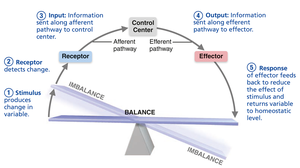
Negative feedback loops operate by reducing the original effect of a stimulus, thereby maintaining homeostasis.
Key Point 1: The effector's response counteracts the stimulus, bringing the variable back toward the set point.
Key Point 2: Most physiological processes, such as temperature regulation and blood glucose control, use negative feedback.
Example: Perspiration cools the body when temperature rises; shivering warms the body when temperature drops.

Components of a Negative Feedback Loop
Stimulus: Produces a change in a variable.
Receptor: Detects the change.
Control Center: Receives input and determines the response.
Effector: Carries out the response to restore balance.
Positive Feedback Mechanisms
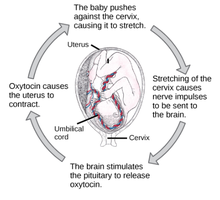
Positive feedback loops amplify the original stimulus, often leading to a cascade of events. These mechanisms are less common and can be destructive, but are beneficial in certain situations.
Key Point 1: The effector's response increases the effect of the stimulus.
Key Point 2: Positive feedback is typically seen in processes such as labor contractions and blood clotting.
Example: During labor, stretching of the cervix triggers the release of oxytocin, which increases uterine contractions, further stretching the cervix.
Comparison of Negative and Positive Feedback
Feedback Type | Response | Commonality | Example |
|---|---|---|---|
Negative Feedback | Reduces stimulus | Most common | Body temperature regulation |
Positive Feedback | Amplifies stimulus | Rare | Labor contractions |
Summary Table: Feedback Mechanism Components
Component | Function |
|---|---|
Stimulus | Change in variable |
Receptor | Detects change |
Control Center | Processes information, determines response |
Effector | Executes response |
Key Equations
Osmosis Equation
The osmotic pressure () can be calculated using the van't Hoff equation: Where:
= ionization constant
= molar concentration
= gas constant
= temperature in Kelvin
Conclusion
Understanding homeostasis and feedback mechanisms is essential for comprehending how the human body maintains stability and responds to internal and external changes. Negative feedback is the primary mechanism for maintaining homeostasis, while positive feedback is used in specific physiological processes. Additional info: Academic context was added to clarify the roles of feedback mechanisms and osmosis in homeostasis.
