 뒤로
뒤로Introduction to Anatomy: Anatomical Language and Organ Systems
스터디 가이드 - 스마트 노트
 자료에 맞춘 맞춤형 노트, 핵심 정의, 예시, 맥락을 확장해 제공합니다.
Chapter 1: The Language of Anatomy
Anatomical Position and Regional Terms
The anatomical position is the standard reference for describing locations and directions on the human body. In this position, the individual stands upright, feet slightly apart, head and toes pointing forward, arms at the sides, and palms facing forward.
Axial region: Includes the head, neck, and torso (trunk).
Appendicular region: Includes the limbs (arms and legs).
Body regions are named areas that help in identifying locations for clinical and anatomical reference. Refer to Table 1.1 for a comprehensive list of these regions.
Directional Terms
Directional terms are used to describe the locations of structures relative to other structures or locations in the body. They are often learned in pairs:
Superior / Inferior: Toward the head (cephalad) / toward the tail (caudal).
Anterior (ventral) / Posterior (dorsal): Toward the front (belly) / toward the back.
Proximal / Distal: Closer to / farther from the point of attachment (used for limbs).
Lateral / Medial: Away from / toward the midline of the body.
Deep / Superficial: Further from / closer to the surface of the body.
Body Planes
Body planes are imaginary lines used to divide the body for anatomical study and imaging:
Sagittal plane: Divides the body into right and left parts.
Frontal (coronal) plane: Divides the body into anterior and posterior parts.
Transverse (horizontal) plane: Divides the body into superior and inferior parts.
Body Cavities and Serous Membranes
The body contains major cavities that house organs and are lined by serous membranes:
Dorsal cavity: Contains the cranial and vertebral cavities.
Ventral cavity: Contains the thoracic and abdominopelvic cavities.
Serous membranes line these cavities and have two layers:
Visceral layer: Touches the organ directly.
Parietal layer: Lines the cavity wall.
Serous fluid: Found between the two layers, reduces friction.
Types of serous membranes:
Pleura: Surrounds the lungs.
Pericardium: Surrounds the heart.
Peritoneum: Surrounds the abdominal organs. Organs outside this membrane, such as the kidneys, are called retroperitoneal.
Abdominopelvic Quadrants and Regions
The abdominopelvic cavity is divided for clinical and anatomical reference:
Quadrants: Right upper, left upper, right lower, left lower.
Regions: Nine regions including the epigastric, umbilical, hypogastric, and others.
Chapter 2: Organ Systems Overview
The Eleven Human Body Organ Systems
The human body is organized into eleven major organ systems, each with specific organs and primary functions. Understanding these systems is foundational for anatomy and physiology.
Cardiovascular system: Transports blood, nutrients, gases, and wastes.
Digestive system: Breaks down food and absorbs nutrients.
Endocrine system: Regulates body functions via hormones.
Integumentary system: Protects the body, regulates temperature, and provides sensory information.
Lymphatic system: Defends against infection and disease, returns tissue fluids to the bloodstream.
Muscular system: Produces movement, maintains posture, and generates heat.
Nervous system: Directs immediate responses to stimuli, coordinates activities of other organ systems.
Reproductive system: Produces sex cells and hormones, supports embryonic development.
Respiratory system: Delivers air to sites where gas exchange occurs.
Skeletal system: Provides support, protects tissues, stores minerals, forms blood cells.
Urinary system: Eliminates waste, controls water balance.
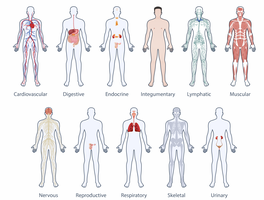
Table: Overview of Human Body Organ Systems
System | Major Organs | Primary Functions |
|---|---|---|
Cardiovascular | Heart, blood vessels | Transport of substances in blood |
Digestive | Mouth, esophagus, stomach, intestines, liver, pancreas | Breakdown and absorption of nutrients |
Endocrine | Pituitary, thyroid, adrenal glands, pancreas, gonads | Hormonal regulation of body processes |
Integumentary | Skin, hair, nails | Protection, temperature regulation, sensation |
Lymphatic | Lymph nodes, lymphatic vessels, spleen, thymus | Immune response, fluid balance |
Muscular | Skeletal muscles | Movement, posture, heat production |
Nervous | Brain, spinal cord, nerves | Coordination of body activities |
Reproductive | Testes, ovaries, uterus, penis, vagina | Production of offspring |
Respiratory | Nasal cavity, trachea, lungs | Gas exchange |
Skeletal | Bones, joints | Support, protection, blood cell formation |
Urinary | Kidneys, ureters, bladder, urethra | Elimination of wastes, water balance |
Laboratory Activities and Study Recommendations
To reinforce your understanding, complete all review questions and hands-on activities using anatomical models and diagrams. Focus on identifying body regions, directional terms, planes, cavities, and organ systems as outlined in the exercises. Regularly review the learning outcomes to ensure mastery of foundational concepts.
