 뒤로
뒤로Introduction to Anatomy and Physiology: Foundational Concepts and Terminology
스터디 가이드 - 스마트 노트
 자료에 맞춘 맞춤형 노트, 핵심 정의, 예시, 맥락을 확장해 제공합니다.
What is Anatomy and Physiology?
Definitions and Distinctions
Anatomy and physiology are closely related fields that together form the foundation of biomedical sciences. Anatomy is the study of the structure of body parts and their relationships to one another, while physiology is the study of the function of the body’s structural machinery—how the body parts work and carry out their life-sustaining activities.
Anatomy: Focuses on the physical structures (e.g., bones, organs, tissues).
Physiology: Focuses on the processes and functions (e.g., how the heart pumps blood, how muscles contract).
Principle of Complementarity: Structure and function are inseparable; the function of a body part depends on its structure.
Example: The heart’s anatomy (chambers, valves) enables its physiology (pumping blood in one direction).
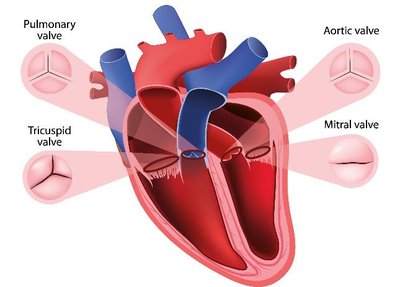
Additional info: Understanding both anatomy and physiology is essential for diagnosing and treating medical conditions.
Levels of Organization
Hierarchical Structure of the Human Body
The human body is organized into a hierarchy of structural levels, each building on the previous one:
Chemical Level: Atoms and molecules essential for life (e.g., water, proteins, DNA).
Cellular Level: Cells are the basic units of life.
Tissue Level: Groups of similar cells performing a common function (e.g., muscle tissue).
Organ Level: Structures composed of at least two tissue types (e.g., heart, liver).
Organ System Level: Groups of organs working together (e.g., digestive system).
Organism Level: The complete living being.
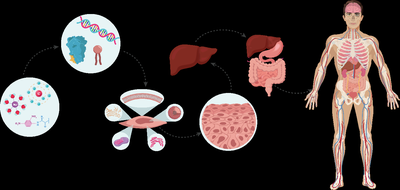
Example: Statins work at the molecular level to inhibit cholesterol synthesis, affecting cells, tissues, organs, and the whole organism.
Variation in Anatomy and Physiology
Normal and Pathological Variation
There is significant variation in human anatomy and physiology. Textbooks often present a 'reference body'—a healthy young adult of average size—to standardize learning, but real individuals may differ in organ arrangement, size, or function.
Anatomical Variation: Differences in structure (e.g., branching of blood vessels).
Physiological Variation: Differences in function (e.g., metabolic rate).
Reference Body: Used for consistency in teaching and communication.
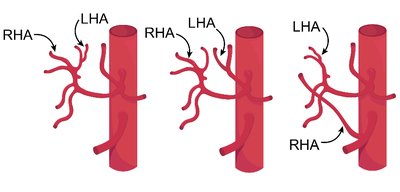
Additional info: Extreme anatomical variation may impact surgical procedures and medical outcomes.
Introduction to Organ Systems
Overview of Major Organ Systems
The human body is organized into organ systems, each with specific functions but all working together to maintain homeostasis.
Protection and Support: Integumentary, skeletal, and muscular systems.
Communication and Integration: Nervous and endocrine systems.
Transport and Immunity: Cardiovascular and lymphatic systems.
Exchange of Materials: Respiratory, digestive, and urinary systems.
Reproduction: Male and female reproductive systems.
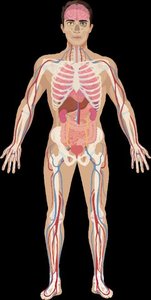
Additional info: Many organs serve multiple functions and belong to more than one system.
Anatomical Position and Directional Terms
Standard Reference for Describing the Body
The anatomical position is the universally accepted starting point for describing body parts and positions. The body stands upright, facing forward, feet shoulder-width apart, arms at the sides, and palms facing forward. Directional terms are always used relative to this position.
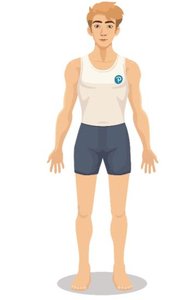
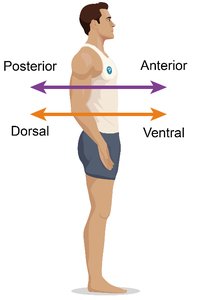
Anterior (ventral): Toward the front of the body.
Posterior (dorsal): Toward the back of the body.
Superior: Toward the head.
Inferior: Toward the feet.
Medial: Toward the midline.
Lateral: Away from the midline.
Proximal: Closer to the point of attachment (limbs).
Distal: Farther from the point of attachment (limbs).
Superficial: Closer to the surface.
Deep: Further from the surface.
Anatomical Terms for Body Regions
Regional Terminology
Specific terms are used to describe regions of the body, often derived from Greek or Latin roots. These terms help precisely locate injuries, diseases, or procedures.
Cephalic: Head
Cervical: Neck
Thoracic: Chest
Abdominal: Abdomen
Pelvic: Pelvis
Brachial: Arm
Femoral: Thigh
Crural: Leg
Plantar: Sole of the foot
Additional info: Mastery of regional terms is essential for effective communication in healthcare.
Abdominopelvic Quadrants and Regions
Divisions of the Abdomen and Pelvis
The abdomen and pelvis are divided into quadrants and regions to localize pain, injuries, or disease.
Quadrants: Right Upper (RUQ), Left Upper (LUQ), Right Lower (RLQ), Left Lower (LLQ)
Regions: Right/Left hypochondriac, epigastric, right/left lumbar, umbilical, right/left inguinal, hypogastric

Example: Appendicitis often causes pain in the right lower quadrant (RLQ).
Anatomical Planes and Sections
Imaginary Divisions of the Body
Anatomical planes are used to describe locations or directions of cuts through the body:
Frontal (coronal) plane: Divides body into anterior and posterior parts.
Sagittal plane: Divides body into right and left parts (midsagittal = equal halves).
Transverse (horizontal) plane: Divides body into superior and inferior parts.
Oblique plane: Cuts at an angle.
Organization of the Body: Body Cavities
Major Body Cavities and Their Contents
The body contains several major cavities that house and protect organs:
Dorsal (posterior) cavity: Contains the cranial cavity (brain) and vertebral cavity (spinal cord).
Ventral (anterior) cavity: Contains the thoracic cavity (heart, lungs) and abdominopelvic cavity (digestive, urinary, reproductive organs).
Serous membranes: Line body cavities and reduce friction between organs.
Additional info: The diaphragm separates the thoracic and abdominopelvic cavities.
Homeostasis and Feedback Loops
Maintaining Internal Stability
Homeostasis is the maintenance of a stable internal environment despite external changes. It is achieved through feedback loops:
Negative Feedback: Reverses a change to maintain a set point (e.g., body temperature regulation).
Positive Feedback: Amplifies a change (e.g., blood clotting, labor contractions).
Components of a Feedback Loop:
Receptor: Detects change.
Control Center: Processes information and determines response.
Effector: Carries out the response to restore balance.
Example Equation: (for homeostatic regulation)
$\text{Set Point} + \text{Deviation} \xrightarrow{\text{Feedback}} \text{Correction toward Set Point}$
Additional info: Failure of homeostasis can result in disease (pathology).
