 뒤로
뒤로Introduction to Anatomy and Physiology: Foundational Concepts and Chemical Principles
스터디 가이드 - 스마트 노트
 자료에 맞춘 맞춤형 노트, 핵심 정의, 예시, 맥락을 확장해 제공합니다.
Introduction to Anatomy and Physiology
Overview of Anatomy and Physiology
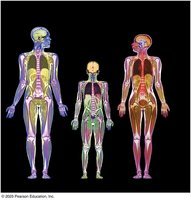
Anatomy and physiology are foundational sciences for understanding the human body. Anatomy is the study of the structure or form of the human body, while physiology is the study of the body’s functions. The relationship between structure and function is a central theme: the form of a body part is closely related to its function, summarized by the phrase "form follows function."
Levels of Structural Organization and Body Systems
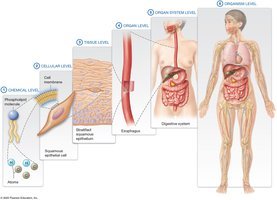
The human body is organized into a series of hierarchical levels, each building upon the previous. This organization allows for increasing complexity and specialization:
Chemical Level: Atoms and molecules form the building blocks of matter.
Cellular Level: Molecules combine to form cells, the basic units of life.
Tissue Level: Groups of similar cells and their extracellular matrix perform a common function.
Organ Level: Two or more tissue types combine to form organs with specialized functions.
Organ System Level: Groups of organs work together to perform broad functions necessary for life.
Organism Level: All organ systems function together to form the complete human organism.
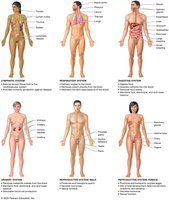
The 11 Organ Systems of the Human Body
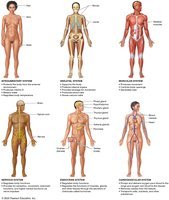
The human body contains 11 distinct organ systems, each with specialized roles that contribute to overall health and function:
Integumentary System
Skeletal System
Muscular System
Nervous System
Endocrine System
Cardiovascular System
Lymphatic System
Respiratory System
Digestive System
Urinary System
Reproductive System
Core Principles in Anatomy and Physiology
Overview of Core Principles
Several core principles are essential for understanding anatomy and physiology. These principles are repeatedly referenced throughout the study of the human body and are crucial for maintaining the body’s internal environment:
Feedback Loops
Relationship of Structure and Function
Gradients
Cell-Cell Communication
Homeostasis: The Central Theme
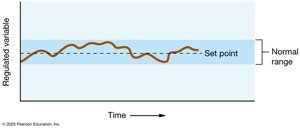
Homeostasis is the condition in which the body maintains a relatively stable internal environment. This stability is necessary for survival and health. Homeostatic imbalances can lead to disease or death if not corrected. Variables such as temperature, blood sugar, and blood pressure are tightly regulated to remain within a normal range.
Feedback Loops in Homeostasis
Feedback loops are mechanisms that help maintain homeostasis by responding to changes in regulated variables:
Negative Feedback Loops: Oppose the initial change and reduce the output, promoting stability. Each variable has a set point and a normal range around that set point.
Positive Feedback Loops: Reinforce the initial change and increase the output. These are less common and typically occur within a negative feedback loop to produce a rapid response.
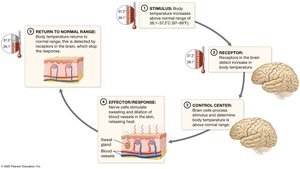
Steps of a Negative Feedback Loop
Stimulus: A regulated variable is outside the normal range.
Receptor (Sensor): Detects the stimulus.
Control Center: Receives information and determines the response (often the brain or a gland).
Effector: Carries out the response to return the variable to normal.
Response: The variable returns to the normal range.
Positive Feedback Loop Example
Positive feedback loops amplify the response to a stimulus. An example is the process of blood clotting, where the response is increased until an endpoint is reached.
Common Misconceptions about Homeostasis
Negative feedback is not inherently bad, nor is positive feedback inherently good; both are necessary for homeostasis.
Homeostasis does not mean the internal environment is unchanging; fluctuations within a normal range are normal.
Feedback loops are not simply "on" or "off"; they are dynamic and continuously active.
Only variables with detectable receptors can be regulated by feedback loops.
Principle of Complementarity of Structure and Function
The principle of complementarity states that the form of a structure is suited to its function at all levels of organization. For example, the thin walls of lung tissue facilitate rapid gas exchange necessary for respiration.
Gradients in Physiology
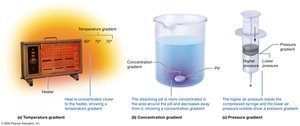
A gradient exists whenever more of something is present in one area than another, and the two areas are connected. Gradients drive many physiological processes, such as the movement of substances across cell membranes.
Temperature Gradient: Difference in temperature between two regions.
Concentration Gradient: Difference in concentration of a substance between two areas.
Pressure Gradient: Difference in pressure between two connected regions.
Cell-Cell Communication
Cells must communicate to coordinate body functions and maintain homeostasis. Communication occurs through electrical signals (e.g., nerve impulses) and chemical messengers (e.g., hormones, neurotransmitters).
Summary Table: Core Principles
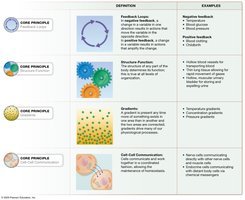
The following table summarizes the core principles, their definitions, and examples:
Core Principle | Definition | Examples |
|---|---|---|
Feedback Loops | In negative feedback, a change in a variable triggers a response that opposes the change. In positive feedback, a change triggers a response that amplifies the change. | Negative: Body temperature, blood pressure Positive: Blood clotting, childbirth |
Structure-Function | The anatomy of any part of the body is suited to its function. | Thin lung tissue for gas exchange, thick heart muscle for pumping blood |
Gradients | Exist whenever more of something is present in one area than another, driving physiological processes. | Temperature, concentration, and pressure gradients |
Cell-Cell Communication | Cells communicate via electrical signals or chemical messengers to coordinate functions. | Nerve cells signaling muscles, hormones regulating organs |
Chapter 2: The Chemistry of Life
2.1 Atoms and Elements
The study of chemistry is fundamental to understanding human anatomy and physiology, as all biological processes are governed by chemical interactions. Matter is anything that has mass and occupies space, and it is composed of atoms, the smallest units retaining the properties of an element.
Atom: Smallest unit of matter, composed of subatomic particles.
Element: Substance made of identical atoms; cannot be broken down by chemical means.
Matter: Anything with mass and volume.
Chemistry: Study of matter and its interactions.
2.1 Atoms and Atomic Structure
Atoms consist of three types of subatomic particles: protons, neutrons, and electrons. The atomic nucleus contains protons and neutrons, while electrons orbit in shells around the nucleus.
Proton (p+): Positively charged, located in the nucleus.
Neutron (n0): Uncharged, slightly larger than protons, located in the nucleus.
Electron (e-): Negatively charged, found in electron shells surrounding the nucleus.
Atoms are electrically neutral when the number of protons equals the number of electrons.
Most atomic mass comes from protons and neutrons.
2.1 Elements in the Periodic Table and the Human Body
Elements are defined by their atomic number (number of protons). The human body is primarily composed of four major elements, with several mineral elements playing essential roles:
Major Elements: Oxygen (65%), Carbon (18%), Hydrogen (10%), Nitrogen (3%)
Mineral Elements: Sodium, Potassium, Calcium, Chlorine, Magnesium, Phosphorus, Sulfur
2.1 Isotopes and Radioactivity
Isotopes are atoms of the same element with different numbers of neutrons. Some isotopes are unstable and emit radiation, forming the basis for nuclear medicine.
Mass Number: Sum of protons and neutrons.
Isotope: Same atomic number, different mass number.
Radioisotope: Unstable isotope that releases energy as radiation.
2.1 Nuclear Medicine
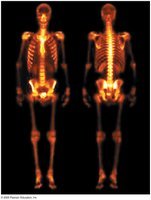
Nuclear medicine utilizes radioisotopes for diagnostic imaging and treatment, such as cancer radiation therapy and thyroid disorder treatment.
Cancer Radiation Therapy: Damages and kills cancer cells.
Radiotracers: Used for imaging organs and tissues.
Iodine-131: Treats thyroid disorders.
2.2 Chemical Bonds
Chemical bonds are energy relationships between atoms, forming molecules and macromolecules. The interaction of valence electrons in the outermost shell is key to bond formation.
Molecule: Two or more atoms chemically bonded.
Macromolecule: Large compound of many atoms.
Valence Electrons: Electrons in the outermost shell.
Octet Rule: Atoms are most stable with 8 electrons in the valence shell.
2.2 Covalent Bonds
Covalent bonds involve the sharing of electrons between nonmetal atoms and are the strongest type of chemical bond. Bonds can be single, double, or triple, depending on the number of shared electron pairs.
Covalent Bond: Electrons shared between atoms.
Single, double, and triple bonds represent one, two, or three shared pairs.
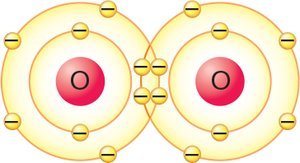
Electron Sharing in Covalent Bonds
Bond Type | Number of Shared Electron Pairs | Example |
|---|---|---|
Single | 1 | H2 |
Double | 2 | O2 |
Triple | 3 | N2 |
2.2 Nonpolar and Polar Covalent Bonds
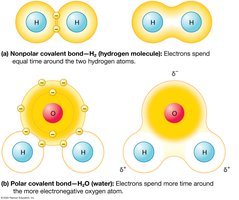
Nonpolar covalent bonds share electrons equally, while polar covalent bonds share electrons unequally, resulting in dipoles with partial charges.
Nonpolar Covalent Bond: Equal sharing; often between same element or C-H bonds.
Polar Covalent Bond: Unequal sharing; one atom attracts electrons more strongly (higher electronegativity).
Dipole: Molecule with partial positive and negative ends.
2.2 Hydrogen Bonds
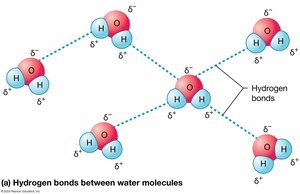
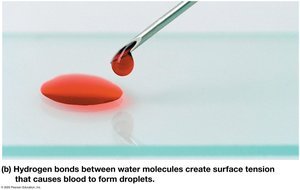
Hydrogen bonds are weak attractions between partially positive and negative atoms in polar molecules, such as water. They contribute to surface tension and are crucial in biological systems.
Hydrogen Bond: Weak attraction, not a true bond.
Surface Tension: Caused by hydrogen bonding in water.
2.3 Chemical Notation and Reactions
Chemical reactions involve the formation, breaking, or rearrangement of bonds. Chemical notation uses symbols to represent reactants and products.
Reactants: Starting substances.
Products: Resulting substances.
Reversible Reaction: Can proceed in both directions.
Irreversible Reaction: Proceeds in one direction.
2.3 Reaction Rates and Enzymes
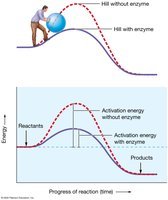
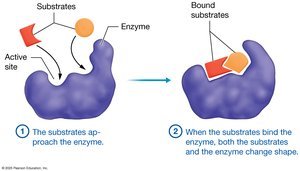
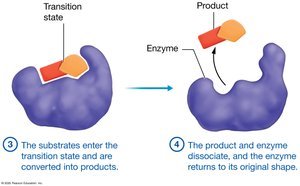
Reaction rates are influenced by concentration, temperature, properties of reactants, and the presence of catalysts. Enzymes are biological catalysts that lower activation energy and speed up reactions.
Enzyme: Protein catalyst, highly specific, not permanently altered.
Activation Energy: Energy required to start a reaction.
Induced Fit Mechanism: Enzyme changes shape to fit substrate.
2.4 Inorganic Compounds: Water, Acids, Bases, and Salts
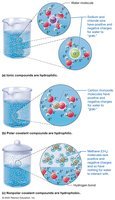
Inorganic compounds do not contain carbon bonded to hydrogen. Water is the primary solvent in the body, dissolving hydrophilic solutes but not hydrophobic ones.
Hydrophilic: Water-loving, dissolves in water.
Hydrophobic: Water-hating, does not dissolve in water.
2.4 Acids and Bases
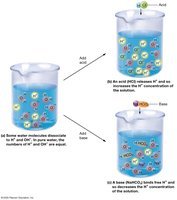
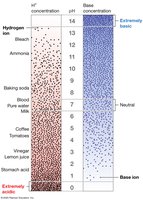
Acids are proton donors, increasing hydrogen ion concentration in water. Bases are proton acceptors, decreasing hydrogen ion concentration. The pH scale measures hydrogen ion concentration.
Acid: Increases H+ in solution.
Base: Decreases H+ in solution.
pH: Negative logarithm of H+ concentration.
Buffer: Resists changes in pH; major buffer is carbonic acid–bicarbonate system.
2.5 Monomers and Polymers
The body contains four main organic compounds: carbohydrates, lipids, proteins, and nucleic acids. Monomers are single subunits, and polymers are chains of monomers.
Monomer: Single subunit.
Polymer: Chain of monomers.
2.5 Carbohydrates
Carbohydrates are polar, hydrophilic molecules made of carbon, hydrogen, and oxygen. They function primarily as fuel and have structural roles.
Monosaccharide: Simple sugar, e.g., glucose.
Glycoprotein/Glycolipid: Carbohydrate attached to protein/lipid for cell recognition.
2.5 Lipids
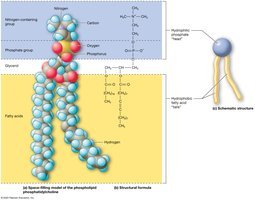
Lipids are nonpolar, hydrophobic molecules that include fatty acids, triglycerides, phospholipids, and steroids. They serve as fuel, membrane components, and hormones.
Fatty Acid: Lipid monomer.
Triglyceride: Three fatty acids linked to glycerol; storage form.
Phospholipid: Glycerol backbone, two fatty acids, phosphate group; amphiphilic.
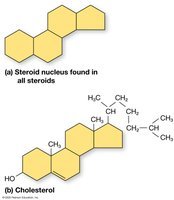
Steroid: Four-ring structure; includes cholesterol, bile acids, sex hormones.
2.5 Proteins
Proteins are made of amino acids and perform diverse functions, including structural roles, enzymatic activity, defense, communication, and muscle contraction. Protein denaturation disrupts function.
Amino Acid: Protein monomer; 21 types.
Denaturation: Loss of protein shape due to heat, pH, or chemicals.
2.5 Nucleotides and Nucleic Acids
Nucleic acids (DNA and RNA) are made of nucleotides, which consist of a nitrogenous base, a five-carbon sugar, and a phosphate group. ATP is a nucleotide that stores energy for cellular processes.
Nucleotide: Monomer of nucleic acids.
DNA/RNA: Genetic material.
ATP: Main energy source; synthesized from ADP and phosphate.
2.5 Organic Compound Summary
Compound | Monomer | Main Functions |
|---|---|---|
Carbohydrates | Monosaccharides | Fuel, structure, cell recognition |
Lipids | Fatty acids | Fuel, membranes, hormones |
Proteins | Amino acids | Structure, enzymes, defense, communication, contraction |
Nucleic Acids | Nucleotides | Genetic information, energy (ATP) |
