 뒤로
뒤로Introduction to Anatomy and Physiology: Levels of Structural Organization
스터디 가이드 - 스마트 노트
 자료에 맞춘 맞춤형 노트, 핵심 정의, 예시, 맥락을 확장해 제공합니다.
Overview of Anatomy and Physiology
Anatomy
Anatomy is the scientific study of the structure of living organisms. It is divided into several subdivisions based on the scale and method of observation:
Gross or macroscopic anatomy: Examines structures visible to the naked eye, such as organs and organ systems. Includes regional, systemic, and surface anatomy.
Microscopic anatomy: Focuses on structures that require magnification, such as cells (cytology) and tissues (histology).
Developmental anatomy: Studies structural changes throughout the life span, including embryology.
To study anatomy effectively, mastery of anatomical terminology and techniques such as observation, manipulation, palpation, and auscultation are essential.
Physiology
Physiology is the study of the function of the body and its parts. It is often subdivided based on organ systems, such as renal physiology (kidneys) or cardiovascular physiology (heart and blood vessels). Physiology frequently focuses on cellular and molecular levels, emphasizing how chemical reactions within cells drive bodily functions.
Key principles: Ability to focus at multiple levels (systemic, cellular, molecular), and understanding basic physical (e.g., electrical currents, pressure, movement) and chemical principles.
Principle of Complementarity
Anatomy and physiology are inseparable disciplines. The function of a body part always reflects its structure, and what a structure can do depends on its specific form. This is known as the principle of complementarity.
Levels of Structural Organization
Hierarchical Levels
The human body is organized into a hierarchy of structural levels, each building upon the previous:
Chemical level: Atoms combine to form molecules, which in turn form organelles within cells.
Cellular level: Cells are the basic structural and functional units of life, composed of molecules and organelles.
Tissue level: Tissues consist of groups of similar cells that perform a common function. Examples include muscle, connective, and epithelial tissues.
Organ level: Organs are made up of two or more types of tissues working together to perform specific functions.
Organ system level: Organ systems consist of different organs that work closely together to accomplish a common purpose (e.g., cardiovascular system).
Organismal level: The human organism is made up of many organ systems functioning together to sustain life.
Example: Structural Organization in Action
Consider the act of playing tennis. The movement involves:
Atoms and molecules forming organelles within muscle cells
Muscle cells grouped into muscle tissue
Muscle tissue forming organs such as muscles
Muscles working within organ systems (e.g., muscular and cardiovascular systems)
The entire organism (the tennis player) performing coordinated actions
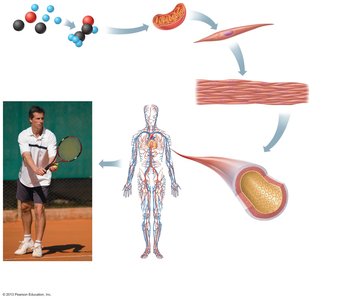
Figure: This image illustrates the levels of structural organization, from atoms and molecules to the whole human organism, using the example of a tennis player. It visually demonstrates how each level builds upon the previous, culminating in complex activities.
Summary Table: Levels of Structural Organization
Level | Description | Example |
|---|---|---|
Chemical | Atoms and molecules form organelles | Water, proteins, mitochondria |
Cellular | Cells are basic units of life | Muscle cell, neuron |
Tissue | Groups of similar cells | Muscle tissue, epithelial tissue |
Organ | Two or more tissue types | Heart, blood vessel |
Organ System | Organs working together | Cardiovascular system |
Organismal | All organ systems | Human body |
Additional info: The levels of structural organization are foundational concepts in anatomy and physiology, providing a framework for understanding how complex functions arise from simple building blocks.
