 뒤로
뒤로Introduction to Anatomy & Physiology: Organization, Homeostasis, and Anatomical Terminology
스터디 가이드 - 스마트 노트
 자료에 맞춘 맞춤형 노트, 핵심 정의, 예시, 맥락을 확장해 제공합니다.
Introduction to Anatomy & Physiology
What is Life?
Biology defines life through a set of shared characteristics that distinguish living organisms from non-living matter. These characteristics are foundational to the study of anatomy and physiology.
Responsiveness: The ability to detect and respond to internal or external stimuli (e.g., temperature, pain, blood glucose levels).
Growth: Increase in organism size, primarily due to an increase in cell number and, to a lesser extent, cell size.
Reproduction: Production of offspring, ensuring the continuation of the species.
Movement: Includes both the movement of the organism as a whole and the movement of substances within the organism (e.g., blood, lymph).
Metabolism: All chemical and physical reactions in the body, including energy production through respiration.
Definition of Anatomy and Physiology
Anatomy: The study of the shape, structure, location, and physical relationships among body parts. Example: Describing the heart's four chambers or the location of the lungs.
Physiology: The study of the functions of anatomical structures and the mechanisms by which they operate. Example: Explaining how the heart pumps blood or how the kidneys filter waste.
Key Concept: Structure is directly related to function; the form of a tissue or organ determines its role in the body.
Levels of Organization
Hierarchy of Biological Organization
The human body is organized into a hierarchy of structural levels, from the simplest to the most complex:
Chemical or Molecular Level: Atoms, ions, molecules, and macromolecules (e.g., water, proteins, carbohydrates, lipids, nucleic acids).
Cellular Level: Specialized organelles grouped within cells.
Tissue Level: Groups of similar cells performing a common function.
Organ Level: Several tissues working together for a specific function.
Organ System Level: Groups of organs working together (e.g., digestive system).
Organism Level: The complete living being, encompassing all previous levels.
Homeostasis
Definition and Importance
Homeostasis is the maintenance of a stable internal environment, essential for the survival of organisms. All body systems contribute to homeostasis by responding to internal and external changes to keep variables within a normal range.
Small variations are normal; large deviations can lead to disease or death.
Feedback Systems
Homeostatic regulation is achieved through feedback systems, which monitor and adjust physiological processes.
Negative Feedback: The most common mechanism; the response opposes the initial stimulus, restoring normal conditions.
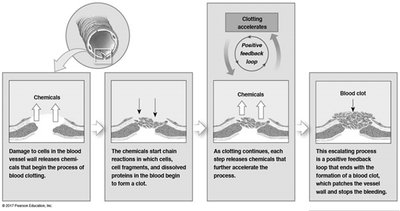
Positive Feedback: The response enhances or exaggerates the original stimulus; typically used for processes that must be rapidly completed (e.g., blood clotting).
Pathway of Feedback Systems
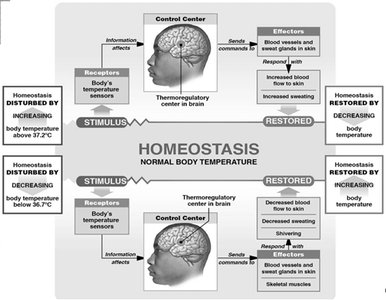
Stimulus: Change away from the normal range.
Receptor: Detects the stimulus.
Afferent Pathway: Carries signal to the control center.
Integration (Control) Center: Processes the signal and sends instructions.
Efferent Pathway: Carries response signal to the effector.
Effector: Muscle, gland, or organ that performs the action.
Response: Action that returns the body to homeostasis.
Example: Negative Feedback in Thermoregulation
Body temperature is regulated by negative feedback to maintain homeostasis. If temperature rises or falls, the body initiates mechanisms to restore normal temperature.
Example: Negative Feedback in Blood Glucose Regulation
Stimulus: Elevated blood glucose.
Receptors: Detect change.
Afferent Pathway: Signal to control center.
Control Center: Pancreas releases insulin.
Efferent Pathway: Insulin acts on body cells.
Effector: Cells uptake glucose.
Response: Blood glucose returns to normal.
Example: Positive Feedback in Blood Clotting
Blood clotting is regulated by a positive feedback loop, where each step accelerates the process until the clot is formed and bleeding stops.
Anatomical Terminology
Anatomical Position
The anatomical position is the standard reference for describing locations and directions on the human body:
Standing upright, facing forward
Feet together, pointing forward
Arms at sides, palms facing forward, thumbs pointing laterally
Supine Position: Lying face up
Prone Position: Lying face down
Directional terms are always based on the anatomical position, regardless of the actual position of the body.
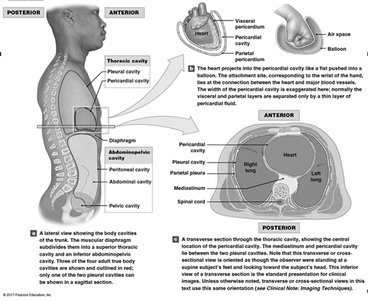
Body Cavities
Major Body Cavities and Their Functions
Body cavities protect internal organs and allow them to change shape. They serve two main functions:
Protection from shocks
Permit changes in size and shape of organs
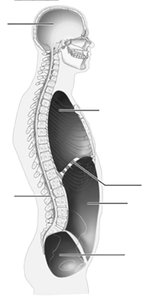
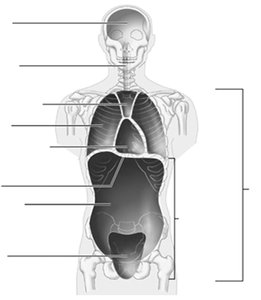
Ventral Body Cavity (Coelom)
Divided by the diaphragm into:
Thoracic Cavity: Contains right and left pleural cavities (lungs), pericardial cavity (heart), and mediastinum (central compartment).
Abdominopelvic Cavity: Contains abdominal cavity (digestive organs) and pelvic cavity (reproductive organs, bladder, rectum).
Serous Membranes
Line body cavities and cover organs
Secrete lubricating serous fluid to reduce friction
Consist of two layers:
Parietal Layer: Lines the cavity wall
Visceral Layer: Covers the organs
Dorsal Body Cavity
Almost completely surrounded by bone
Protects the central nervous system (CNS)
Divided into:
Cranial Cavity: Contains the brain
Vertebral Cavity: Contains the spinal cord
Body Cavities and Sectional Planes
Understanding the orientation and boundaries of body cavities is essential for anatomical study and clinical practice.
Key Terms
Physiology: Study of body function
Histology: Study of tissues
Prone Position: Lying face down
Cytology: Study of cells
Sign: Objective evidence of disease
Supine Position: Lying face up
Homeostasis: Maintenance of stable internal conditions
Symptom: Subjective evidence of disease
Peritoneum: Serous membrane lining the abdominal cavity
Thermoregulation: Maintenance of body temperature
Negative Feedback: Mechanism that reverses a deviation from the set point
Pleura: Serous membrane surrounding the lungs
Serous Membrane: Membrane lining body cavities and covering organs
Positive Feedback: Mechanism that amplifies a stimulus
Mediastinum: Central compartment of the thoracic cavity
Anatomical Position: Standard reference position for the body
