 뒤로
뒤로Introduction to Anatomy and Physiology: Structure, Function, and Homeostasis
스터디 가이드 - 스마트 노트
 자료에 맞춘 맞춤형 노트, 핵심 정의, 예시, 맥락을 확장해 제공합니다.
Overview of Anatomy and Physiology
Anatomy: The Study of Structure
Anatomy is the scientific study of the structure of body parts and their relationships to one another. It is divided into several levels:
Gross (macroscopic) anatomy: Study of large body structures visible to the naked eye, often involving dissection.
Microscopic anatomy: Study of structures too small to be seen without magnification, such as cells and tissues. Histology is the microscopic analysis of tissues.
Developmental anatomy: Study of anatomical changes throughout the lifespan.
Physiology: The Study of Function
Physiology focuses on the function of body systems and how body parts carry out life-sustaining activities. Examples include neurophysiology and muscle physiology.
Principle of Complementarity of Structure and Function
The principle of complementarity states that the function of a body part is dependent on its structure, and structure reflects function. Anatomy and physiology are inseparable because what a structure can do depends on its specific form.
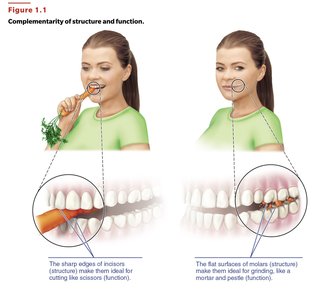
Example: The sharp edges of incisors are ideal for cutting food, while the flat surfaces of molars are suited for grinding.
Levels of Structural Organization
The human body is organized into hierarchical levels, each building on the previous one:
Chemical level: Atoms combine to form molecules.
Cellular level: Cells are made up of molecules and are the basic units of life.
Tissue level: Tissues consist of similar types of cells working together for a common function.
Organ level: Organs are composed of at least two tissue types and perform specific functions.
Organ system level: Organ systems consist of different organs that work closely together.
Organismal level: The human organism is made up of many organ systems working cooperatively.
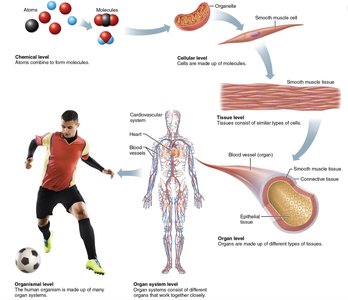
Key Point: No cell, tissue, organ, or organ system works in isolation; all levels are interdependent, and failure at any level can affect the entire organism.
Homeostasis
Definition and Importance
Homeostasis is the dynamic state of equilibrium in which the body's internal environment remains relatively stable, despite external changes. It is essential for maintaining internal consistency and overall health.
Most organ systems contribute to homeostasis.
The nervous and endocrine systems play central roles in homeostatic regulation.
Homeostatic Control Mechanisms
Homeostatic control involves three main components:
Receptor: Detects changes (stimuli) in the environment and sends information via the afferent pathway.
Control Center: Determines the set point for the variable, analyzes input, and initiates a response via the efferent pathway.
Effector: Carries out the response to restore balance.
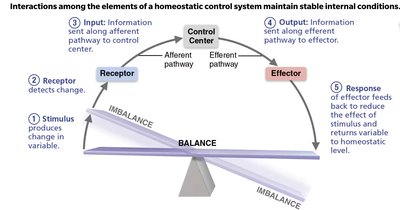
Example: If body temperature rises above normal, receptors detect the change, the control center (brain) processes the information, and effectors (sweat glands) are activated to cool the body.
Types of Feedback Mechanisms
Negative Feedback
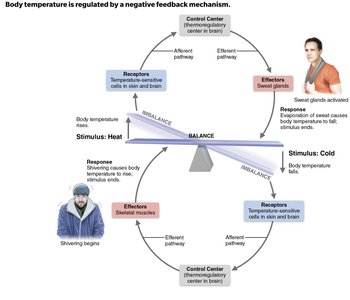
Negative feedback mechanisms reduce or eliminate the original stimulus, returning the variable to its normal range. This is the most common type of homeostatic control.
Example: Regulation of body temperature. When body temperature rises, mechanisms such as sweating are activated to cool the body; when it falls, shivering generates heat.
Positive Feedback
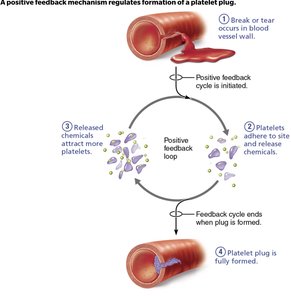
Positive feedback mechanisms enhance or amplify the original stimulus, moving the variable further from its original value. These are less common but important in specific situations.
Example: Formation of a platelet plug during blood clotting. Platelets adhere to a damaged vessel, release chemicals to attract more platelets, and the cycle continues until the break is sealed.
Directional Terms in Anatomy
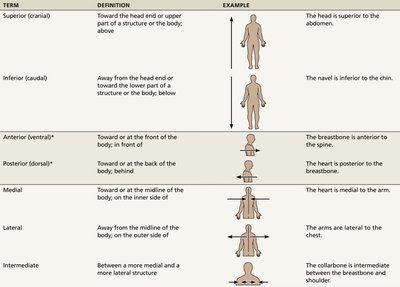
Directional terms are used to describe the locations of structures relative to other structures or locations in the body.
Term | Definition | Example |
|---|---|---|
Superior (cranial) | Toward the head end or upper part of a structure or the body; above | The head is superior to the abdomen. |
Inferior (caudal) | Away from the head end or toward the lower part of a structure or the body; below | The navel is inferior to the chin. |
Anterior (ventral) | Toward or at the front of the body; in front of | The breastbone is anterior to the spine. |
Posterior (dorsal) | Toward or at the back of the body; behind | The heart is posterior to the breastbone. |
Medial | Toward or at the midline of the body; on the inner side of | The heart is medial to the arm. |
Lateral | Away from the midline of the body; on the outer side of | The arms are lateral to the chest. |
Intermediate | Between a more medial and a more lateral structure | The collarbone is intermediate between the breastbone and shoulder. |
Term | Definition | Example |
|---|---|---|
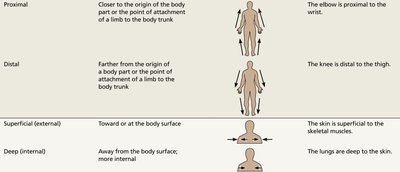
Proximal | Closer to the origin of the body part or the point of attachment of a limb to the body trunk | The elbow is proximal to the wrist. |
Distal | Farther from the origin of a body part or the point of attachment of a limb to the body trunk | The knee is distal to the thigh. |
Superficial (external) | Toward or at the body surface | The skin is superficial to the skeletal muscles. |
Deep (internal) | Away from the body surface; more internal | The lungs are deep to the skin. |
Body Planes and Sections
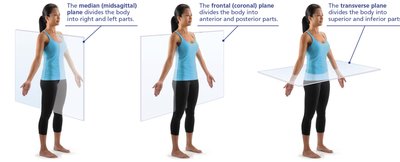
Body planes are imaginary lines used to divide the body into sections for anatomical study:
Median (midsagittal) plane: Divides the body into right and left parts.
Frontal (coronal) plane: Divides the body into anterior (front) and posterior (back) parts.
Transverse (horizontal) plane: Divides the body into superior (upper) and inferior (lower) parts.
Body Cavities
The body contains several major cavities that house and protect vital organs:
Dorsal body cavity: Includes the cranial cavity (brain) and vertebral cavity (spinal cord).
Ventral body cavity: Includes the thoracic cavity (heart and lungs) and abdominopelvic cavity (digestive organs, bladder, reproductive organs, and rectum).
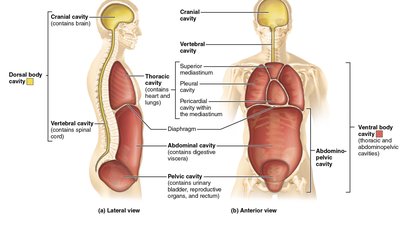
Additional info: The diaphragm separates the thoracic and abdominopelvic cavities. Each cavity contains smaller subdivisions that house specific organs.
