 뒤로
뒤로Introduction to Human Anatomy & Physiology: Body Organization and Foundational Concepts
스터디 가이드 - 스마트 노트
 자료에 맞춘 맞춤형 노트, 핵심 정의, 예시, 맥락을 확장해 제공합니다.
Chapter 1: Body Organization
Course Objectives
This course aims to provide a comprehensive understanding of the human body's design and organization, focusing on the structure and function of major organ systems. Students will learn to interpret pathologies, master anatomical terminology, and appreciate the relevance of anatomy and physiology to contemporary health issues.
Understand the structure and function of major organ systems and their changes across the lifespan.
Explain the interactions and complementarity of organ systems.
Assess major pathologies and disease states.
Apply anatomical and medical terminology appropriately.
Relate the study of the human body to current medical and health issues.
Scientific Method in Anatomy & Physiology
The scientific method is a systematic approach to understanding the organization and properties of the physical world, including the human body.
Observation: Careful examination of phenomena.
Hypothesis: A plausible explanation that makes specific predictions.
Experimentation: Testing hypotheses with controlled experiments.
Variables: Dependent, independent, and controlled variables are identified.
Data Analysis: Statistical analysis determines significance (null hypothesis testing).
Theory Formation: Well-tested hypotheses with broad predictive power become scientific theories, which may be modified as new information arises.
Example: Theories such as Newton’s gravity and Darwin’s evolution have been refined over time as new evidence emerged.
Scientific Method in Medicine
Medical diagnosis applies the scientific method through a series of steps:
Taking a complete medical history
Physical examination (inspection, palpation, percussion, auscultation)
Diagnostic procedures or tests
Treatment plan design
Follow-up using the SOAP protocol (Subjective, Objective, Assessment, Plan)
Statistical Hypothesis Testing
Statistical errors can occur during hypothesis testing:
Type I Error (False Positive): Rejecting a true null hypothesis (e.g., screening tests like pregnancy or HIV ELISA tests).
Type II Error (False Negative): Failing to reject a false null hypothesis (e.g., confirmatory tests like serum pregnancy or Western blot for HIV).
Definitions: Anatomy and Physiology
Anatomy: The study of internal and external structures and their physical relationships.
Physiology: The study of how living organisms perform vital functions.
Principle of Complementarity
Anatomy and physiology are closely integrated; function always reflects structure. This is summarized by the law of architecture: "form follows function." For example, bones support and protect due to their mineral content, and heart valves ensure unidirectional blood flow.
Types of Anatomy
Macroscopic (Gross) Anatomy: Study of structures visible to the naked eye.
Microscopic Anatomy: Study of structures requiring magnification (cytology and histology).
Types of Microscopic Anatomy
Cytology: Study of individual cell structure.
Histology: Study of tissue organization.
Specialized Anatomy
Surface Anatomy: Study of superficial features.
Regional Anatomy: Study of specific body areas.
Surgical Anatomy: Anatomical landmarks important in surgery.
Systemic Anatomy: Study of organ systems.
Developmental Anatomy: Changes from conception to maturity.
Pathologic Anatomy: Structural changes during disease.
Radiographic Anatomy: Imaging-based analysis.
Types of Physiology
Cell Physiology: Functions of living cells.
Special Physiology: Physiology of specific organs.
Systemic Physiology: Physiology of organ systems.
Pathological Physiology: Effects of disease on function.
Structural Hierarchy of the Human Body
The human body is organized into a hierarchy of increasing complexity:
Chemical (atoms, molecules)
Macromolecular
Cellular
Tissue
Organ
Organ System
Organism
The organization at each level determines the characteristics and functions of higher levels, demonstrating emergent properties and interdependency.
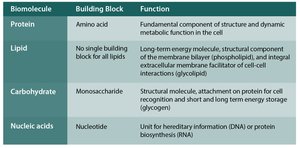
The Four Major Classes of Biomolecules
Biomolecules are essential building blocks for cells, tissues, and organs.
Biomolecule | Building Block | Function |
|---|---|---|
Protein | Amino acid | Structural and metabolic functions in the cell |
Lipid | No single building block | Energy storage, membrane structure, cell signaling |
Carbohydrate | Monosaccharide | Energy storage, cell recognition, structural roles |
Nucleic acids | Nucleotide | Genetic information (DNA), protein synthesis (RNA) |
Body Organ Systems
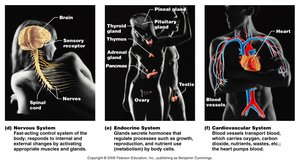
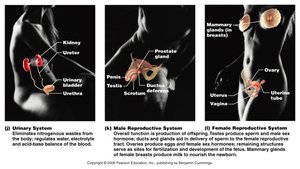
The human body consists of multiple organ systems, each with specialized functions:
Integumentary: Protection, thermoregulation
Skeletal: Support, protection, mineral storage, blood formation
Muscular: Movement, support, heat production
Nervous: Rapid coordination, response to stimuli
Endocrine: Long-term regulation via hormones
Lymphatic: Defense against infection
Urinary: Waste elimination, water/electrolyte balance
Cardiovascular: Transport of nutrients, gases, wastes
Respiratory: Gas exchange
Digestive: Food processing, nutrient absorption
Reproductive: Production of gametes and hormones
Body Fluid Compartments
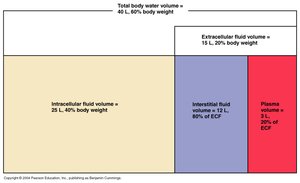
Body fluids are distributed between intracellular and extracellular compartments:
Intracellular fluid (ICF): Fluid within cells (~2/3 of body water)
Extracellular fluid (ECF): Fluid outside cells (~1/3 of body water), including interstitial fluid and plasma
Homeostasis
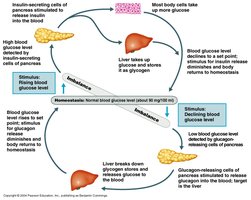
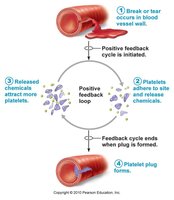
Homeostasis is the maintenance of a stable internal environment despite external changes. It is the central principle of physiology, and its failure leads to disease or death.
Regulatory Components: Receptor (sensor), control center, effector
Negative Feedback: Most homeostatic mechanisms; response reduces the original stimulus (e.g., thermoregulation, blood glucose regulation)
Positive Feedback: Response enhances the original stimulus; rare and usually part of larger negative feedback cycles (e.g., blood clotting, childbirth)
Anatomical Terminology and Body Orientation
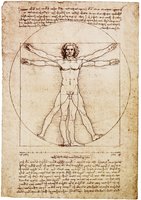
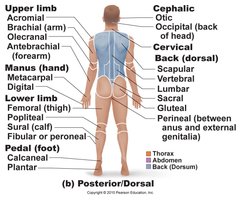
Precise anatomical terminology allows clear communication about body structures. The anatomical position is the standard reference point. The body is divided into axial and appendicular regions, and directional terms describe relationships between structures.
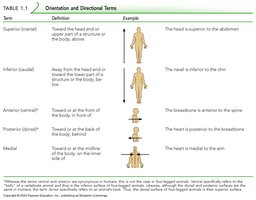
Directional Terms: Superior/inferior, anterior/posterior, medial/lateral, superficial/deep, proximal/distal
Term | Definition | Example |
|---|---|---|
Superior (cranial) | Toward the head/upper part | The head is superior to the abdomen |
Inferior (caudal) | Away from the head/lower part | The navel is inferior to the chin |
Anterior (ventral) | Toward the front | The breastbone is anterior to the spine |
Posterior (dorsal) | Toward the back | The heart is posterior to the breastbone |
Medial | Toward the midline | The heart is medial to the arm |
Sectional Anatomy and Body Cavities
The body is three-dimensional but often studied in two-dimensional planes:
Frontal (coronal) plane
Sagittal plane (midsagittal, parasagittal)
Transverse (horizontal) plane
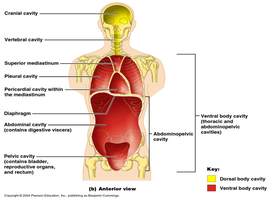
Body cavities house and protect organs, allowing for organ movement and growth:
Dorsal cavity: Cranial and vertebral cavities
Ventral cavity: Thoracic and abdominopelvic cavities, separated by the diaphragm
Serous Membranes
Serous membranes line body cavities and cover organs, reducing friction during organ movement. Each has a parietal (lining cavity wall) and visceral (covering organ) layer, with serous fluid in between. Examples include pleura (lungs), pericardium (heart), and peritoneum (abdominal organs).
Abdominopelvic Mapping
The abdominopelvic region is mapped for clinical and anatomical reference, using quadrants and regions to localize organs and pathologies.
Other Body Cavities
Additional smaller cavities include those in the head (nasal, orbital, middle ear) and synovial cavities in joints. Many open to the body exterior and are involved in special senses or movement.
Chapter 2 Preview
Chapter 2 covers general chemistry concepts essential for understanding anatomy and physiology, such as ions, molecules, diffusion, acid-base balance, and pH. Students are encouraged to review these topics as needed.
Additional info: This guide is based on introductory lecture materials and is intended as a foundational overview for further study in Anatomy & Physiology.
