 뒤로
뒤로Introduction to Human Anatomy and Physiology: Levels of Organization and Characteristics of Life
스터디 가이드 - 스마트 노트
 자료에 맞춘 맞춤형 노트, 핵심 정의, 예시, 맥락을 확장해 제공합니다.
Introduction to Anatomy and Physiology
Overview
Human Anatomy and Physiology is the study of the structure and function of the human body. This foundational course introduces the hierarchical organization of the body and the essential characteristics that define living organisms. Understanding these concepts is crucial for further study in health and biological sciences.
Levels of Organization in the Human Body
Hierarchy of Structural Organization
The human body is organized into a series of hierarchical levels, each building upon the previous one. This organization allows for increasing complexity and specialization of function.
Chemical Level: The simplest level, consisting of atoms and molecules that form the building blocks of matter.
Cellular Level: Molecules combine to form cells, the basic units of life. Each cell type has specialized functions.
Tissue Level: Similar cells group together to form tissues, such as epithelial, connective, muscular, and nervous tissues.
Organ Level: Different tissues combine to form organs, each with specific functions (e.g., the esophagus).
Organ System Level: Organs work together as part of organ systems (e.g., the digestive system) to perform complex functions.
Organism Level: All organ systems function together to maintain the life of the entire organism—the human body.
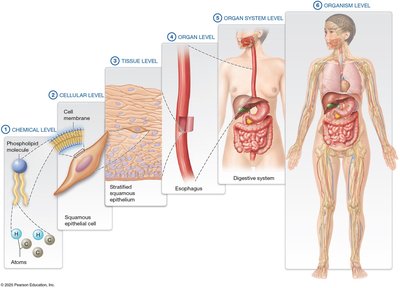
Major Tissue Types
Classification of Tissues
The body contains four primary tissue types, each with distinct roles:
Epithelial Tissue: Covers body surfaces and lines cavities.
Connective Tissue: Supports, binds, and protects organs.
Muscular Tissue: Responsible for movement.
Nervous Tissue: Initiates and transmits electrical impulses for communication.
Additional info: These tissue types are foundational for the structure and function of all organs and organ systems.
Characteristics of Living Organisms
Essential Life Processes
Living organisms, including humans, share several key characteristics that distinguish them from non-living matter:
Metabolism: The sum of all chemical reactions in the body, including anabolic (building up) and catabolic (breaking down) processes.
Anabolism: Synthesis of complex molecules from simpler ones.
Catabolism: Breakdown of complex molecules into simpler ones.
Growth: Increase in size and number of cells, occurring when anabolic processes exceed catabolic ones.
Excretion: Removal of metabolic waste products from the body.
Movement: Motion at the cellular, tissue, organ, or whole-organism level.
Reproduction: Production of new cells (cellular level) or new organisms (organismal level).
Responsiveness: Ability to sense and respond to changes in the internal or external environment.
Homeostasis: Maintenance of a stable internal environment despite external changes.
Example: Muscle contraction (movement), sweating to cool the body (homeostasis), and cell division (reproduction) are all manifestations of these characteristics.
Summary Table: Levels of Organization
Level | Description | Example |
|---|---|---|
Chemical | Atoms and molecules | Water (H2O), proteins |
Cellular | Basic unit of life | Squamous epithelial cell |
Tissue | Group of similar cells | Stratified squamous epithelium |
Organ | Two or more tissue types | Esophagus |
Organ System | Group of organs with a common function | Digestive system |
Organism | All organ systems working together | Human body |
Key Equations
Metabolism:
Conclusion
Understanding the levels of organization and the characteristics of life provides a framework for studying the structure and function of the human body. These foundational concepts are essential for all further topics in Anatomy and Physiology.
