 뒤로
뒤로Introduction to Human Anatomy & Physiology: Organization, Systems, and Orientation
스터디 가이드 - 스마트 노트
 자료에 맞춘 맞춤형 노트, 핵심 정의, 예시, 맥락을 확장해 제공합니다.
The Human Body: An Orientation
Levels of Structural Organization
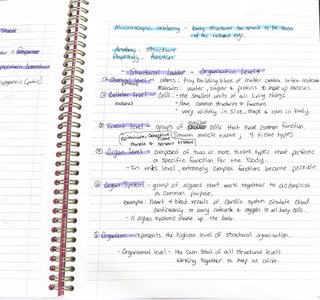
The human body is organized into hierarchical levels, each building upon the previous to form a complete organism. Understanding these levels is foundational to the study of anatomy and physiology.
Atomic/Molecular Level: Atoms combine to form molecules, the chemical building blocks of cells.
Macromolecule Level: Large, complex molecules such as proteins, lipids, and nucleic acids.
Organelle Level: Specialized structures within cells that perform distinct functions (e.g., mitochondria, nucleus).
Cellular Level: Cells are the basic units of life; different types perform various functions.
Tissue Level: Groups of similar cells working together to perform a common function (e.g., muscle tissue, nervous tissue).
Organ Level: Structures composed of two or more tissue types that perform specific functions (e.g., heart, liver).
Organ System Level: Groups of organs that work together to accomplish a common purpose (e.g., digestive system).
Organismal Level: The highest level, representing the living human being as a whole.
Definitions and Scope
Anatomy: The study of the structure of body parts and their relationships to one another.
Physiology: The study of the function of the body and its parts; how the body and its parts work or function.
Microscopic Anatomy: Structures too small to be seen with the naked eye, such as cells and tissues.
Reference Body and Anatomical Position
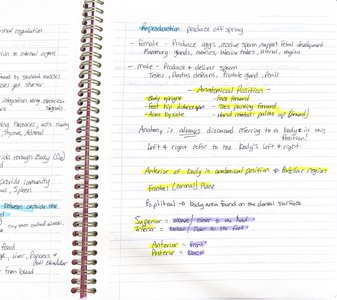
Standard anatomical position is used as a reference for describing locations and directions on the human body. The body stands upright, facing forward, with arms at the sides and thumbs pointing outward.
Anterior (Ventral): Toward the front of the body.
Posterior (Dorsal): Toward the back of the body.
Superior: Toward the head or upper part of a structure.
Inferior: Away from the head or toward the lower part of a structure.
Medial: Toward the midline of the body.
Lateral: Away from the midline of the body.
Proximal: Closer to the origin of the body part or point of attachment.
Distal: Farther from the origin of the body part or point of attachment.
Superficial: Toward or at the body surface.
Deep: Away from the body surface; more internal.
Body Planes and Sections
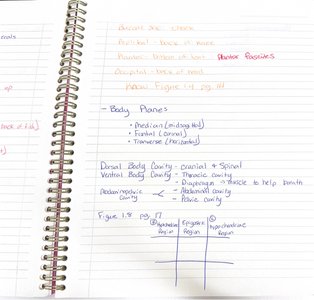
Body planes are imaginary lines used to divide the body into sections for anatomical study.
Sagittal Plane: Divides the body into right and left parts (midsagittal if equal parts).
Frontal (Coronal) Plane: Divides the body into anterior and posterior parts.
Transverse (Horizontal) Plane: Divides the body into superior and inferior parts.
Body Cavities
The body contains several cavities that house and protect vital organs.
Dorsal Body Cavity: Includes the cranial and spinal cavities.
Ventral Body Cavity: Includes the thoracic cavity (chest) and abdominopelvic cavity (abdomen and pelvis).
Organ Systems Overview
Major Organ Systems and Their Functions
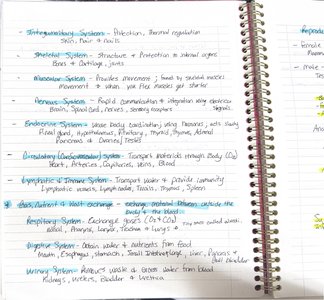
The human body is organized into organ systems, each with specific functions essential for survival and homeostasis.
Integumentary System: Protection, temperature regulation; includes skin, hair, and nails.
Skeletal System: Structure and protection; includes bones, cartilage, and joints.
Muscular System: Provides movement, maintains posture, and produces heat.
Nervous System: Fast-acting control system; responds to internal and external changes by activating muscles and glands.
Endocrine System: Glands secrete hormones that regulate processes such as growth, reproduction, and metabolism.
Cardiovascular System: Transports blood, nutrients, gases, and wastes; includes heart and blood vessels.
Lymphatic System: Returns leaked fluids to blood, involved in immunity; includes lymph nodes and vessels.
Respiratory System: Exchanges gases (oxygen and carbon dioxide) between blood and air; includes lungs and airways.
Digestive System: Breaks down food, absorbs nutrients, and eliminates waste; includes mouth, esophagus, stomach, intestines.
Urinary System: Eliminates nitrogenous wastes, regulates water and electrolyte balance; includes kidneys, ureters, bladder, urethra.
Reproductive System: Produces offspring; includes testes, ovaries, and associated structures.
Survival Needs and Homeostasis
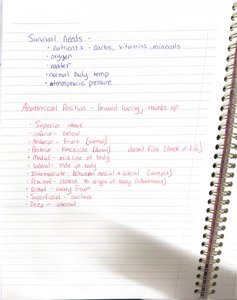
Basic Survival Needs
For survival, the human body requires several essential factors:
Nutrients: Carbohydrates, proteins, fats, vitamins, and minerals.
Oxygen: Required for cellular respiration and energy production.
Water: The most abundant chemical in the body; necessary for metabolic reactions.
Normal Body Temperature: Needed for proper metabolic function.
Atmospheric Pressure: Required for adequate breathing and gas exchange in the lungs.
Homeostasis
Homeostasis is the maintenance of a stable internal environment despite changes in the external environment. It is vital for normal body functioning and sustaining life.
Basic Pathway: Stimulus → Receptor → Control Center → Effector → Response
Negative Feedback: The response reduces or shuts off the original stimulus (e.g., regulation of body temperature, blood glucose levels).
Positive Feedback: The response enhances the original stimulus (e.g., blood clotting, labor contractions).

Directional Terms and Body Orientation
Key Directional Terms
Directional terms are used to describe the locations of structures relative to other structures or locations in the body.
Superior (Cranial): Toward the head end or upper part of a structure.
Inferior (Caudal): Away from the head end or toward the lower part of a structure.
Anterior (Ventral): Toward or at the front of the body.
Posterior (Dorsal): Toward or at the back of the body.
Medial: Toward the midline of the body.
Lateral: Away from the midline of the body.
Intermediate: Between a more medial and a more lateral structure.
Proximal: Closer to the origin of the body part or the point of attachment.
Distal: Farther from the origin of the body part or the point of attachment.
Superficial (External): Toward or at the body surface.
Deep (Internal): Away from the body surface; more internal.
Summary Table: Levels of Structural Organization
Level | Description | Example |
|---|---|---|
Atomic/Molecular | Atoms combine to form molecules | Water (H2O), Glucose (C6H12O6) |
Macromolecule | Large, complex molecules | Proteins, DNA |
Organelle | Specialized structures within cells | Mitochondria, Nucleus |
Cellular | Basic unit of life | Muscle cell, Neuron |
Tissue | Groups of similar cells | Muscle tissue, Nervous tissue |
Organ | Two or more tissue types | Heart, Liver |
Organ System | Group of organs with a common function | Digestive system |
Organismal | All structural levels working together | Human being |
Additional info:
Some academic context and definitions were expanded for clarity and completeness.
Images were included only when directly relevant to the adjacent content, as per instructions.
