뒤로
뒤로Introduction to Human Physiology: Core Concepts, Organization, and Homeostasis
스터디 가이드 - 스마트 노트
 자료에 맞춘 맞춤형 노트, 핵심 정의, 예시, 맥락을 확장해 제공합니다.
Introduction to Physiology
Definition and Scope
Physiology is the study of the normal functioning of living organisms and their component parts, including all chemical and physical processes. It emphasizes how cells, tissues, organs, and systems interact to produce emergent properties that cannot be predicted from the sum of individual parts.
Emergent properties: Characteristics of a system that arise from the interactions of its components, not predictable from the properties of individual parts.
Integration: Cells, tissues, and organ systems work together to maintain the function of the organism.
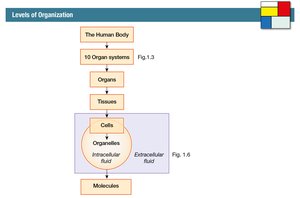
Levels of Organization in the Human Body
Hierarchy of Biological Organization
The human body is organized into a hierarchy of structural levels, each with specific roles and emergent properties:
Molecules: Chemical building blocks of cells.
Cells: Basic unit of life, containing organelles and surrounded by a membrane.
Tissues: Groups of similar cells performing a common function.
Organs: Structures composed of multiple tissue types working together.
Organ systems: Groups of organs that perform related functions.
Organism: The complete living being.
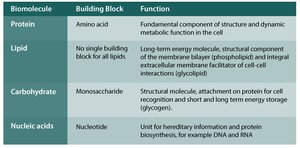
Biomolecules and Their Functions
Biomolecules are essential components of cells, each with distinct building blocks and functions:
Biomolecule | Building Block | Function |
|---|---|---|
Protein | Amino acid | Structural and metabolic functions in the cell |
Lipid | No single building block for all lipids | Energy storage, membrane structure, and cell signaling |
Carbohydrate | Monosaccharide | Energy storage, cell recognition, and structural roles |
Nucleic acids | Nucleotide | Genetic information storage and protein synthesis |
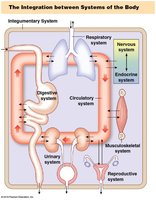
Organ Systems of the Human Body
Overview and Functions
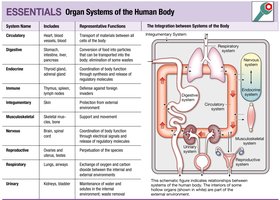
The human body consists of multiple organ systems, each with specialized functions that contribute to overall homeostasis and survival:
System Name | Includes | Representative Functions |
|---|---|---|
Circulatory | Heart, blood vessels, blood | Transport of materials between cells |
Digestive | Stomach, intestine, liver, pancreas | Conversion of food into particles for absorption; elimination of waste |
Endocrine | Thyroid gland, adrenal gland | Coordination of body function via hormones |
Immune | Thymus, spleen, lymph nodes | Defense against foreign invaders |
Integumentary | Skin | Protection from external environment |
Musculoskeletal | Muscles, bones | Support and movement |
Nervous | Brain, spinal cord | Coordination of body function through electrical signals |
Reproductive | Ovaries, uterus, testes | Perpetuation of the species |
Respiratory | Lungs, airways | Exchange of oxygen and carbon dioxide |
Urinary | Kidneys, bladder | Maintenance of water and solutes in the internal environment |
Structure and Function
Relationship Between Anatomy and Physiology
Structure and function are closely linked at all levels of biological organization. For example, the three-dimensional shape of a protein determines its function, and the arrangement of tissues in an organ dictates its role in the body. Chemical interactions, such as those between hydrophilic and hydrophobic molecules, are fundamental to physiological processes.
Homeostasis and Homeodynamics
Definition and Importance
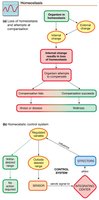
Homeostasis refers to the maintenance of relatively constant internal conditions despite external changes. This dynamic steady state is essential for life and involves the regulation of variables such as blood gases, solutes, pressure, volume, osmolarity, and temperature.
Homeodynamics: Emphasizes the dynamic, adaptive nature of physiological regulation.
Pathophysiology: The study of disease states resulting from homeostatic failure, which may be caused by genetic factors, toxins, trauma, pathogens, or cellular dysfunction.
Internal and External Fluid Compartments
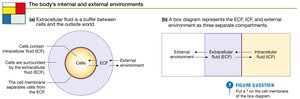
The body is divided into compartments separated by membranes:
Intracellular fluid (ICF): Fluid within cells (cytosol).
Extracellular fluid (ECF): Fluid outside cells, including plasma and interstitial fluid.
Homeostasis vs. Equilibrium
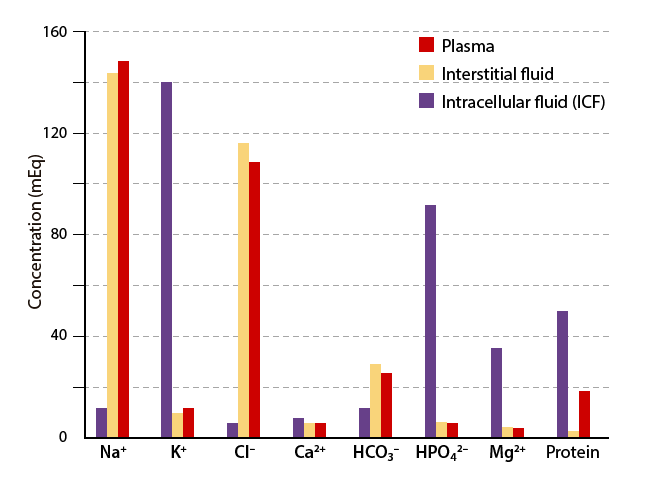
Homeostasis maintains a steady state with constant internal conditions, but not necessarily equal concentrations between compartments (disequilibrium). In contrast, equilibrium implies equal concentrations across compartments.
Example: Ion concentrations differ between plasma, interstitial fluid, and intracellular fluid, reflecting homeostasis rather than equilibrium.
Control Systems and Mechanisms in Homeostasis
Components of a Control System
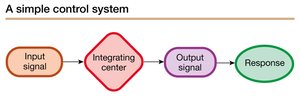
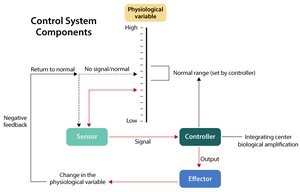
Physiological control systems regulate homeostasis through the following components:
Stimulus & Sensor: Detects changes in a regulated variable.
Integrating Center/Controller: Processes information and determines response.
Output Signal: Communicates instructions to effectors.
Effector/Target Cell: Produces the physiological response.
Local vs. Reflex (Long-Distance) Control
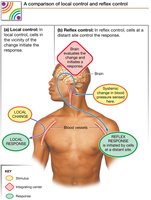
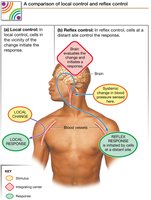
Control mechanisms can be local (acting near the site of change) or reflex (involving distant sites such as the nervous or endocrine systems):
Local control: Paracrine and autocrine signaling, e.g., nitric oxide release by endothelium.
Reflex control: Involves integration in the nervous or endocrine system, allowing coordination across the body.
Feedback Mechanisms
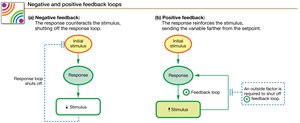
Feedback loops are essential for maintaining homeostasis:
Negative feedback: The response counteracts the stimulus, promoting stability and homeostasis.
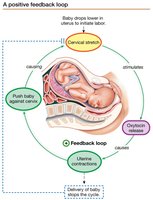
Positive feedback: The response reinforces the stimulus, driving the system to completion (e.g., childbirth).
Feedforward Control
Feedforward control anticipates changes in a regulated variable and initiates responses before the variable changes, such as salivation and gastric activation when thinking about food. This mechanism can help maintain homeostasis by preparing the body for expected changes.
Summary: Homeostasis in the Big Picture
Homeostasis involves short-term variations with long-term stability. For example, blood glucose levels fluctuate after meals or fasting but are maintained within a homeostatic range (60–120 mg/dL) through the coordinated actions of multiple organ systems.