 뒤로
뒤로Major Systemic Arteries, Veins, and Blood Pressure: Anatomy & Physiology Study Notes
스터디 가이드 - 스마트 노트
 자료에 맞춘 맞춤형 노트, 핵심 정의, 예시, 맥락을 확장해 제공합니다.
Major Systemic Arteries, Veins, and Blood Pressure
Overview of the Circulatory System
The circulatory system is responsible for the transport of blood, nutrients, gases, and wastes throughout the body. It consists of the heart, blood vessels (arteries, veins, and capillaries), and blood. This system is divided into systemic and pulmonary circuits, with the systemic circuit supplying blood to the body and the pulmonary circuit facilitating gas exchange in the lungs.
Systemic Arteries
Major Arteries of the Body
Arteries are blood vessels that carry blood away from the heart. The systemic arteries deliver oxygenated blood to tissues throughout the body. The largest artery is the aorta, which branches into major arteries serving different regions.
Aorta: The main artery leaving the heart, divided into ascending aorta, aortic arch, and descending aorta (thoracic and abdominal).
Brachiocephalic artery (trunk): First major branch of the aortic arch, supplying the right arm and head.
Subclavian arteries: Supply the arms.
Common carotid arteries: Supply the head and neck.
External and internal carotid arteries: External supplies face/scalp; internal supplies brain.
Vertebral arteries: Supply the posterior brain.
Axillary, brachial, radial, and ulnar arteries: Supply the upper limbs.
Common iliac, femoral, popliteal, tibial, and dorsalis pedis arteries: Supply the lower limbs.
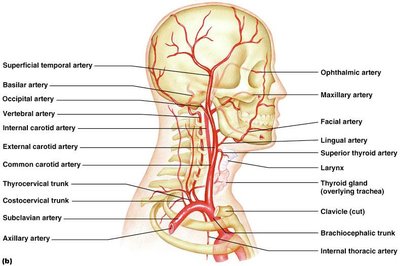
Arteries of the Head and Neck
The head and neck receive blood from branches of the common carotid and subclavian arteries. The internal carotid and vertebral arteries are especially important for cerebral circulation.
External carotid artery: Supplies face, scalp, and neck.
Internal carotid artery: Supplies the brain.
Vertebral artery: Joins to form the basilar artery, contributing to the Circle of Willis.
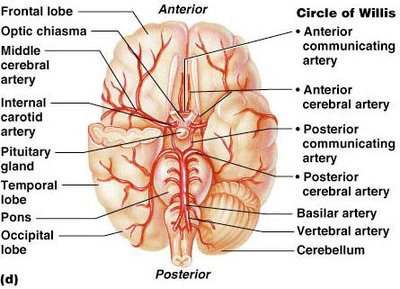
Circle of Willis
The Circle of Willis is a circular arterial anastomosis at the base of the brain. It provides multiple pathways for blood to supply the brain, equalizes pressure, and allows for collateral circulation if a major artery is blocked.
Components: Anterior cerebral arteries, anterior communicating artery, internal carotid arteries, posterior cerebral arteries, posterior communicating arteries, basilar artery (from vertebral arteries).
Function: Ensures consistent blood supply to the brain.
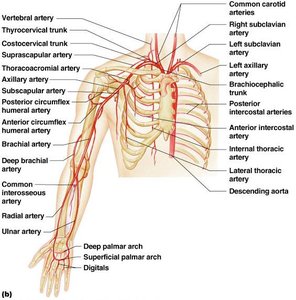
Arteries of the Upper Extremities
The upper limbs are supplied by branches of the subclavian artery, which becomes the axillary, brachial, radial, and ulnar arteries as it travels down the arm.
Axillary artery: Supplies the shoulder and upper arm.
Brachial artery: Main artery of the upper arm.
Radial and ulnar arteries: Supply the forearm and hand.
Arteries of the Abdomen
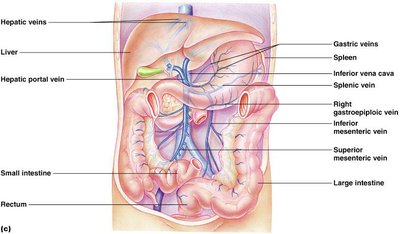
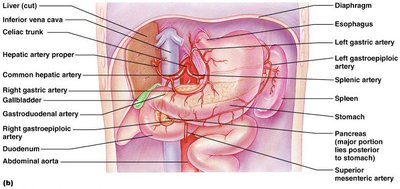
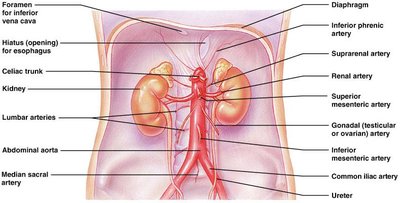
The abdominal aorta gives rise to several major branches that supply the abdominal organs and lower limbs.
Celiac trunk: Branches into the splenic, common hepatic, and left gastric arteries.
Superior mesenteric artery: Supplies the small intestine and part of the colon.
Renal arteries: Supply the kidneys.
Gonadal arteries: Supply the gonads.
Inferior mesenteric artery: Supplies the distal colon and rectum.
Arteries of the Lower Extremities
The lower limbs are supplied by the common iliac arteries, which branch into internal and external iliac arteries, then into femoral, popliteal, tibial, and dorsalis pedis arteries.
Femoral artery: Main artery of the thigh.
Popliteal artery: Behind the knee.
Anterior and posterior tibial arteries: Supply the lower leg and foot.
Dorsalis pedis artery: Supplies the top of the foot.
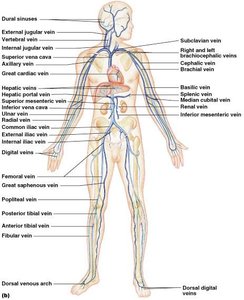
Systemic Veins
Major Veins of the Body
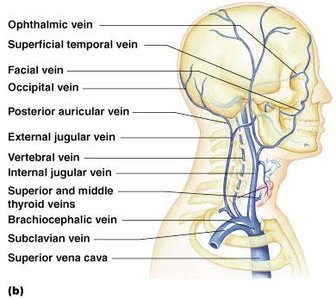
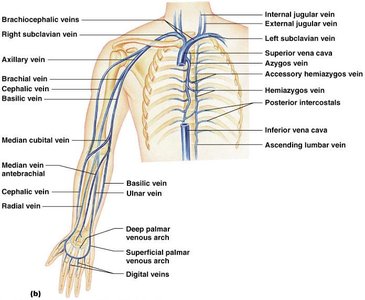
Veins return deoxygenated blood to the heart. The two largest veins are the superior and inferior vena cava, which drain the upper and lower body, respectively.
Jugular veins: Drain the head and neck.
Subclavian, axillary, brachial, radial, and ulnar veins: Drain the upper limbs.
Common iliac, femoral, great saphenous, popliteal, tibial, and dorsalis pedis veins: Drain the lower limbs.
Hepatic Portal System
The hepatic portal system is a specialized venous system that drains nutrient-rich blood from the digestive organs to the liver for processing before it enters the systemic circulation.
Hepatic portal vein: Formed by the union of the superior mesenteric and splenic veins.
Function: Allows the liver to detoxify substances and regulate nutrient levels.
Blood Pressure
Measuring Blood Pressure
Blood pressure is the force exerted by circulating blood on the walls of blood vessels, typically measured in the brachial artery. It is recorded as two numbers: systolic (during heart contraction) and diastolic (during heart relaxation).
Normal blood pressure: Less than 120/80 mmHg.
Prehypertensive: 120/80 – 139/89 mmHg.
Hypertension stages: Stage 1 (140/90 – 159/99), Stage 2 (160/100 – 179/109), Stage 3 (180/110 – 209/119), Stage 4 (210/120 and higher).
Pulse: The rhythmic expansion and recoil of arteries with each heartbeat, palpable at various pulse points (e.g., radial, carotid, femoral arteries).
Blood Pressure Categories Table
Category | Systolic (mmHg) | Diastolic (mmHg) |
|---|---|---|
Optimal | < 120 | < 80 |
Prehypertensive | 120–139 | 80–89 |
Stage 1 Hypertension | 140–159 | 90–99 |
Stage 2 Hypertension | 160–179 | 100–109 |
Stage 3 Hypertension | 180–209 | 110–119 |
Stage 4 Hypertension | ≥ 210 | ≥ 120 |
Key Terms and Concepts
Artery: Vessel carrying blood away from the heart.
Vein: Vessel carrying blood toward the heart.
Anastomosis: Connection between blood vessels providing alternate routes for blood flow.
Pulse point: Location where an artery is close to the surface and pulse can be felt.
Sphygmomanometer: Device used to measure blood pressure.
Summary Table: Major Systemic Arteries and Veins
Region | Major Arteries | Major Veins |
|---|---|---|
Head & Neck | Common carotid, Internal/External carotid, Vertebral | Jugular (internal/external), Vertebral |
Upper Limb | Subclavian, Axillary, Brachial, Radial, Ulnar | Subclavian, Axillary, Brachial, Cephalic, Basilic |
Abdomen | Abdominal aorta, Celiac trunk, Mesenteric, Renal | Inferior vena cava, Renal, Hepatic, Portal |
Lower Limb | Common iliac, Femoral, Popliteal, Tibial, Dorsalis pedis | Common iliac, Femoral, Great saphenous, Popliteal, Tibial |
Additional info: These notes are based on standard anatomical and physiological knowledge, with expanded explanations and context for clarity and completeness.
