 뒤로
뒤로Membrane Transport & Resting Potential: Study Notes for Anatomy & Physiology
스터디 가이드 - 스마트 노트
 자료에 맞춘 맞춤형 노트, 핵심 정의, 예시, 맥락을 확장해 제공합니다.
Membrane Transport
Overview of Membrane Transport
Membrane transport refers to the mechanisms by which substances move across the plasma membrane, maintaining differences in concentration and electrical charge between the inside and outside of the cell. The membrane's permeability determines which substances can cross, with hydrophobic (lipid-soluble) substances crossing more easily than hydrophilic (water-soluble) substances.
Permeability: The ability of the membrane to allow substances to pass through.
Passive vs. Active Transport: Passive transport moves substances down their concentration gradient without energy input, while active transport moves substances against their gradient and requires energy.
Diffusion: Net movement from high concentration to low concentration due to random molecular motion; no ATP required.
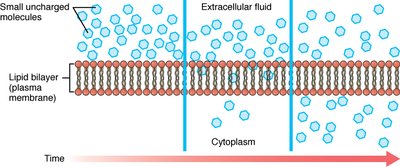
Factors Affecting Diffusion Through Membrane
Several factors influence the rate and effectiveness of diffusion across the membrane:
Concentration Difference: Larger gradients increase net diffusion.
Surface Area: Greater membrane area allows more opportunity for crossing.
Hydrophobicity: Lipid-soluble substances cross more readily.
Molecular Size: Smaller molecules diffuse more easily.
Membrane Thickness: Thicker membranes slow diffusion.
Osmosis and Water Movement
Salt and Water: Semipermeable Membranes
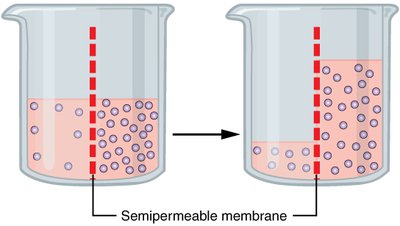
When a solute cannot cross the membrane but water can, water movement becomes the primary means of equalizing concentrations. A semipermeable membrane allows water to cross more readily than the solute.
Osmosis: Water moves toward the side with more nonpenetrating solute.
Semipermeable Membrane: Allows selective movement of water, not solute.
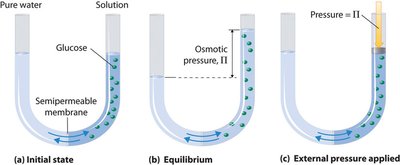
Osmotic Pressure and Tonicity
Osmotic pressure is the force required to prevent water movement across a membrane. Tonicity describes the relative concentration of solutes in solutions separated by a membrane.
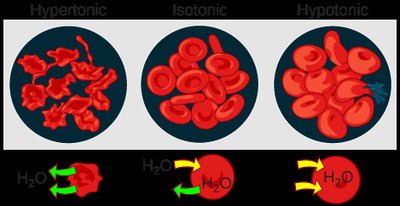
Hypertonic: Higher osmotic pressure; water moves out of the cell.
Hypotonic: Lower osmotic pressure; water moves into the cell.
Isotonic: Equal osmotic pressure; no net water movement.
Net Water Movement: Occurs from hypotonic to hypertonic solution.
Assisted Membrane Transport
Carrier-Mediated Transport
Membrane proteins assist solutes and ions in crossing the membrane when the lipid bilayer is not a suitable pathway. This includes facilitated diffusion and active transport.
Facilitated Diffusion: Downhill movement through a protein; no ATP required.
Active Transport: Uphill movement through a protein; requires energy (usually ATP).
Carrier-Mediated Transport: Transporters are stereospecific, competitive, and saturable.
Facilitated Diffusion: Ion Channels and Carrier Proteins
Facilitated diffusion occurs via ion channels or carrier proteins:
Ion Channel: Forms a hydrophilic path for ions or polar substances to move down their gradient.
Carrier Protein: Binds solute on the high-concentration side, changes shape, and releases solute on the low-concentration side.
Primary Active Transport
Mechanism of Primary Active Transport
Primary active transport uses ATP to move substances against their concentration gradient. The transporter undergoes a conformational change powered by ATP hydrolysis.
Binding: Carrier binds solute on the low-concentration side.
ATP-Driven Change: ATP provides energy for the carrier to release solute on the high-concentration side.
Gradient Maintenance: Maintains rather than dissipates concentration gradients.
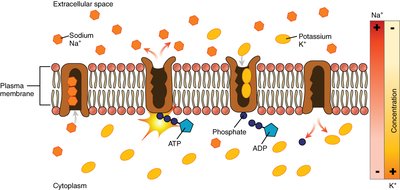
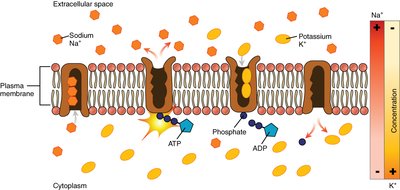
Na+/K+ Pump (Na+/K+ ATPase)
The Na+/K+ ATPase is a primary active transporter that moves sodium out of the cell and potassium into the cell, both against their concentration gradients.
ECF (Extracellular Fluid): High Na+, Low K+
ICF (Intracellular Fluid): Low Na+, High K+
Creates Na+ and K+ Gradients: Essential for cell function and electrical activity.
Secondary Active Transport
Mechanism of Secondary Active Transport
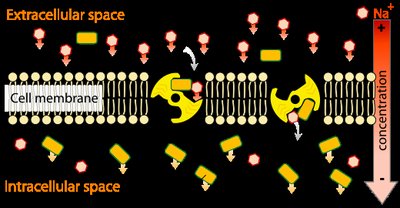
Secondary active transport uses the energy stored in the Na+ gradient (created by the Na+/K+ ATPase) to power the uphill movement of another substance.
Na+ Gradient: High outside, low inside.
Downhill Na+ Entry: Indirectly powers uphill movement of another substance.
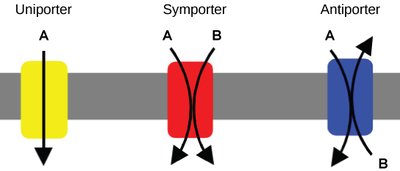
Symport (Cotransport): Both substances move in the same direction.
Antiport (Countertransport): Substances move in opposite directions.
Transport and Electrical Conditions
Membrane Potential and Ion Channels
The plasma membrane uses proteins to control the composition inside versus outside the cell. The Na+/K+ ATPase creates Na+ and K+ gradients, and ion channels allow these gradients to influence electrical charge.
Leak Channels: Always open enough to allow a small amount of ion movement.
Na+ Leak: Na+ leaks in, making the cell more positive.
K+ Leak: K+ leaks out, making the cell more negative.
Resting Potential: At rest, K+ leaking out is much greater than Na+ leaking in, resulting in a negative charge inside the cell.
Definition: Resting membrane potential is the electrical potential difference across the plasma membrane when the cell is at rest.
Summary Table: Types of Membrane Transport
Type | Energy Requirement | Direction | Example |
|---|---|---|---|
Simple Diffusion | No | High to Low | O2, CO2 |
Facilitated Diffusion | No | High to Low | Glucose via GLUT transporter |
Primary Active Transport | Yes (ATP) | Low to High | Na+/K+ ATPase |
Secondary Active Transport | Indirect (Na+ gradient) | Low to High (for one substance) | Na+/glucose symport |
Equation for Osmotic Pressure:
\Pi: Osmotic pressure
i: van 't Hoff factor (number of particles)
M: Molarity
R: Gas constant
T: Temperature (Kelvin)
Example: The Na+/K+ ATPase is essential for maintaining the resting membrane potential and for secondary active transport processes such as glucose absorption in the intestine.
Additional info: Academic context was added to clarify mechanisms, definitions, and examples for completeness.
