뒤로
뒤로Molecular Interactions: Biomolecules and Chemical Bonds in Human Physiology
스터디 가이드 - 스마트 노트
 자료에 맞춘 맞춤형 노트, 핵심 정의, 예시, 맥락을 확장해 제공합니다.
Biomolecules: Structure and Function
Overview of Biomolecules
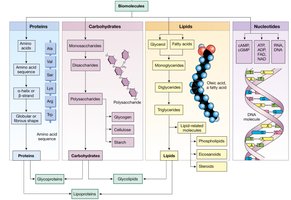
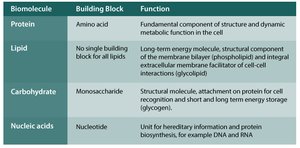
Biomolecules are organic molecules essential for life, forming the structural and functional basis of cells. There are four major classes: proteins, lipids, carbohydrates, and nucleic acids. Each class has unique building blocks and functions in the human body.
Biomolecule | Building Block | Function |
|---|---|---|
Protein | Amino acid | Structural and metabolic roles, including enzymes and cell signaling |
Lipid | No single building block for all lipids | Energy storage, membrane structure, signaling |
Carbohydrate | Monosaccharide | Energy storage, cell recognition, structural support |
Nucleic acids | Nucleotide | Genetic information storage and transfer |
Lipids
True Lipids: Triglycerides
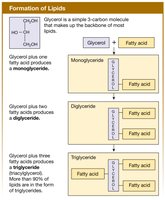
Lipids are hydrophobic molecules primarily involved in energy storage and membrane structure. Triglycerides are the most common true lipids, formed by the combination of three fatty acids and one glycerol molecule.
Monoglyceride: Glycerol + 1 fatty acid
Diglyceride: Glycerol + 2 fatty acids
Triglyceride: Glycerol + 3 fatty acids (main storage form in adipose tissue)
Fatty Acids: Saturated vs. Unsaturated
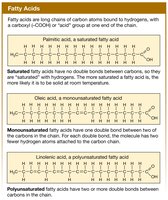
Fatty acids are long hydrocarbon chains with a carboxyl group. They can be classified based on the presence of double bonds:
Saturated fatty acids: No double bonds; solid at room temperature (e.g., palmitic acid)
Monounsaturated fatty acids: One double bond (e.g., oleic acid)
Polyunsaturated fatty acids: Two or more double bonds (e.g., linoleic acid)
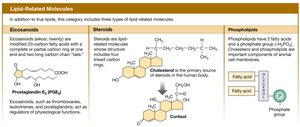
Lipid-Related Molecules
Some molecules are derived from or related to lipids and play important roles in physiology:
Eicosanoids: Derived from fatty acids; act as signaling molecules (e.g., prostaglandins)
Steroids: Four-ring structure; includes cholesterol, cortisol, and sex hormones
Phospholipids: Glycerol backbone, two fatty acids, and a phosphate group; major component of cell membranes
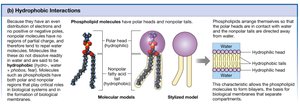
Hydrophobic and Amphipathic Properties
Lipids are generally hydrophobic, meaning they do not dissolve in water. Phospholipids are amphipathic, containing both hydrophilic (phosphate head) and hydrophobic (fatty acid tails) regions, allowing them to form biological membranes.
Carbohydrates
Monosaccharides
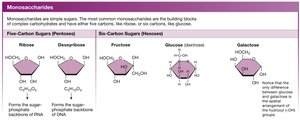
Carbohydrates are composed of carbon, hydrogen, and oxygen. The simplest carbohydrates are monosaccharides (single sugar units), which can have five (pentose) or six (hexose) carbon atoms.
Pentoses: Ribose, deoxyribose (important in nucleic acids)
Hexoses: Glucose, fructose, galactose (energy sources)
Disaccharides and Polysaccharides
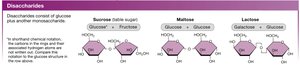
Disaccharides are formed by joining two monosaccharides (e.g., sucrose = glucose + fructose). Polysaccharides are long chains of monosaccharides, such as glycogen (energy storage in animals).
Oligosaccharides: 3–10 monosaccharide units
Polysaccharides: More than 10 units; glycogen can have up to 50,000 units
Proteins
Amino Acids and Peptide Bonds
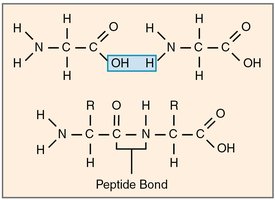
Proteins are polymers of amino acids (20 types, differing by their R-group). Amino acids are linked by peptide bonds to form polypeptides and proteins.
Dipeptide: 2 amino acids
Tripeptide: 3 amino acids
Oligopeptide: 3–10 amino acids
Polypeptide: 10–100 amino acids
Protein: More than 100 amino acids
Levels of Protein Structure
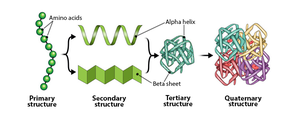
Proteins have four levels of structure, each contributing to their function:
Primary: Sequence of amino acids
Secondary: Alpha helices and beta sheets formed by hydrogen bonding
Tertiary: Three-dimensional folding driven by interactions among R-groups
Quaternary: Association of multiple polypeptide chains (e.g., hemoglobin)
Nucleotides and Nucleic Acids
Nucleotide Structure
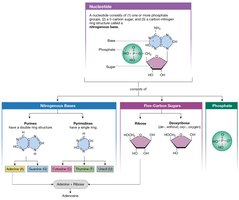
Nucleotides are the building blocks of nucleic acids. Each nucleotide consists of a phosphate group, a five-carbon sugar (ribose or deoxyribose), and a nitrogenous base (adenine, guanine, cytosine, thymine, or uracil).
Functions of Nucleotides
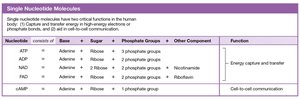
Nucleotides serve as energy carriers (e.g., ATP), signaling molecules (e.g., cAMP), and building blocks for nucleic acids (DNA and RNA).
Nucleotide | Base | Sugar | Phosphate Groups | Other Component | Function |
|---|---|---|---|---|---|
ATP | Adenine | Ribose | 3 | — | Energy capture and transfer |
ADP | Adenine | Ribose | 2 | — | Energy capture and transfer |
NAD | Adenine | Ribose | 2 | Nicotinamide | Energy capture and transfer |
FAD | Adenine | Ribose | 2 | Riboflavin | Energy capture and transfer |
cAMP | Adenine | Ribose | 1 | — | Cell-to-cell communication |
Nucleic Acids: DNA and RNA
DNA (deoxyribonucleic acid) stores genetic information, while RNA (ribonucleic acid) is involved in protein synthesis and gene regulation. DNA is double-stranded; RNA is usually single-stranded.
Atoms to Molecules: Chemical Bonds
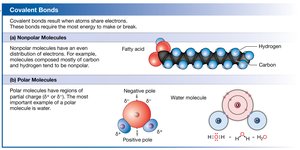
Covalent Bonds
Covalent bonds involve the sharing of electrons between atoms. They can be:
Nonpolar: Electrons shared equally (e.g., fatty acids, CO2)
Polar: Electrons shared unequally, creating partial charges (e.g., water)
Noncovalent Bonds
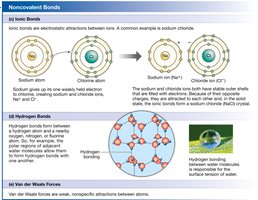
Noncovalent bonds are weaker than covalent bonds and include:
Ionic bonds: Transfer of electrons, forming charged ions (e.g., Na+ + Cl- → NaCl)
Hydrogen bonds: Attraction between a slightly positive hydrogen and a slightly negative atom
Van der Waals forces: Weak electrical attractions, often within molecules
Molecular Shape and Function
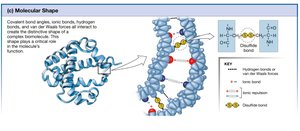
The shape of a molecule is determined by the types of bonds and interactions present, which in turn affects its biological function. Attractions and repulsions within molecules contribute to their three-dimensional structure.
Biological Solutions and pH
Aqueous Solutions and Solubility
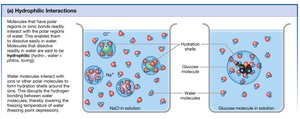
Biological reactions occur in aqueous solutions, where water is the solvent. Solubility depends on the molecule's polarity:
Hydrophilic: Water-loving; dissolve easily in water (e.g., ions, glucose)
Hydrophobic: Water-fearing; do not dissolve in water (e.g., lipids)
Amphipathic: Molecules with both hydrophilic and hydrophobic regions (e.g., phospholipids)
pH and Buffer Systems
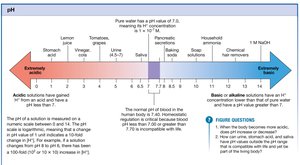
pH is a measure of hydrogen ion concentration, defined as . The scale ranges from 0 (acidic) to 14 (basic), with 7 being neutral. Blood pH is tightly regulated between 7.35 and 7.45.
Acids: Release H+ ions (e.g., HCl → H+ + Cl-)
Bases: Release OH- ions (e.g., NaOH → Na+ + OH-)
Buffers: Moderate pH changes (e.g., H2CO3 ↔ H+ + HCO3-)
Protein Function and Regulation
Protein Functions
Proteins perform a wide variety of functions in the cell, including:
Enzymes: Catalyze biochemical reactions
Membrane transport: Channels and transporters
Signal molecules: Hormones and other signaling proteins
Receptors: Bind signal molecules
Binding proteins: Transport non-soluble molecules in blood
Immunoglobulins: Antibodies
Motor proteins: Intracellular transport
Structural proteins: Cytoskeleton, cell structure
Regulatory proteins: Regulate cell functions
Protein Binding and Specificity
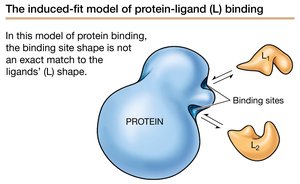
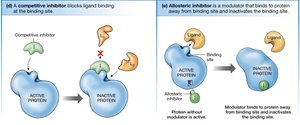
Proteins bind ligands (substrates) at specific binding sites. The interaction is determined by molecular complementarity (shape and charge), and binding is reversible. Affinity describes the strength of binding, and competition can occur between different ligands for the same site.
Protein Regulation: Isoforms, Activation, and Inhibition
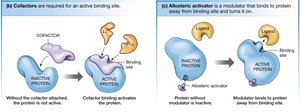
Proteins can exist in different isoforms (e.g., fetal vs. adult hemoglobin) and may require cofactors or coenzymes for activation. Regulation can occur via:
Allosteric modulators: Bind away from the active site to activate or inhibit the protein
Competitive inhibitors: Compete with the ligand for the binding site
Regulation by Concentration and Physical Factors
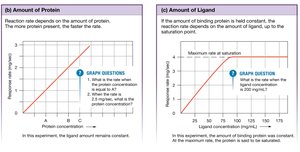
Protein activity is influenced by protein and ligand concentration (saturation), as well as physical factors such as temperature and pH. Extreme conditions can denature proteins, causing loss of function.
Summary Figure: Biomolecules Overview
The following figure summarizes the relationships among the four major classes of biomolecules, their building blocks, and their functions in the human body.