 뒤로
뒤로Muscle Tissue: Structure, Function, and Terminology
스터디 가이드 - 스마트 노트
 자료에 맞춘 맞춤형 노트, 핵심 정의, 예시, 맥락을 확장해 제공합니다.
Muscle Tissue Overview
Muscle Terminology and Etymology
The terminology used in anatomy for muscles is rooted in Latin and Greek, reflecting both the structure and function of muscle tissue.
Musculus: Derived from Latin, meaning "little mouse," referencing the appearance of muscles under the skin.
Fasci- and Fascicul-: Fascia refers to a band or fibrous membrane covering muscles, while fasciculus means a small bundle, especially of nerve or muscle fibers.
Burs-: From Latin bursa, meaning a leather sac; in anatomy, it refers to a synovial fluid-filled sac reducing friction near joints.
Types of Muscle Tissue
Classification of Muscle Tissue
Muscle tissue is classified into three main types based on structure, location, and function:
Skeletal Muscle: Voluntary, striated muscle responsible for body movement and posture.
Cardiac Muscle: Involuntary, striated muscle found only in the heart, responsible for pumping blood.
Smooth Muscle: Involuntary, non-striated muscle found in the walls of hollow organs, responsible for moving substances through internal body channels.
Skeletal Muscle Structure and Function
Characteristics of Skeletal Muscle
Skeletal muscle fibers are the longest muscle cells, characterized by their striated appearance and voluntary control.
Contain muscle fibers, nerves, blood vessels, and connective tissue.
Each muscle is served by at least one nerve, artery, and vein, which branch extensively within the muscle.
Rich blood supply ensures constant delivery of nutrients and oxygen.
Each muscle fiber is innervated by a nerve ending that controls its activity.
Connective Tissue Sheaths
Muscles are organized and protected by connective tissue sheaths:
Epimysium: Dense irregular connective tissue surrounding the entire muscle.
Perimysium: Surrounds bundles of muscle fibers (fascicles).
Endomysium: Fine areolar connective tissue surrounding individual muscle fibers.
These sheaths are continuous with tendons, which attach muscles to bones.
Muscle Attachments
Direct (fleshy) attachment: Epimysium fuses with the periosteum of bone or perichondrium of cartilage.
Indirect attachment: Connective tissue extends beyond the muscle as a tendon or aponeurosis.
Microscopic Structure of Muscle Fibers
Muscle fibers are long, cylindrical cells with multiple nuclei located beneath the sarcolemma (plasma membrane).
The sarcoplasm (cytoplasm) contains large amounts of glycogen and myoglobin for energy storage and oxygen binding.
Cardiac Muscle
Structure and Function
Cardiac muscle is found only in the heart and is responsible for pumping blood throughout the body.
Striated and involuntary.
Cells are branched and interconnected, allowing coordinated contractions.
Smooth Muscle
Structure and Function
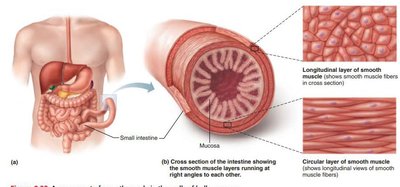
Smooth muscle is found in the walls of hollow organs such as the stomach, urinary bladder, and respiratory passages.
Elongated, non-striated, and involuntary cells.
Arranged in two layers: longitudinal (parallel to organ axis) and circular (around organ circumference).
Responsible for moving substances through internal body channels, forming valves, and regulating passage of substances.
Functional Characteristics of Muscle Tissue
Properties of Muscle Tissue
Excitability (Responsiveness): Ability to receive and respond to stimuli by changing membrane potential.
Contractility: Ability to shorten forcibly when stimulated.
Extensibility: Ability to be stretched or extended.
Elasticity: Ability to recoil and resume resting length after stretching.
Functions of Muscle Tissue
Produce movement: Skeletal muscles enable locomotion and manipulation; cardiac muscle pumps blood; smooth muscle moves substances through organs.
Maintain posture and body position
Stabilize joints: Muscles pull on bones to strengthen and stabilize joints.
Generate heat: Muscle contractions produce heat, helping maintain body temperature.
Muscle Actions and Groupings
Muscle Movement and Coordination
Muscles can only pull, not push.
Contraction moves the insertion toward the origin.
Muscles are classified functionally as:
Prime movers (agonists): Produce specific movements.
Antagonists: Oppose or reverse a movement.
Synergists: Assist prime movers by adding force or reducing unnecessary movement.
Muscle Naming Conventions
Criteria for Naming Muscles
Location: Named for the bone or region (e.g., temporalis).
Shape: Named for shape (e.g., deltoid).
Size: Terms like maximus (largest), minimus (smallest), longus (long).
Direction of fibers: Rectus (straight), oblique (diagonal), transversus (across).
Number of origins: Biceps (two heads), triceps (three heads), quadriceps (four heads).
Location of attachments: Named for points of origin/insertion (e.g., sternocleidomastoid).
Action: Named for the movement produced (e.g., adductor longus).
Fascicle Arrangements and Muscle Shapes
Types of Fascicle Arrangements
Circular: Fascicles arranged in concentric rings, forming sphincters that close body openings.
Convergent: Broad origin with fascicles converging toward a single tendon (triangular/fan-shaped).
Parallel: Fascicles run parallel to the long axis of the muscle; can be strap-like or spindle-shaped (fusiform).
Pennate: Fascicles attach obliquely to a central tendon; can be unipennate, bipennate, or multipennate.
The arrangement of fascicles determines a muscle's range of motion and power.
Latin Muscle Terminology and Examples
Common Latin Roots and Their Meanings
Muscle names often reflect their function, location, or structure. The following table summarizes common Latin forms, their combining forms, meanings, and examples:
LATIN FORM | COMBINING FORM | MEANING | EXAMPLE |
|---|---|---|---|
constringere | CONSTRICT- | to draw, bind together | constrictor |
corrugare | CORRUGAT- | to corrugate, wrinkle | corrugator |
extendere extensum | EXTENS- | to extend, expand | extensor |
levare levatum | LEVAT- | to raise, lift up | levator |
arrectre | ARRECT- | to raise, lift up | arrector |
rotare | ROTAT- | to cause to turn around | rotator |
accelerare, acceleratum | ACCELERAT- | to accelerate | accelerator |
attrahere | ATTRAH- | to draw, attract | attrahens |
attollere | ATTOLL- | to raise, lift up | attollens |
bucca | BUCC- | cheek | buccinator |
opponere | OPPON- | to put opposite, before | opponens |
tendere tensum | TENS- | to stretch out, extend, spread | tensor |
Additional info: This table helps in understanding the logic behind muscle names, which often describe their action or location.
