 뒤로
뒤로Overview of the Four Primary Tissue Types in the Human Body
스터디 가이드 - 스마트 노트
 자료에 맞춘 맞춤형 노트, 핵심 정의, 예시, 맥락을 확장해 제공합니다.
Tissue Types in Anatomy & Physiology
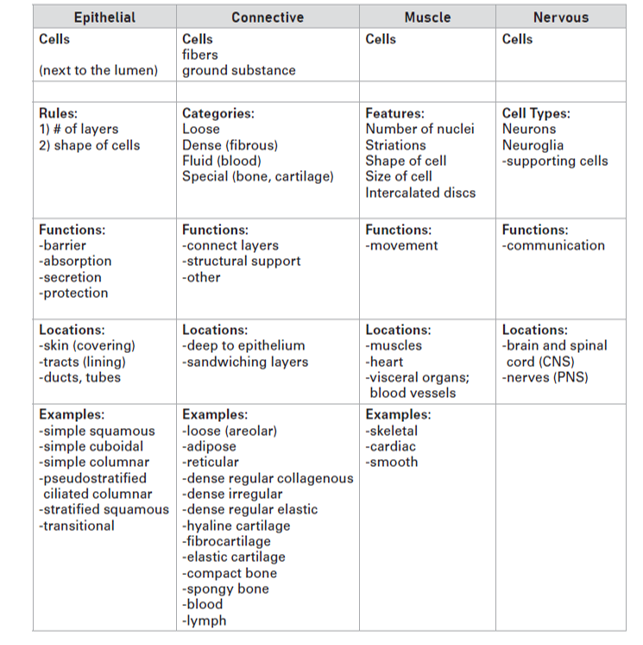
The human body is composed of four primary tissue types: epithelial, connective, muscle, and nervous tissues. Each tissue type has distinct structural features, functions, and locations within the body. Understanding these tissues is fundamental to studying human anatomy and physiology.
Epithelial Tissue
Epithelial tissue forms the coverings and linings of the body, including skin and internal tracts. It is characterized by the arrangement and shape of its cells.
Rules:
Number of layers (simple vs. stratified)
Shape of cells (squamous, cuboidal, columnar, transitional)
Functions:
Barrier
Absorption
Secretion
Protection
Locations:
Skin (covering)
Tracts (lining)
Ducts, tubes
Examples:
Simple squamous
Simple cuboidal
Simple columnar
Pseudostratified ciliated columnar
Stratified squamous
Transitional
Connective Tissue
Connective tissue supports, connects, and separates different parts of the body. It is defined by the presence of cells, fibers, and ground substance.
Categories:
Loose (areolar, adipose, reticular)
Dense (regular collagenous, irregular, regular elastic)
Fluid (blood, lymph)
Special (bone, cartilage)
Functions:
Connect layers
Structural support
Other specialized functions
Locations:
Deep to epithelium
Sandwiching layers
Examples:
Loose (areolar, adipose, reticular)
Dense regular collagenous
Dense irregular
Dense regular elastic
Hyaline cartilage
Fibrocartilage
Elastic cartilage
Compact bone
Spongy bone
Blood
Lymph
Muscle Tissue
Muscle tissue is specialized for contraction and movement. It is classified based on cell features such as nuclei, striations, and intercalated discs.
Features:
Number of nuclei
Striations
Shape and size of cell
Intercalated discs (in cardiac muscle)
Functions:
Movement
Locations:
Muscles
Heart
Visceral organs
Blood vessels
Examples:
Skeletal muscle
Cardiac muscle
Smooth muscle
Nervous Tissue
Nervous tissue is responsible for communication and control throughout the body. It consists of neurons and supporting cells called neuroglia.
Cell Types:
Neurons
Neuroglia (supporting cells)
Functions:
Communication
Locations:
Brain and spinal cord (central nervous system, CNS)
Nerves (peripheral nervous system, PNS)
Summary Table: Tissue Types
The following table summarizes the main features, functions, locations, and examples of each tissue type:
Tissue Type | Main Features | Functions | Locations | Examples |
|---|---|---|---|---|
Epithelial | Cell layers, cell shape | Barrier, absorption, secretion, protection | Skin, tracts, ducts | Simple squamous, stratified squamous, transitional |
Connective | Cells, fibers, ground substance | Connect layers, structural support | Deep to epithelium, between layers | Areolar, adipose, bone, blood |
Muscle | Number of nuclei, striations, cell shape | Movement | Muscles, heart, organs | Skeletal, cardiac, smooth |
Nervous | Neurons, neuroglia | Communication | Brain, spinal cord, nerves | Neurons, supporting cells |
Additional info: The table and notes provide a concise overview of tissue types, suitable for exam preparation and foundational understanding in Anatomy & Physiology.
