뒤로
뒤로Special Senses: Eye Reflexes, Vision Disorders, and The Ear
스터디 가이드 - 스마트 노트
 자료에 맞춘 맞춤형 노트, 핵심 정의, 예시, 맥락을 확장해 제공합니다.
Special Senses
Eye Reflexes
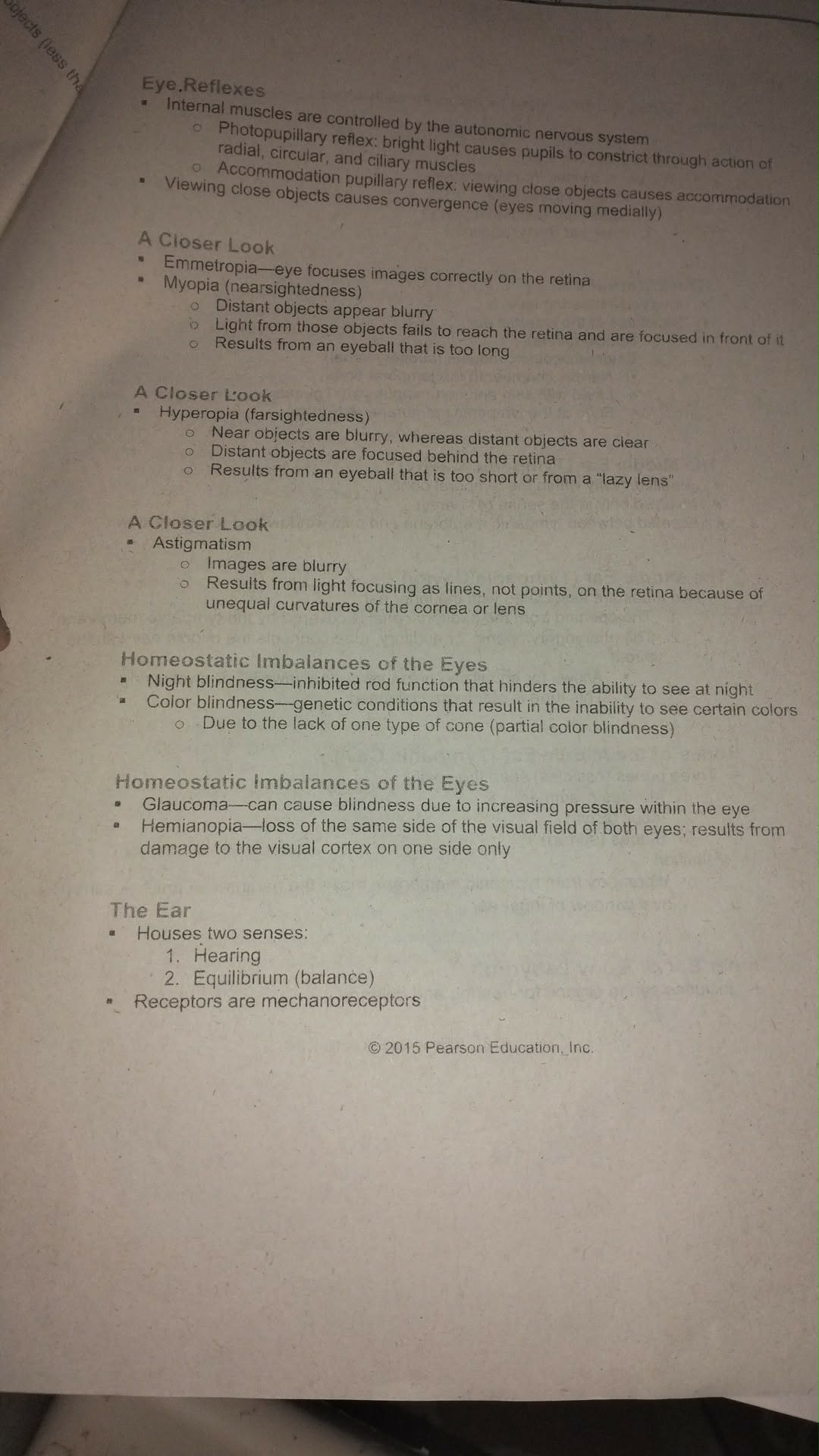
The eye possesses several reflexes that are essential for vision and protection. These reflexes are controlled by internal muscles regulated by the autonomic nervous system.
Photopupillary Reflex: Bright light causes the pupils to constrict via the action of radial, circular, and ciliary muscles. This reflex protects the retina from excessive light exposure.
Accommodation Pupillary Reflex: When viewing close objects, the pupils constrict to increase the depth of focus. This reflex also involves the convergence of the eyes (medial movement) to maintain single binocular vision.
Vision and Common Disorders
The eye's ability to focus images on the retina is crucial for clear vision. Several conditions can affect this process:
Emmetropia
Definition: The eye focuses images correctly on the retina, resulting in normal vision.
Myopia (Nearsightedness)
Definition: Distant objects appear blurry because light from those objects fails to reach the retina and is focused in front of it.
Cause: Results from an eyeball that is too long.
Example: Difficulty seeing distant road signs while driving.
Hyperopia (Farsightedness)
Definition: Near objects are blurry, whereas distant objects are clear.
Cause: Distant objects are focused behind the retina, often due to an eyeball that is too short or a "lazy lens" that does not properly accommodate.
Example: Trouble reading a book up close.
Astigmatism
Definition: Images are blurry due to light focusing as lines, not points, on the retina.
Cause: Unequal curvatures of the cornea or lens.
Example: Difficulty seeing both near and far objects clearly.
Homeostatic Imbalances of the Eyes
Several conditions can disrupt normal eye function and vision:
Night Blindness: Inhibited rod function hinders the ability to see at night. Rods are photoreceptor cells responsible for vision in low light.
Color Blindness: Genetic conditions result in the inability to see certain colors, often due to the lack of one type of cone (partial color blindness). Cones are photoreceptor cells responsible for color vision.
Glaucoma: Increased pressure within the eye can cause blindness by damaging the optic nerve.
Hemianopia: Loss of the same side of the visual field in both eyes, usually resulting from damage to the visual cortex on one side only.
The Ear: Structure and Function
The ear is responsible for two major senses: hearing and equilibrium (balance). Both functions rely on specialized receptors.
Hearing: The process by which sound waves are detected and interpreted by the brain.
Equilibrium (Balance): The sense that allows the body to maintain its position and posture.
Receptors: Mechanoreceptors are specialized cells that respond to mechanical stimuli such as sound waves and movement.