 뒤로
뒤로The Action Potential: Mechanisms and Dynamics in Excitable Cells
스터디 가이드 - 스마트 노트
 자료에 맞춘 맞춤형 노트, 핵심 정의, 예시, 맥락을 확장해 제공합니다.
The Action Potential
Introduction to Membrane Potential and Ion Gradients
Cells maintain homeostasis by regulating the movement of ions across their plasma membranes. The gradients of sodium (Na+) and potassium (K+) ions between the extracellular fluid (ECF) and intracellular fluid (ICF) are central to the cell’s electrical behavior. - Key Point 1: The ECF contains high Na+ and low K+, while the ICF contains low Na+ and high K+. - Key Point 2: These gradients are maintained by active transport mechanisms, such as the Na+/K+ ATPase pump. - Example: The potential energy stored in these gradients is used for signaling in excitable cells.
Ion Channels and Their Types
Ion channels are proteins embedded in the plasma membrane that allow ions to cross. Most channels are gated, opening and closing in response to specific stimuli.
Voltage-Gated Channels
Voltage-gated channels open or close depending on the electrical conditions across the membrane. They are crucial for generating action potentials. 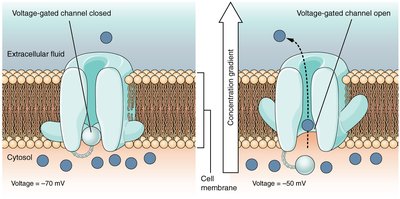
Ligand-Gated Channels
Ligand-gated channels open in response to the binding of a chemical signal (ligand), such as a neurotransmitter. These channels are common in the nervous system. 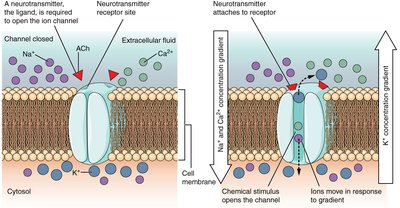
Mechanically-Gated Channels
Mechanically-gated channels open when the membrane is physically deformed, such as in touch receptors or inner ear cells. 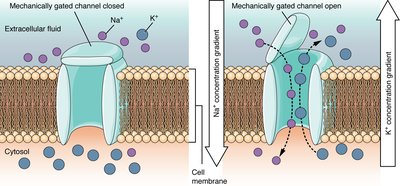
Leak Channels
Leak channels are not tightly gated and allow a baseline flow of ions, contributing to the resting membrane potential. 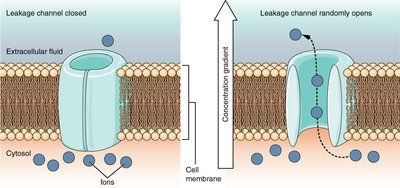
Resting Membrane Potential
The resting membrane potential is primarily determined by selective permeability, especially K+ leak channels. - Key Point 1: At rest, K+ leaks out of the cell much more than Na+ leaks in, making the inside of the cell negative relative to the outside. - Key Point 2: This electrical potential is called polarization. - Example: Typical resting membrane potential is around -70 mV.
Excitable Cells and Changes in Membrane Potential
Excitable cells (nerve, muscle, gland cells) can change their membrane potential. An action potential is a rapid, regenerative change in membrane potential triggered when threshold is reached. - Key Point 1: Membrane potential is a quantity; action potential is an event. - Key Point 2: Changes in membrane potential are described by their direction: depolarization (less negative) and hyperpolarization (more negative). 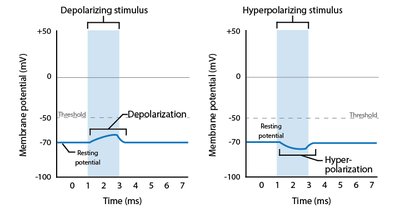
Graded Potentials
Graded potentials are local changes in membrane potential that vary in size and die out as they spread. - Key Point 1: Graded potentials can summate; if depolarization reaches threshold, an action potential is initiated. - Example: Ripples on water represent graded potentials. 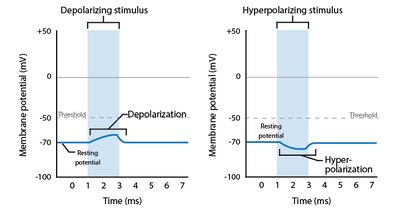
Action Potential: All-or-None Event
When depolarization reaches threshold, voltage-gated channels create an all-or-none action potential. The action potential is regenerated in adjacent membrane, propagating without dying out. - Key Point 1: Action potentials are caused by the opening and closing of Na+ and K+ channels in a precise sequence. - Key Point 2: The action potential is the basis for neural signaling and muscle contraction. 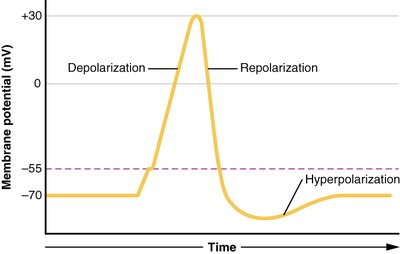
Phases of the Action Potential
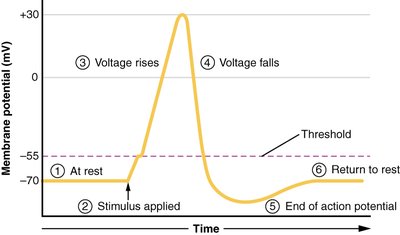
The action potential consists of several phases: 1. Resting state (negative membrane potential) 2. Depolarization to threshold 3. Rapid depolarization to peak 4. Repolarization 5. Hyperpolarization (overshoot) 6. Return to resting potential 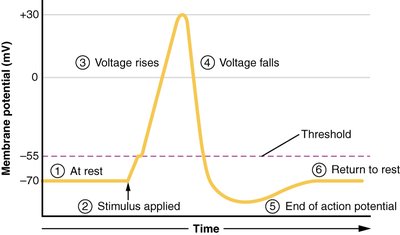
Channel Dynamics During Action Potential
Voltage-gated Na+ channels cycle through closed, open, and inactivated states. K+ channels open more slowly and then close. 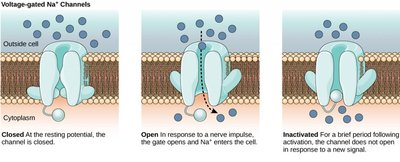
Sequence of Channel Events
At threshold: 1. Na+ channels open, Na+ rushes in (depolarization) 2. Na+ channels inactivate, K+ channels begin opening (delayed) 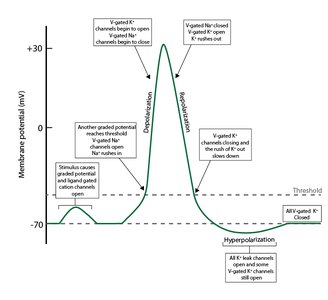 Starting at the peak: 3. K+ rushes out (repolarization) 4. K+ channels begin to close, Na+ channels reset 5. Excitability gradually returns as channels recover
Refractory Periods
The refractory periods limit the frequency of action potentials and ensure one-way propagation. - Absolute refractory period: Na+ channels are open or inactivated; no new action potential can occur. - Relative refractory period: Some Na+ channels have reset, but K+ permeability remains elevated; a stronger stimulus is required for another action potential.
Summary Table: Channel Types and Their Properties
Channel Type | Stimulus | Function | Example Location |
|---|---|---|---|
Voltage-Gated | Change in membrane potential | Initiates action potential | Axon of neuron |
Ligand-Gated | Binding of chemical ligand | Synaptic transmission | Dendrites, synapses |
Mechanically-Gated | Membrane deformation | Sensory transduction | Touch receptors, inner ear |
Leak | Random opening | Maintains resting potential | Throughout cell membrane |
Key Equations
Nernst Equation: Used to calculate the equilibrium potential for a particular ion. Resting Membrane Potential: Determined by the Goldman-Hodgkin-Katz equation. Action Potential Threshold: The minimum depolarization required to trigger an action potential. Example: Threshold is typically around -55 mV in neurons.
Conclusion
The action potential is a fundamental event in excitable cells, driven by the orchestrated opening and closing of ion channels. Understanding these mechanisms is essential for comprehending neural signaling, muscle contraction, and many physiological processes. Additional info: Academic context was added to clarify channel types, equations, and the physiological significance of action potentials.
