 뒤로
뒤로The Cell: Structure, Membrane Transport, and Membrane Potential
스터디 가이드 - 스마트 노트
 자료에 맞춘 맞춤형 노트, 핵심 정의, 예시, 맥락을 확장해 제공합니다.
Chapter 3: The Cell
3.1 Basic Processes of Cells
Cells are the fundamental units of life, carrying out essential processes to maintain homeostasis and support the organism. These processes include metabolism, transport, communication, and reproduction.
Cell Metabolism: The sum of all chemical reactions in a cell, including anabolic (building), catabolic (breaking down), and oxidation-reduction reactions.
Membrane Transport: The movement of substances into, out of, or within the cell.
Communication: Cells interact with their environment and other cells via signaling molecules and receptors.
Cell Reproduction: Most cells divide to produce new cells, essential for growth and repair.
3.1 Overview of Cell Structure
Most animal cells share several basic structural components that allow them to function efficiently.
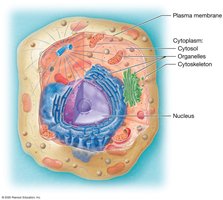
Plasma Membrane: The outer boundary that separates the cell from its environment.
Cytoplasm: The region between the plasma membrane and the nucleus, containing cytosol, organelles, and the cytoskeleton.
Nucleus: The control center of the cell, containing most of the cell's DNA.
Functions of the Plasma Membrane
Physical isolation from the environment
Structural support
Cell communication
Regulation of transport
Cell identification
Defines intracellular (cytosol) and extracellular (ECF) fluid compartments
Components of the Cytoplasm
Cytosol: Watery gel with proteins and dissolved solutes; may contain inclusions (storage bodies).
Organelles: Specialized structures performing specific cellular functions.
Cytoskeleton: Protein filament network for support, shape, organelle positioning, and intracellular transport.
Nucleus
Surrounded by a double membrane (nuclear envelope)
Contains DNA and is the site of RNA production
Controls cellular functions by coding for proteins
3.2 The Phospholipid Bilayer
The plasma membrane is primarily composed of a phospholipid bilayer, which forms a selective barrier between the cell's interior and exterior.
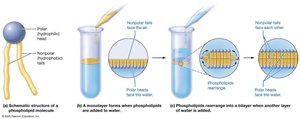
Phospholipids: Molecules with hydrophilic (water-attracting) heads and hydrophobic (water-repelling) tails.
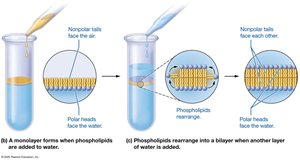
In water, phospholipids arrange into a bilayer with heads facing outward and tails inward, excluding water from the hydrophobic core.
3.2 The Fluid Mosaic Model of the Plasma Membrane
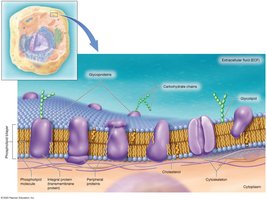
The plasma membrane is described by the fluid mosaic model, which highlights its dynamic and complex structure.
Composed of phospholipids, proteins, cholesterol, and carbohydrates.
Components move laterally, giving the membrane fluidity essential for its functions.
Membrane Proteins
Integral Proteins: Span the membrane; if they reach both sides, called transmembrane proteins.
Peripheral Proteins: Located on one side of the membrane, often anchored by the cytoskeleton.
Functions of Membrane Proteins
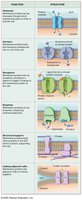
Function | Structure |
|---|---|
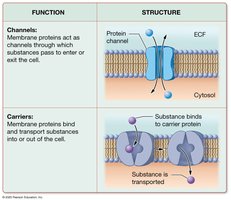
Channels | Allow passage of substances through the membrane |
Carriers | Bind and transport substances |
Receptors | Bind ligands to trigger cellular changes |
Enzymes | Catalyze reactions at the membrane |
Structural Support | Maintain cell shape and integrity |
Linker Proteins | Connect adjacent cells |
Other Membrane Components
Cholesterol: Stabilizes membrane structure during temperature changes.
Glycolipids and Glycoproteins: Carbohydrate chains attached to lipids or proteins; function in cell recognition.
3.3 Transport across the Plasma Membrane
The plasma membrane is selectively permeable, allowing only certain substances to cross. Transport mechanisms are classified as passive or active.
Passive Transport: Does not require energy (ATP).
Active Transport: Requires energy expenditure (ATP).
Variables Affecting Transport
Type of substance
Membrane permeability
Concentration gradient
3.3 Passive Transport Processes
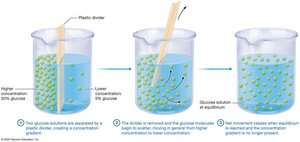
Passive transport relies on the natural movement of molecules down their concentration gradients.
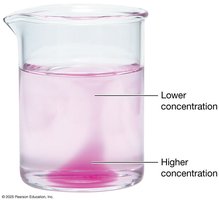
Diffusion: Movement of solute molecules from high to low concentration, driven by the concentration gradient.
Types of Diffusion
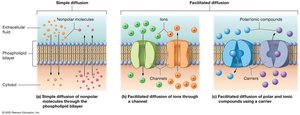
Simple Diffusion: Nonpolar solutes and gases pass directly through the bilayer.
Facilitated Diffusion: Polar or charged solutes cross via channel or carrier proteins.
Osmosis
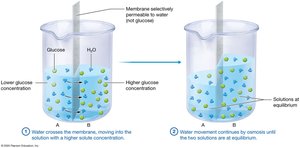
Osmosis is the movement of water across a selectively permeable membrane from a region of lower solute concentration to higher solute concentration.
Water moves through aquaporins or between phospholipids.
Results in changes in fluid volume in compartments.
Tonicity
Isotonic: Equal solute concentration inside and outside the cell; no net water movement.
Hypertonic: Higher solute concentration outside; cell loses water and shrivels (crenates).
Hypotonic: Lower solute concentration outside; cell gains water, swells, and may lyse.
3.3 Active Transport via Membrane Proteins
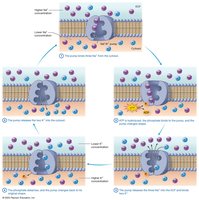
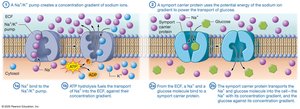
Active transport moves substances against their concentration gradients using energy from ATP and specialized carrier proteins called pumps.
Primary Active Transport: Direct use of ATP to move solutes (e.g., sodium-potassium pump).
Secondary Active Transport: Uses the energy from the movement of one substance down its gradient to drive another substance against its gradient.
3.3 Active Transport via Vesicles
Large particles and macromolecules are transported across the membrane in vesicles, a process requiring ATP.
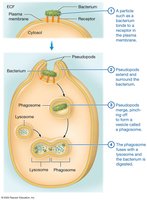
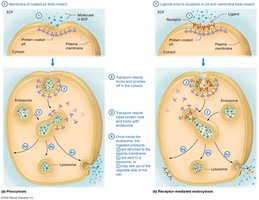
Endocytosis: Bringing substances into the cell (includes phagocytosis and pinocytosis).
Phagocytosis: "Cell eating" of large particles by phagocytes.
Pinocytosis: "Cell drinking" of extracellular fluid and dissolved substances.
Receptor-Mediated Endocytosis: Specific uptake of molecules via receptors.
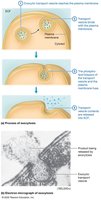
Exocytosis: Release of substances from the cell; adds components to the plasma membrane.
Transcytosis: Substances are transported into, across, and then out of the cell.
3.6 Membrane Potential
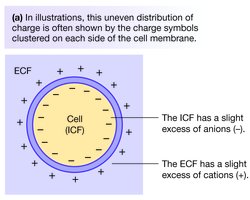
The membrane potential is the voltage difference across the plasma membrane, resulting from the unequal distribution of ions and selective permeability.
Electrochemical Gradient: Combination of concentration and electrical gradients for an ion.
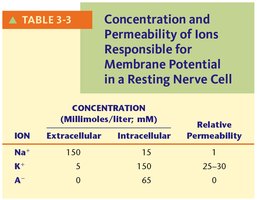
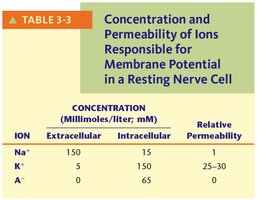
Resting Membrane Potential (Vrest): Typically -70 mV in neurons; inside is negative relative to outside.
Key Ions: Na+ (sodium), K+ (potassium), and large anions (A-).
Na+/K+ Pump: Maintains gradients by pumping 3 Na+ out and 2 K+ in per ATP hydrolyzed.
Selective Permeability: Membrane is more permeable to K+ than Na+.
Equilibrium Potential and the Nernst Equation
The equilibrium potential for an ion is the membrane voltage at which the net flow of that ion is zero. It can be calculated using the Nernst equation:
For K+: mV
For Na+: mV
Goldman Equation
The resting membrane potential (Vm) is determined by the relative permeabilities and concentrations of multiple ions:
K+ permeability is much higher than Na+.
Typical Vm is about -70 mV in neurons.
Net Force on Ions
Net force = Vm - Ex
If positive, drives positive ions out; if negative, drives them in; if zero, no net movement.
Specialized Use of Membrane Potential
Nerve and muscle cells can rapidly change their membrane potential in response to stimuli, enabling nerve impulses and muscle contraction.
Additional info: The concepts of membrane transport and membrane potential are foundational for understanding nerve signaling, muscle contraction, and overall cellular physiology.
