 뒤로
뒤로The Chemical Level of Organization: Foundations for Anatomy & Physiology
스터디 가이드 - 스마트 노트
 자료에 맞춘 맞춤형 노트, 핵심 정의, 예시, 맥락을 확장해 제공합니다.
The Chemical Level of Organization
Introduction to Chemistry in Anatomy & Physiology
Chemistry is fundamental to understanding the structure and function of the human body. All physiological processes depend on chemical interactions at the molecular and atomic levels. This chapter introduces the basic principles of chemistry as they relate to anatomy and physiology.
Organization of Matter
Matter: Anything that has mass and occupies space. Exists in three forms: solid, liquid, and gas.
Mass vs. Weight: Mass is the amount of matter in a substance; weight is the force of gravity acting on that mass.
Chemical Elements and the Human Body
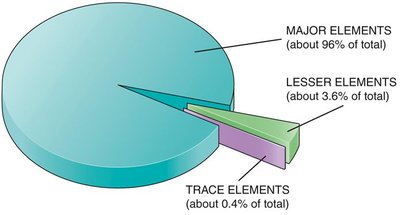
All matter is composed of elements, which are substances that cannot be broken down into simpler substances by ordinary chemical means. The human body is primarily composed of a few major elements, with others present in lesser or trace amounts.
Major Elements (about 96%): Carbon (C), Oxygen (O), Hydrogen (H), Nitrogen (N)
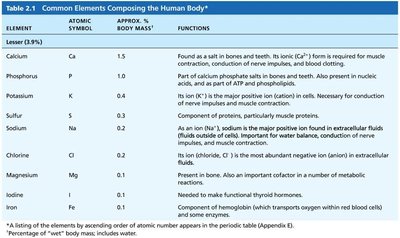
Lesser Elements (about 3.6%): Calcium (Ca), Phosphorus (P), Potassium (K), Sulfur (S), Sodium (Na), Chlorine (Cl), Magnesium (Mg), Iron (Fe), Iodine (I)
Trace Elements (about 0.4%): Essential for enzyme function and other cellular processes
Atoms: Structure and Properties
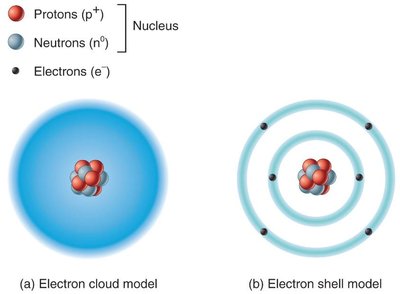
Atoms are the smallest units of elements that retain the properties of that element. Each atom consists of a nucleus (containing protons and neutrons) and electrons that orbit the nucleus in shells.
Protons (p+): Positively charged, found in the nucleus
Neutrons (n0): Neutral, found in the nucleus
Electrons (e-): Negatively charged, orbit the nucleus
Atomic Number, Mass Number, and Isotopes
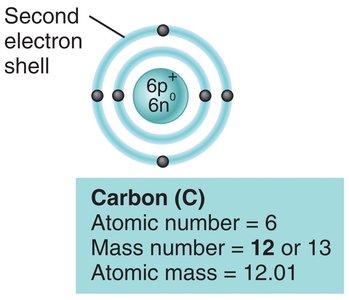
Atomic Number: Number of protons in the nucleus; defines the element.
Mass Number: Sum of protons and neutrons in the nucleus.
Isotopes: Atoms of the same element with different numbers of neutrons.
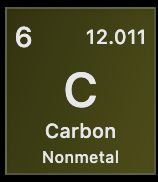
Electron Shells and Chemical Reactivity
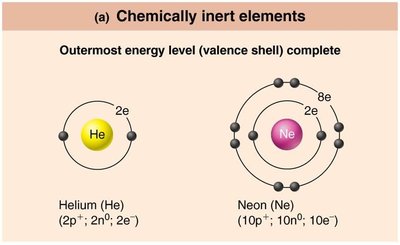
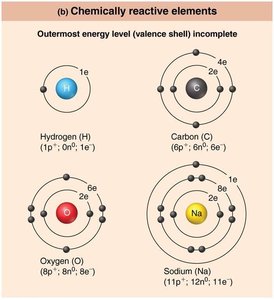
Electrons are arranged in shells around the nucleus. The outermost shell (valence shell) determines an atom's chemical behavior. Atoms are most stable when their valence shell is full (octet rule).
Chemically Inert Elements: Have full valence shells (e.g., noble gases)
Chemically Reactive Elements: Have incomplete valence shells and tend to form bonds
Ions, Molecules, and Compounds
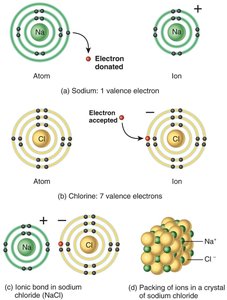
Ion: An atom that has gained or lost electrons, acquiring a charge (cation: positive, anion: negative)
Molecule: Two or more atoms bonded together
Compound: Molecule containing two or more different elements
Chemical Bonds
Atoms form bonds to achieve stability. The three major types of chemical bonds are:
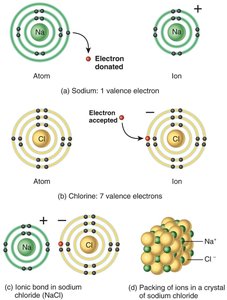
Ionic Bonds: Transfer of electrons from one atom to another, resulting in oppositely charged ions that attract each other (e.g., NaCl)
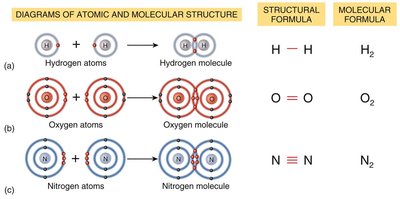
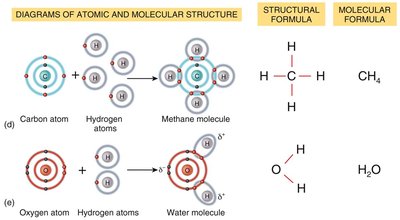
Covalent Bonds: Sharing of electrons between atoms. Can be single, double, or triple bonds. Covalent bonds can be nonpolar (equal sharing) or polar (unequal sharing).
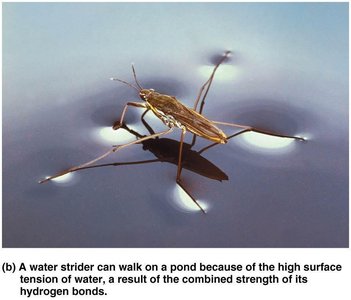
Hydrogen Bonds: Weak attractions between a hydrogen atom (already covalently bonded to another atom) and an electronegative atom (e.g., O or N) in another molecule.
Chemical Reactions
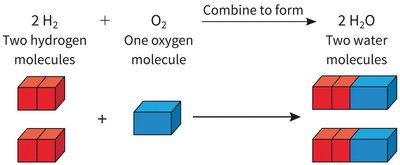
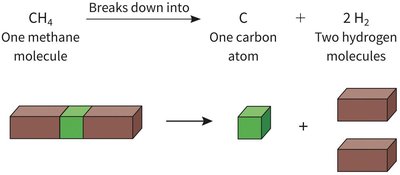
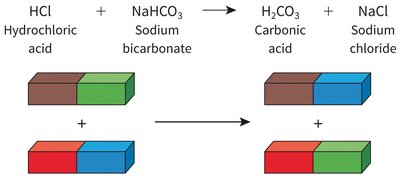
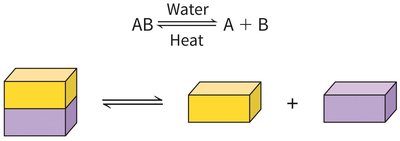
Chemical reactions involve the formation or breaking of bonds. They are represented by chemical equations showing reactants and products.
Synthesis (Anabolic) Reactions: Build larger molecules from smaller ones ()
Decomposition (Catabolic) Reactions: Break down molecules into smaller units ()
Exchange Reactions: Involve both synthesis and decomposition ()
Reversible Reactions: Can proceed in both directions ()
Oxidation-Reduction (Redox) Reactions: Involve the transfer of electrons between atoms or molecules
Energy in Chemical Reactions
Energy: The capacity to do work. Exists as potential (stored) or kinetic (in motion).
Chemical Energy: Stored in the bonds of molecules; released or absorbed during chemical reactions.
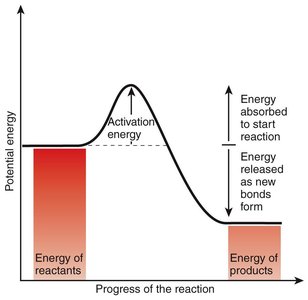
Exergonic Reactions: Release energy (products have less energy than reactants)
Endergonic Reactions: Absorb energy (products have more energy than reactants)
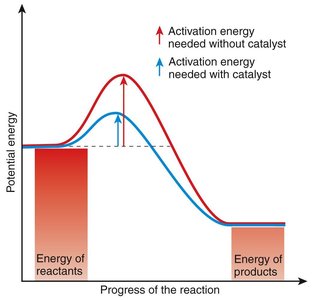
Activation Energy: The energy required to initiate a reaction. Enzymes lower activation energy, speeding up reactions.
Inorganic and Organic Compounds
Inorganic Compounds: Usually lack carbon; include water, salts, acids, and bases.
Organic Compounds: Contain carbon and hydrogen; include carbohydrates, lipids, proteins, and nucleic acids.
Water: The Universal Solvent
Water is the most abundant inorganic compound in the body and is essential for life. It acts as a solvent, participates in chemical reactions, and helps regulate temperature.
High heat capacity: Absorbs and releases heat slowly
High heat of vaporization: Requires a lot of energy to change from liquid to gas
Polar solvent properties: Dissolves ionic and polar substances
Reactivity: Involved in hydrolysis and dehydration synthesis reactions
Cushioning: Protects organs and tissues
Acids, Bases, Salts, and pH
Acids: Proton donors; release H+ ions in solution
Bases: Proton acceptors; release OH- ions in solution
Salts: Ionic compounds that dissociate into cations and anions in water
pH Scale: Measures the concentration of H+ ions; ranges from 0 (acidic) to 14 (basic), with 7 being neutral
Buffer Systems
Buffers are mixtures of compounds that resist changes in pH. They are critical for maintaining homeostasis in body fluids by releasing or binding hydrogen ions as needed.
Major Organic Compounds
Carbohydrates: Main source of energy; include sugars, glycogen, starches, and cellulose
Lipids: Energy storage, insulation, and cell membrane structure; include triglycerides, phospholipids, steroids, and eicosanoids
Proteins: Structure, regulation, transport, enzymes, and more; made of amino acids
Nucleic Acids: Store and transmit genetic information; DNA and RNA
Summary Table: Lesser Elements in the Human Body
Element | Atomic Symbol | Approx. % Body Mass | Functions |
|---|---|---|---|
Calcium | Ca | 1.5 | Bone/teeth structure, muscle contraction, nerve impulses, blood clotting |
Phosphorus | P | 1.0 | Bones/teeth, nucleic acids, ATP |
Potassium | K | 0.4 | Major cation in cells, nerve impulse conduction, muscle contraction |
Sulfur | S | 0.3 | Proteins, muscle contraction |
Sodium | Na | 0.2 | Major cation in extracellular fluids, water balance, nerve/muscle function |
Chlorine | Cl | 0.2 | Major anion in extracellular fluids, water balance |
Magnesium | Mg | 0.1 | Enzyme cofactor, metabolic reactions |
Iodine | I | 0.1 | Thyroid hormones |
Iron | Fe | 0.1 | Hemoglobin, oxygen transport |
Key Takeaways
Chemistry underpins all physiological processes in the body.
Understanding atomic structure, chemical bonds, and reactions is essential for studying anatomy and physiology.
Major, lesser, and trace elements all play critical roles in maintaining life and homeostasis.
