 뒤로
뒤로The Chemical Level of Organization: Foundations for Anatomy & Physiology
스터디 가이드 - 스마트 노트
 자료에 맞춘 맞춤형 노트, 핵심 정의, 예시, 맥락을 확장해 제공합니다.
Chapter 2: The Chemical Level of Organization
Introduction to Matter and Elements
All living organisms are composed of matter, which consists of chemical elements in pure form or in combinations called compounds. Understanding the chemical basis of life is essential for studying anatomy and physiology.
Matter: Anything that takes up space and has mass.
Element: A substance that cannot be broken down into other substances by chemical reactions.
Atom: The smallest unit of matter that retains the properties of an element.
The properties of an element depend on the structure of its atoms, specifically the number of protons in the nucleus.
Subatomic Particles
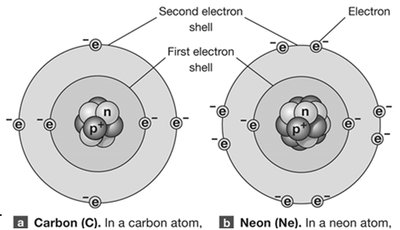
Atoms are composed of three main subatomic particles: protons, neutrons, and electrons.
Protons: Positively charged (+1), found in the nucleus, mass ≈ 1 amu (atomic mass unit).
Neutrons: No charge (neutral), found in the nucleus, mass ≈ 1 amu.
Electrons: Negatively charged (-1), orbit the nucleus in electron shells, negligible mass.
The number of protons determines the atomic number and identity of the element.
Atomic Number, Mass Number, and Isotopes
The atomic number is the number of protons in an atom, while the mass number is the sum of protons and neutrons.
Atomic Number (Z): Number of protons in the nucleus.
Mass Number (A): Number of protons + neutrons.
Isotopes: Atoms of the same element with different numbers of neutrons.
Radioisotopes: Unstable isotopes that emit radiation; used in medical imaging and cancer treatment.
Principal Elements in the Human Body
About 25 elements are essential for life. Four elements—carbon, hydrogen, oxygen, and nitrogen—make up 96% of living matter. Trace elements are required in minute amounts but are vital for health.
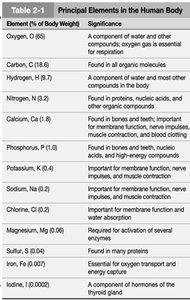
Oxygen (O): Essential for respiration.
Iron (Fe): Required for hemoglobin in red blood cells.
Iodine (I): Needed for thyroid hormone production; deficiency can cause goiter.

Chemical Bonds
Atoms combine through chemical bonds to form molecules and compounds. The main types of chemical bonds are ionic, covalent, and hydrogen bonds.
Ionic Bonds
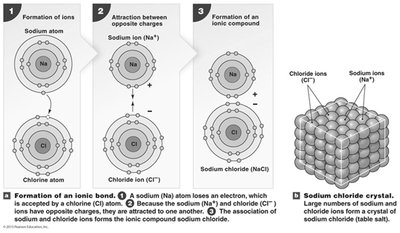
Formed when electrons are transferred from one atom to another, creating ions.
Cation: Positively charged ion (lost electrons).
Anion: Negatively charged ion (gained electrons).
Ionic compounds (e.g., NaCl) are held together by the attraction between oppositely charged ions.
Covalent Bonds
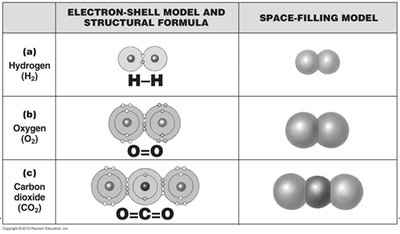
Formed when two atoms share one or more pairs of electrons.
Single bond: Sharing one pair of electrons (e.g., H2).
Double bond: Sharing two pairs of electrons (e.g., O2, CO2).
Nonpolar covalent bond: Electrons shared equally.
Polar covalent bond: Electrons shared unequally, creating partial charges (e.g., H2O).
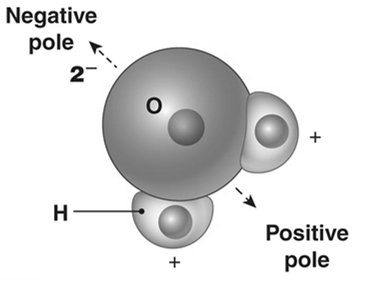
Hydrogen Bonds
Weak bonds between a hydrogen atom (covalently bonded to an electronegative atom) and another electronegative atom.
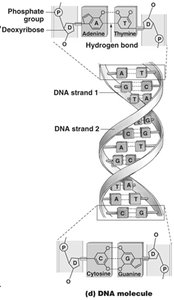
Important in stabilizing the structures of proteins and DNA, and in the properties of water.
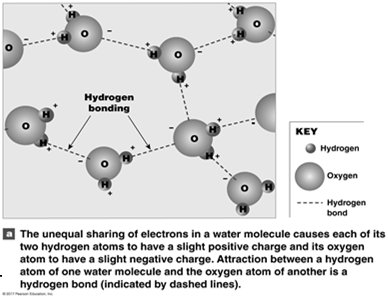
Water: Properties and Importance
Water is essential for life due to its unique properties, which arise from its polarity and ability to form hydrogen bonds.
High heat capacity: Helps regulate temperature in organisms.
Excellent solvent: Dissolves many substances, facilitating biochemical reactions.
Cohesion and adhesion: Allows water to transport substances in biological systems.
Dissociation: Water can dissociate into H+ and OH-, affecting pH.
Acids, Bases, and the pH Scale
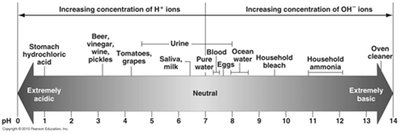
The pH scale measures the concentration of hydrogen ions in a solution, indicating its acidity or alkalinity.
Acid: Substance that increases [H+]; pH < 7.
Base: Substance that decreases [H+] (or increases [OH-]); pH > 7.
Neutral: pH = 7 (e.g., pure water).
Each step on the pH scale represents a tenfold change in [H+].
Blood pH is tightly regulated (7.35–7.45) by buffer systems such as bicarbonate.
Buffers
Buffers are substances that minimize changes in pH by accepting or donating hydrogen ions. They are essential for maintaining homeostasis in biological systems.
Bicarbonate buffer system: Maintains blood pH within the narrow range necessary for life.
Acidosis: Blood pH < 7.35; Alkalosis: Blood pH > 7.45.
Macromolecules: Structure and Function
Macromolecules are large, complex molecules essential for life. The four major classes are carbohydrates, lipids, proteins, and nucleic acids.
Carbohydrates
Composed of C, H, and O in a 1:2:1 ratio (e.g., C6H12O6).
Monosaccharides: Simple sugars (e.g., glucose, fructose, ribose).
Disaccharides: Two monosaccharides joined by glycosidic linkage (e.g., sucrose, lactose, maltose).
Polysaccharides: Long chains of monosaccharides (e.g., starch, glycogen, cellulose).
Lipids
Composed mainly of C, H, and O (less O than carbohydrates).
Hydrophobic and insoluble in water.
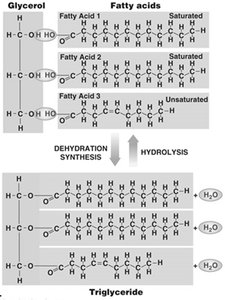
Fats (triglycerides): Glycerol + 3 fatty acids; energy storage.
Saturated fatty acids: No double bonds; solid at room temperature.
Unsaturated fatty acids: One or more double bonds; liquid at room temperature.
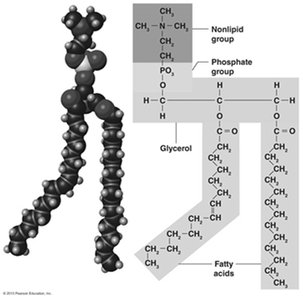
Phospholipids: Glycerol, 2 fatty acids, and a phosphate group; major component of cell membranes.
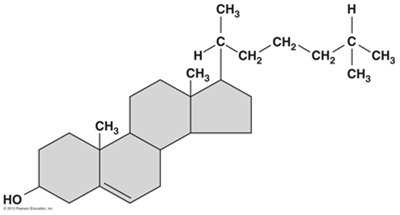
Steroids: Four fused carbon rings; cholesterol is a key example, precursor to steroid hormones.
Proteins
Composed of C, H, O, N (sometimes S).
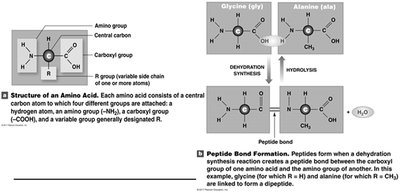
Polymers of amino acids linked by peptide bonds.
Functions: Enzymes, structural support, transport, movement, hormones, defense.
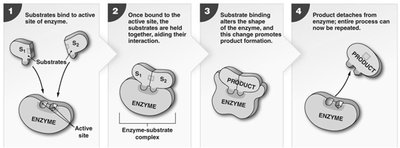
Enzymes: Biological catalysts that speed up chemical reactions by lowering activation energy.
Amino acids: 20 different types, each with a unique R group.
Primary structure: Sequence of amino acids.
Secondary, tertiary, quaternary structures: Higher levels of protein folding and assembly.
Nucleic Acids
Composed of C, H, O, N, P.
DNA: Double-stranded, stores genetic information, found in the nucleus.
RNA: Single-stranded, involved in protein synthesis.
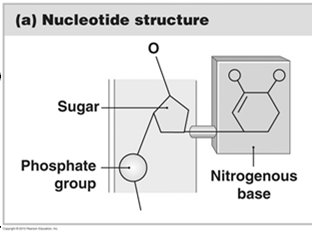
Nucleotide: Monomer of nucleic acids; consists of a phosphate group, pentose sugar, and nitrogenous base.
DNA bases: Adenine (A), Thymine (T), Cytosine (C), Guanine (G).
RNA bases: Adenine (A), Uracil (U), Cytosine (C), Guanine (G).
Complementary base pairing: A-T (or A-U in RNA), C-G.
Key Terms to Know
Elements, Atom, Molecule, Ion, Isotope, Acid, Base, Buffer, Enzyme, Substrate, Protein, Amino Acid, Triglyceride, Phospholipid, Steroid, Nucleotide, DNA, RNA, Glycogen, Cholesterol, Metabolism, Anabolism, Catabolism, Active Site, Covalent Bond, Ionic Bond, Hydrogen Bond, Catalyst, Adenosine Triphosphate (ATP).
