뒤로
뒤로The Endocrine System: Structure, Function, and Regulation
스터디 가이드 - 스마트 노트
 자료에 맞춘 맞춤형 노트, 핵심 정의, 예시, 맥락을 확장해 제공합니다.
The Endocrine System
Overview and Function
The endocrine system is one of the two major regulatory systems of the body, working alongside the nervous system to maintain homeostasis and coordinate physiological processes. Its primary function is intercellular chemical communication through the synthesis and secretion of hormones into the bloodstream, which then interact with specific target cells to regulate various bodily functions.
Regulation of growth and development
Homeostasis (maintenance of internal environment)
Control of reproduction
Activation of body defenses
Maintenance of electrolyte and water balance
Nutrient balance
Regulation of cellular metabolism
Direct effects on behavior
Support of cell growth
Response to external stimuli
Components of the Endocrine System
The endocrine system is composed of several key components:
Endocrine glands: Specialized organs that synthesize and secrete hormones (chemical messengers) directly into the blood.
Hormones: Chemical messengers that interact with specific receptors on target cells.
Target cells: Cells with specific receptors for a given hormone.
Blood: Serves as the transport medium for hormones.
Second messengers: Intracellular signaling molecules that amplify the hormone's effect within the target cell.
How the Endocrine System Works
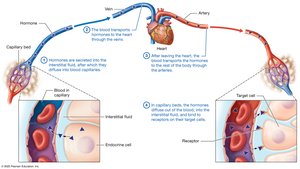
Endocrine cells secrete hormones into the interstitial fluid, which then diffuse into blood capillaries. The blood transports these hormones throughout the body, allowing them to reach distant target cells. Hormones bind to specific receptors on or within target cells, triggering a physiological response.
Comparison: Endocrine vs. Nervous System
Differences
Endocrine system: Hormones are secreted into the bloodstream and act on distant target cells. Effects are slower to initiate but longer-lasting.
Nervous system: Neurotransmitters are released directly onto target cells. Effects are rapid and short-lived unless stimulation is continuous.
Similarities
Both systems coordinate growth, metabolism, reproduction, and adaptation to environmental changes.
Both use chemical messengers for cell communication.
Some molecules can function as both hormones and neurotransmitters.
Types of Endocrine Signals
Endocrine, Paracrine, and Autocrine Signaling
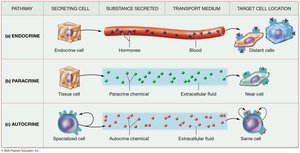
Hormones can act in different ways depending on their route and target:
Endocrine signals: Hormones secreted into the blood to affect distant target cells.
Paracrine signals: Chemicals secreted into the extracellular fluid to affect nearby cells.
Autocrine signals: Chemicals secreted by a cell that affect the same cell.
Endocrine Organs
Primary Endocrine Glands
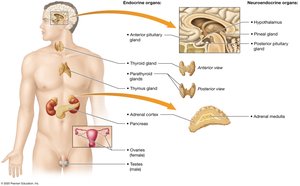
Anterior Pituitary Gland (sphenoid bone of the skull)
Thyroid Gland (anterior neck)
Parathyroid Glands (posterior thyroid)
Adrenal Cortices (superior surface of kidneys)
Endocrine Pancreas (posterior to stomach)
Thymus (superior mediastinum)
Ovaries/Testes (pelvic cavity in females, below pelvic cavity in males)
Secondary Endocrine Glands
Organs that produce hormones but are primarily part of other systems (e.g., heart, kidneys, small intestine, adipose tissue).
Neuroendocrine organs: Nervous tissue that secretes hormones (e.g., hypothalamus, pineal gland, adrenal medulla).
Hormones: Classes and Examples
Classification of Hormones
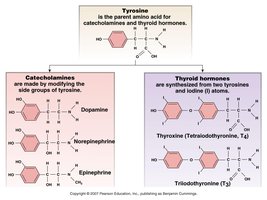
Amino Acid-Based Hormones: Derived from single amino acids (e.g., tyrosine, tryptophan). Includes catecholamines and thyroid hormones.
Peptide/Protein Hormones: Chains of amino acids; can be short (peptides) or long (proteins). Examples: ADH, oxytocin, TSH, LH, FSH, GH, PRL.
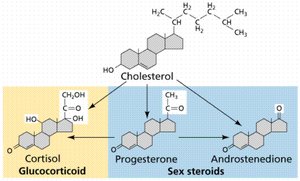
Steroid Hormones: Derived from cholesterol; lipid-soluble. Examples: cortisol, aldosterone, testosterone, estrogen, progesterone.
Amino Acid-Based Hormones
Tyrosine-derived: Thyroid hormones (T3, T4), catecholamines (epinephrine, norepinephrine, dopamine).
Tryptophan-derived: Serotonin, melatonin.
Steroid Hormones
Parent compound: Cholesterol
Glucocorticoids: Cortisol
Mineralocorticoids: Aldosterone
Androgens: Testosterone
Estrogens: Estradiol, estrone
Progestogens: Progesterone
Target Cells and Hormone Receptors
Specificity and Mechanism
Target cells possess specific receptors for hormones. The location of these receptors depends on the hormone's chemical nature:
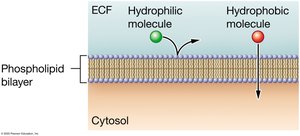
Plasma membrane receptors: Bind hydrophilic hormones (e.g., peptide hormones).
Intracellular receptors (cytosol or nucleus): Bind hydrophobic hormones (e.g., steroid hormones).
Regulation of Receptor Number
Upregulation: Increase in receptor number in response to low hormone levels (increases sensitivity).
Downregulation: Decrease in receptor number after prolonged exposure to high hormone levels (decreases sensitivity).
Example: Oxytocin receptors are upregulated during childbirth; high insulin levels can cause downregulation of insulin receptors on adipose cells.
Hormone Actions and Interactions
Effects of Hormone Actions
Stimulate secretion from other cells
Activate or inhibit enzymes
Stimulate or inhibit cell division (mitosis/meiosis)
Alter membrane potential by opening/closing ion channels
Regulate gene expression (activate/inhibit transcription)
Hormone Interactions
Complementary actions: Different hormones act on different cells to achieve a common goal.
Synergists: Hormones act on the same cell to produce the same effect.
Antagonists: Hormones act on the same cell but have opposite effects.
Hormone Regulation and Secretion
Hormone Half-Life and Elimination
Hormones are removed from the blood by the kidneys (urine) or liver (enzymatic breakdown).
Half-life: Time required for hormone concentration in plasma to decrease by half.
Hydrophobic hormones generally have longer half-lives than hydrophilic hormones.
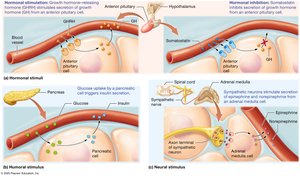
Stimuli for Hormone Secretion
Humoral stimuli: Changes in blood levels of ions or nutrients (e.g., insulin release in response to blood glucose).
Neural stimuli: Nerve fibers stimulate hormone release (e.g., sympathetic stimulation of adrenal medulla).
Hormonal stimuli: Hormones stimulate the release of other hormones (e.g., pituitary hormones stimulating other glands).
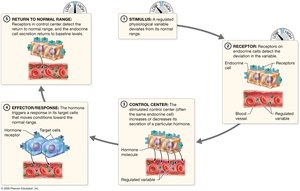
Negative Feedback Regulation
Hormone secretion is typically regulated by negative feedback loops to maintain homeostasis:
Stimulus: A physiological variable deviates from its normal range.
Receptor: Endocrine cell receptors detect the deviation.
Control center: The endocrine cell (or another control center) adjusts hormone secretion.
Effector/response: The hormone acts on target cells to restore the variable to normal.
Return to normal: Hormone secretion returns to baseline as homeostasis is restored.