 뒤로
뒤로The Human Body: An Orientation – Study Notes
스터디 가이드 - 스마트 노트
 자료에 맞춘 맞춤형 노트, 핵심 정의, 예시, 맥락을 확장해 제공합니다.
The Human Body: An Orientation
Anatomical Position
The anatomical position is the standard reference for describing locations and directions on the human body. In this position, the body stands erect, feet slightly apart, with palms facing forward and thumbs pointing away from the body. All directional terms are based on this position, regardless of the actual position of the body.
Right and left always refer to the body being viewed, not the observer.
This standardization ensures clear and consistent communication in anatomy.
Regional Terms
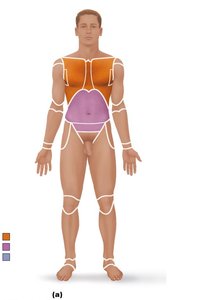
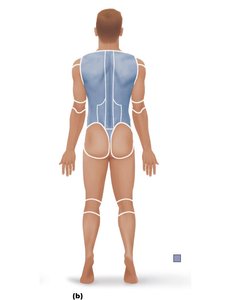
Regional terms are used to designate specific areas within the body’s major divisions. The body is divided into two main regions:
Axial region: Includes the head, neck, and trunk.
Appendicular region: Includes the limbs (arms and legs).
Each region is further subdivided into specific anatomical areas, such as the cephalic (head), cervical (neck), thoracic (chest), abdominal, pelvic, and limb regions.
Orientation and Directional Terms
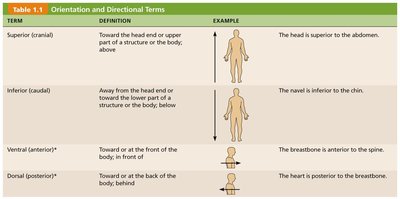
Directional terms describe the location of one body part relative to another. These terms are essential for accurately describing positions and relationships in the body.
Term | Definition | Example |
|---|---|---|
Superior (cranial) | Toward the head end or upper part of a structure or the body; above | The head is superior to the abdomen. |
Inferior (caudal) | Away from the head end or toward the lower part of a structure or the body; below | The navel is inferior to the chin. |
Ventral (anterior) | Toward or at the front of the body; in front of | The breastbone is anterior to the spine. |
Dorsal (posterior) | Toward or at the back of the body; behind | The heart is posterior to the breastbone. |
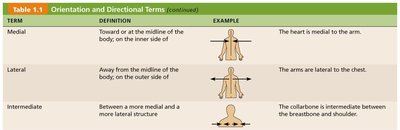
Medial | Toward or at the midline of the body; on the inner side of | The heart is medial to the arm. |
Lateral | Away from the midline of the body; on the outer side of | The arms are lateral to the chest. |
Intermediate | Between a more medial and a more lateral structure | The collarbone is intermediate between the breastbone and shoulder. |
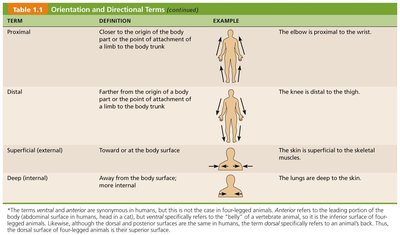
Proximal | Closer to the origin of the body part or the point of attachment of a limb to the body trunk | The elbow is proximal to the wrist. |
Distal | Farther from the origin of a body part or the point of attachment of a limb to the body trunk | The knee is distal to the thigh. |
Superficial (external) | Toward or at the body surface | The skin is superficial to the skeletal muscles. |
Deep (internal) | Away from the body surface; more internal | The lungs are deep to the skin. |
Anatomical Variability
Although most human bodies conform to standard anatomical descriptions, some variability exists. About 90% of structures match textbook descriptions, but variations such as nerves or blood vessels in different locations, or missing small muscles, are common. Extreme variations are rare and usually incompatible with life.
Body Planes and Sections
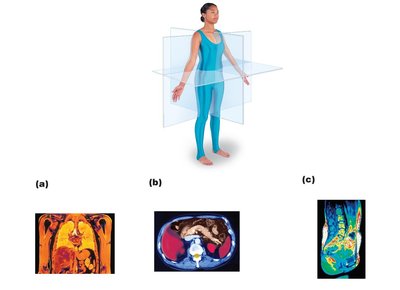
Body planes are imaginary flat surfaces used to divide the body for anatomical study. Sections are cuts made along these planes. The three most common planes are:
Sagittal plane: Divides the body into right and left parts. A midsagittal (median) plane lies on the midline; a parasagittal plane is offset from the midline.
Frontal (coronal) plane: Divides the body into anterior (front) and posterior (back) parts.
Transverse (horizontal) plane: Divides the body into superior (upper) and inferior (lower) parts; produces a cross section.
Oblique section: A cut made at an angle other than 90° to a vertical plane.
Body Cavities
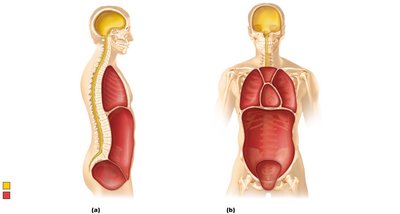
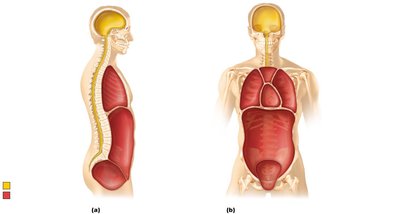
The body contains internal cavities that protect organs and allow for organ movement and expansion. There are two main sets of body cavities:
Dorsal body cavity: Protects the nervous system and has two subdivisions:
Cranial cavity: Encases the brain.
Vertebral cavity: Encases the spinal cord.
Ventral body cavity: Houses internal organs (viscera) and is divided by the diaphragm into:
Thoracic cavity: Contains the heart and lungs, with further subdivisions:
Pleural cavities: Each surrounds a lung.
Mediastinum: Contains the pericardial cavity and surrounds thoracic organs.
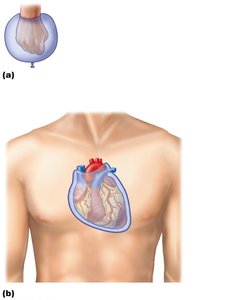
Pericardial cavity: Encloses the heart.
Abdominopelvic cavity: Subdivided into:
Abdominal cavity: Contains the stomach, intestines, spleen, and liver.
Pelvic cavity: Contains the urinary bladder, reproductive organs, and rectum.
Membranes in the Ventral Body Cavity
Serous membranes (serosae) are thin, double-layered membranes that cover the walls of the ventral body cavity and the outer surfaces of the organs. The parietal serosa lines the cavity walls, while the visceral serosa covers the organs. The space between these layers is filled with serous fluid, which reduces friction.
Pericardium: Serosa around the heart.
Pleurae: Serosa around the lungs.
Peritoneum: Serosa of the abdominopelvic cavity.
Abdominopelvic Quadrants and Regions
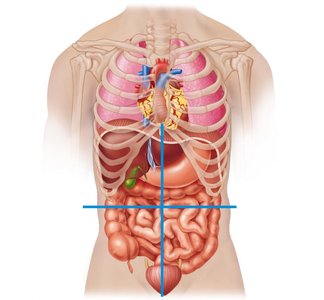
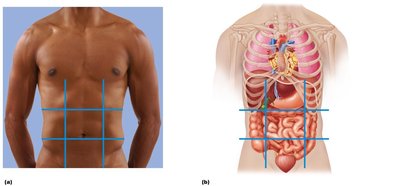
The abdominopelvic cavity is divided for clinical and anatomical purposes:
Quadrants: Four quadrants (right upper, left upper, right lower, left lower) are used by medical personnel to localize pain or abnormalities.
Regions: Nine regions (right/left hypochondriac, epigastric, right/left lumbar, umbilical, right/left iliac, hypogastric) are used by anatomists for more precise localization.
Other Body Cavities
Additional body cavities include:
Exposed to the environment: Oral and digestive cavities, nasal cavity, orbital cavities, and middle ear cavities.
Not exposed to the environment: Synovial cavities (joint cavities).
Additional info: Understanding anatomical terminology and body organization is foundational for all further study in anatomy and physiology, as it allows precise communication and localization of structures and functions.
