 뒤로
뒤로The Language of Anatomy and Physiology: Anatomical Position, Directional Terms, Regional Terms, and Planes of Section
스터디 가이드 - 스마트 노트
 자료에 맞춘 맞춤형 노트, 핵심 정의, 예시, 맥락을 확장해 제공합니다.
Module 1.3: The Language of Anatomy and Physiology
Introduction to Anatomical Terminology
Understanding anatomy and physiology requires learning a specialized language that allows precise communication about the human body. This language is built from word roots, prefixes, and suffixes, many of which are derived from Latin and Greek. Mastery of these terms is essential for students and professionals in health and science fields.
Word Roots: Core components of scientific terms (e.g., card- for heart, encephal- for brain).
Prefixes and Suffixes: Modify the meaning of word roots (e.g., an- means without; -ic means pertaining to).
Combining Vowels: Often an "o" is added between roots for ease of pronunciation (e.g., cardiovascular).
Example: Anencephalic = an- (without) + encephal- (brain) + -ic (pertaining to) = lacking part of the brain.
Anatomical Position and Directional Terms
The Anatomical Position
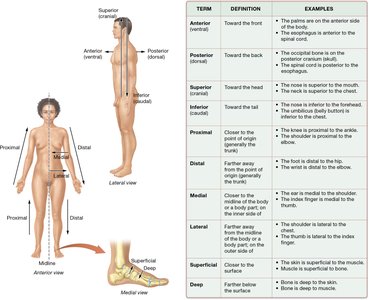
The anatomical position is the standard reference for describing the body. The body stands upright, feet shoulder-width apart, arms at the sides, and palms facing forward. All directional terms are based on this position, regardless of the body's actual orientation.

Directional Terms
Directional terms describe the locations of structures relative to other structures or locations in the body. They are essential for clear communication and preventing medical errors.
Anterior (ventral): Toward the front
Posterior (dorsal): Toward the back
Superior (cranial): Toward the head
Inferior (caudal): Toward the tail or lower part
Proximal: Closer to the point of origin (used for limbs)
Distal: Farther from the point of origin (used for limbs)
Medial: Closer to the midline of the body
Lateral: Farther from the midline
Superficial: Closer to the surface
Deep: Farther from the surface
Regional Terms of the Body
Axial and Appendicular Regions
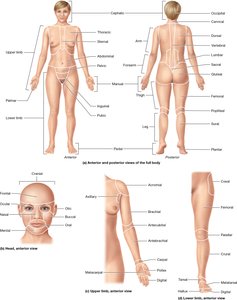
The body is divided into two main regions:
Axial region: Head, neck, and trunk
Appendicular region: Upper and lower limbs
Each region is further subdivided into specific areas, often named as nouns (e.g., brachium for arm) or adjectives (e.g., brachial region).
Summary Table of Regional Terms
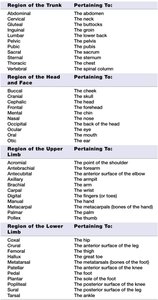
The following table summarizes the main regional terms and the body parts they refer to:
Region | Pertaining To |
|---|---|
Abdominal | The abdomen |
Cervical | The neck |
Gluteal | The buttocks |
Brachial | The arm |
Crural | The shin |
Thoracic | The chest |
Cephalic | The head |
Orbital | The eye |
Oral | The mouth |
Axillary | The armpit |
Femoral | The thigh |
Patellar | The anterior surface of the knee |
Tarsal | The ankle |
Applying Anatomical Terms
Describing Locations with Directional and Regional Terms
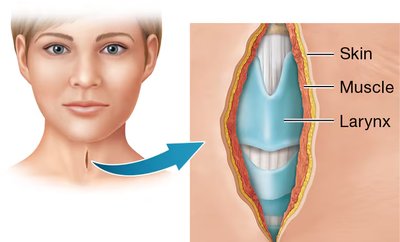
To accurately describe the location of injuries or procedures, combine regional and directional terms. For example, a surgical incision in the cervical region can be described as:
On the anterior cervical region, just lateral to the midline
Extending vertically from 1 cm inferior to the mental region to 2 cm superior to the thoracic region
Deep to the skin and muscle but superficial to the larynx
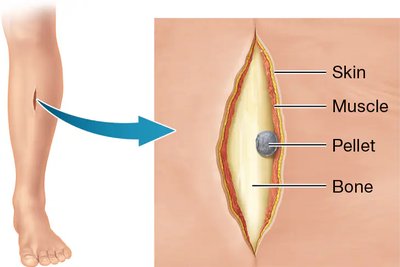
Another example: A pellet wound in the left crural region can be described as:
On the left anteromedial crural region
10 cm proximal to the tarsal region and 6 cm distal to the patellar region
The pellet is lodged deep to the skin and muscle but superficial to the bone
Planes of Section
Standard Anatomical Planes
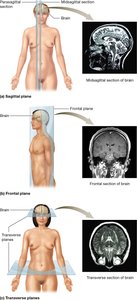
To study internal structures, the body is divided using standard planes of section:
Sagittal Plane: Divides the body into right and left sections.
Midsagittal (Median) Plane: Divides into equal right and left halves.
Parasagittal Plane: Divides into unequal right and left sections.
Frontal (Coronal) Plane: Divides the body into anterior (front) and posterior (back) sections.
Transverse (Horizontal) Plane: Divides the body into superior (upper) and inferior (lower) parts; also called a cross section.
Oblique Plane: Taken at an angle; less commonly used.
Study Strategies for Anatomical Terms
Learning anatomical vocabulary is best accomplished through active recall methods such as flashcards. Mixing up the order and direction of recall (term-to-definition and definition-to-term) enhances retention.
Summary Table: Directional Terms
Term | Definition | Example |
|---|---|---|
Anterior | Toward the front | The palms are on the anterior side of the body. |
Posterior | Toward the back | The spinal cord is posterior to the heart. |
Superior | Toward the head | The nose is superior to the mouth. |
Inferior | Toward the tail | The chest is inferior to the neck. |
Proximal | Closer to the point of origin | The shoulder is proximal to the elbow. |
Distal | Farther from the point of origin | The foot is distal to the hip. |
Medial | Closer to the midline | The heart is medial to the lungs. |
Lateral | Farther from the midline | The thumb is lateral to the index finger. |
Superficial | Closer to the surface | The skin is superficial to the muscle. |
Deep | Farther from the surface | Bone is deep to muscle. |
Additional info: For a comprehensive understanding, students should practice applying these terms to real anatomical scenarios and diagrams.
