 뒤로
뒤로The Metric System: Foundations for Anatomy & Physiology
스터디 가이드 - 스마트 노트
 자료에 맞춘 맞춤형 노트, 핵심 정의, 예시, 맥락을 확장해 제공합니다.
The Metric System in Science and Medicine
Introduction to the Metric System
The metric system is the most widely used system of measurement in science and medicine, including Anatomy & Physiology. It provides a standardized way to measure length, mass, volume, and temperature, ensuring consistency and accuracy in scientific communication and experimentation.
Unit of Length: meter (m)
Unit of Mass: gram (g)
Unit of Volume: liter (l)
Unit of Temperature: degrees Celsius (°C)
The metric system is based on multiples of ten, making conversions straightforward and logical.
Base Units and Their Relationships
Base Units of Measurement
Mass: The gram (g) is the base unit. 1 gram ≈ 1/28 ounce.
Length: The meter (m) is the base unit. 1 meter ≈ 1.094 yards.
Volume: The liter (l) is the base unit. 1 liter ≈ 1.057 quarts.
Temperature: Measured in degrees Celsius (°C).
Volume can also be expressed as cubic centimeters (cm3 or cc), where 1 liter = 1000 cm3.
Metric Prefixes and Powers of Ten
Understanding Metric Prefixes
Metric prefixes are used to indicate multiples or fractions of base units, always in powers of ten. This system simplifies calculations and conversions in scientific contexts.
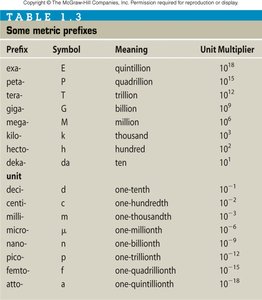
Prefix | Symbol | Meaning | Unit Multiplier |
|---|---|---|---|
kilo- | k | thousand | 103 |
centi- | c | one-hundredth | 10-2 |
milli- | m | one-thousandth | 10-3 |
micro- | μ | one-millionth | 10-6 |
nano- | n | one-billionth | 10-9 |
pico- | p | one-trillionth | 10-12 |
mega- | M | million | 106 |
giga- | G | billion | 109 |
Example: 1 kilometer (km) = 1000 meters (m); 1 milligram (mg) = 0.001 grams (g).
Rules of Metric Notation
Standard Practices
The unit or abbreviation always follows the amount (e.g., 5 g, 10 mg).
Decimals are used for fractional units (e.g., 1.5 ml).
Use a leading zero for values less than one (e.g., 0.5 mg, 0.12 ml).
Converting Between Metric Units
Conversion Principles
Larger to Smaller Unit: Multiply by the order-of-magnitude difference.
Smaller to Larger Unit: Divide by the order-of-magnitude difference.
Example 1: 0.5 mg = 0.5 × 1000 μg = 500 μg
Example 2: 130 ml = 130 ÷ 1000 l = 0.13 l
Always check if your answer is logical: more parts of a smaller unit are needed to equal a larger unit, and vice versa.
Common Metric and U.S. Customary Unit Conversions
Length
1 kilometer ≈ 0.62 miles
1 meter ≈ 1.09 yards ≈ 39.4 inches
1 centimeter ≈ 0.4 inches
1 inch = 2.54 cm
Volume
1 liter ≈ 1.06 quarts
1 milliliter (ml) = 1 cubic centimeter (cc)
1 teaspoon ≈ 5 ml
1 fluid ounce ≈ 30 ml
1 gallon ≈ 3.8 l
Mass
1 kilogram ≈ 2.2 pounds
1 pound ≈ 454 g
1 ounce ≈ 28 g
Example: Convert 66 lbs to kg: 66 ÷ 2.2 = 30 kg
Density of Water
Reference Values
At 4°C, pure water has a density of about 1 g/cm3, 1 g/ml, or 1 kg/liter.
1 ml of water weighs approximately 1 g.
Celsius: The Metric Temperature Scale
Definitions and Conversions
0°C = 32°F (water freezes)
100°C = 212°F (water boils)
1°C ≈ 1.8°F
Conversion Formulas:
Example: Convert 35°C to °F:
Thinking in Celsius
-10°C = frigid (14°F)
0°C = cold (32°F)
10°C = cool (50°F)
20°C = comfortably warm (68°F)
30°C = hot (86°F)
40°C = very hot (104°F)
