 뒤로
뒤로Tissue Types: Structure and Function (Histology, Ch. 4)
스터디 가이드 - 스마트 노트
 자료에 맞춘 맞춤형 노트, 핵심 정의, 예시, 맥락을 확장해 제공합니다.
Tissue Types in Human Anatomy
Overview of Tissue Classification
Tissues are groups of cells with similar structure and function, forming the basic building blocks of organs and systems. The four primary tissue types are epithelial, connective, muscle, and nervous tissue. Each type has distinct characteristics and roles in the body.
Epithelial Tissue
Characteristics and Functions
Epithelial tissue consists of tightly-packed cells that cover body surfaces, line organs, cavities, and vessels, and form glands. It serves as a protective barrier, regulates exchange, and produces secretions.
Cellularity: High density of cells with minimal extracellular matrix.
Polarity: Distinct apical (free) and basal surfaces.
Attachment: Basal surface attached to a basement membrane.
Regeneration: High rate of cell replacement.
Functions: Protection, absorption, filtration, secretion, and sensation.
Classification of Epithelial Tissue
Epithelial tissues are classified by cell shape and number of layers:
Cell shapes: Squamous (flat), cuboidal (cube-shaped), columnar (tall).
Layers: Simple (one layer), stratified (multiple layers), pseudostratified (appears layered but all cells touch the basement membrane), transitional (changes shape).
Examples: Simple squamous lines lungs; stratified squamous forms skin; simple columnar lines intestines; pseudostratified columnar lines trachea; transitional lines bladder.
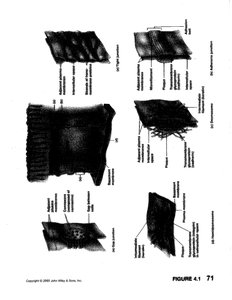
Glandular Epithelium
Glands are specialized epithelial cells that produce secretions. They are classified as:
Exocrine glands: Secrete products into ducts (e.g., sweat, salivary glands).
Endocrine glands: Release hormones directly into the bloodstream (e.g., thyroid, pituitary).
Connective Tissue
General Characteristics
Connective tissue supports, binds, and protects other tissues. It contains cells, fibers, and abundant extracellular matrix. Functions include structural support, transport, energy storage, and immune defense.
Cells: Fibroblasts, adipocytes, chondrocytes, osteocytes, blood cells.
Fibers: Collagen (strength), elastic (flexibility), reticular (support).
Matrix: Ground substance (fluid, gel, or solid).
Types of Connective Tissue
Loose connective tissue: Areolar, adipose, reticular; supports and cushions organs.
Dense connective tissue: Dense regular (tendons, ligaments), dense irregular (dermis), elastic (walls of arteries).
Cartilage: Hyaline (joints, trachea), elastic (ear), fibrocartilage (intervertebral discs).
Bone: Compact and spongy; provides structural support.
Blood: Fluid tissue for transport of cells and nutrients.
Connective Tissue Fiber Types
Fiber Type | Function | Location |
|---|---|---|
Collagen | Strength, resistance to stretching | Tendons, ligaments, skin |
Elastic | Flexibility, recoil | Arteries, lungs, skin |
Reticular | Support, framework | Liver, spleen, lymph nodes |
Muscle Tissue
Characteristics and Types
Muscle tissue is specialized for contraction, enabling movement and heat production. It responds to nervous stimulation.
Skeletal muscle: Voluntary, striated, long fibers; attached to bones.
Cardiac muscle: Involuntary, striated, branched fibers; found in heart.
Smooth muscle: Involuntary, non-striated, spindle-shaped fibers; found in walls of organs, blood vessels.
Nervous Tissue
Structure and Function
Nervous tissue consists of neurons and supporting glial cells. It transmits electrical signals throughout the body, coordinating responses and regulating functions.
Neurons: Specialized for communication via action potentials.
Glial cells: Support, protect, and nourish neurons.
Example: Nervous tissue forms the brain, spinal cord, and peripheral nerves.
Summary Table: Tissue Types and Functions
Tissue Type | Main Function | Key Locations |
|---|---|---|
Epithelial | Protection, secretion, absorption | Skin, lining of organs, glands |
Connective | Support, binding, transport | Bone, cartilage, blood, tendons |
Muscle | Movement, heat production | Skeletal muscles, heart, organ walls |
Nervous | Communication, regulation | Brain, spinal cord, nerves |
