Ch. 13 The Peripheral Nervous System
Amerman - Human Anatomy & Physiology 2nd Edition
Amerman2nd EditionHuman Anatomy & PhysiologyISBN: 9780136873822당신이 사용하는 게 아니라요?교과서 변경
13장, 문제 11

Place the following sequence of events for the detection of somatic sensation in the proper order. Place a 1 by the first event, a 2 by the second event, and so on.     
a. ______The central process transmits the action potential to a second-order sensory neuron in the CNS.     
b. ______The action potential is transferred to the central process in the posterior root ganglion.     
c. ______The stimulus triggers an action potential.     
d. ______The signal is transferred to other CNS sensory neurons for eventual perception and interpretation.     
e. ______The action potential is propagated along the peripheral process of the neuron.

검증된 단계별 안내
1
Step 1: Begin by identifying the initial event in the sequence. The detection of somatic sensation starts when a stimulus triggers an action potential in the sensory receptor. This corresponds to option 'c'.
Step 2: Once the action potential is generated, it is propagated along the peripheral process of the sensory neuron. This corresponds to option 'e'.
Step 3: The action potential then reaches the posterior root ganglion, where it is transferred to the central process of the sensory neuron. This corresponds to option 'b'.
Step 4: The central process transmits the action potential to a second-order sensory neuron located in the central nervous system (CNS). This corresponds to option 'a'.
Step 5: Finally, the signal is transferred to other CNS sensory neurons for further processing, perception, and interpretation. This corresponds to option 'd'.

비슷한 문제에 대한 검증된 영상 답변:

이 영상 해법은 위 문제에 도움이 된다고 튜터들이 추천한 것입니다.
도움이 되었나요?

주요 개념

질문에 올바르게 답하기 위해 반드시 이해해야 하는 핵심 개념들은 다음과 같습니다.

Somatic Sensation

Somatic sensation refers to the body's ability to perceive stimuli from the environment through sensory receptors. This includes sensations such as touch, temperature, pain, and proprioception. Understanding somatic sensation is crucial for grasping how the body interacts with its surroundings and how these signals are processed by the nervous system.
추천 영상:
1:50
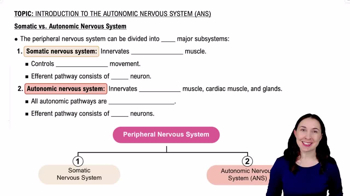
Somatic vs. Autonomic Nervous System

Action Potential

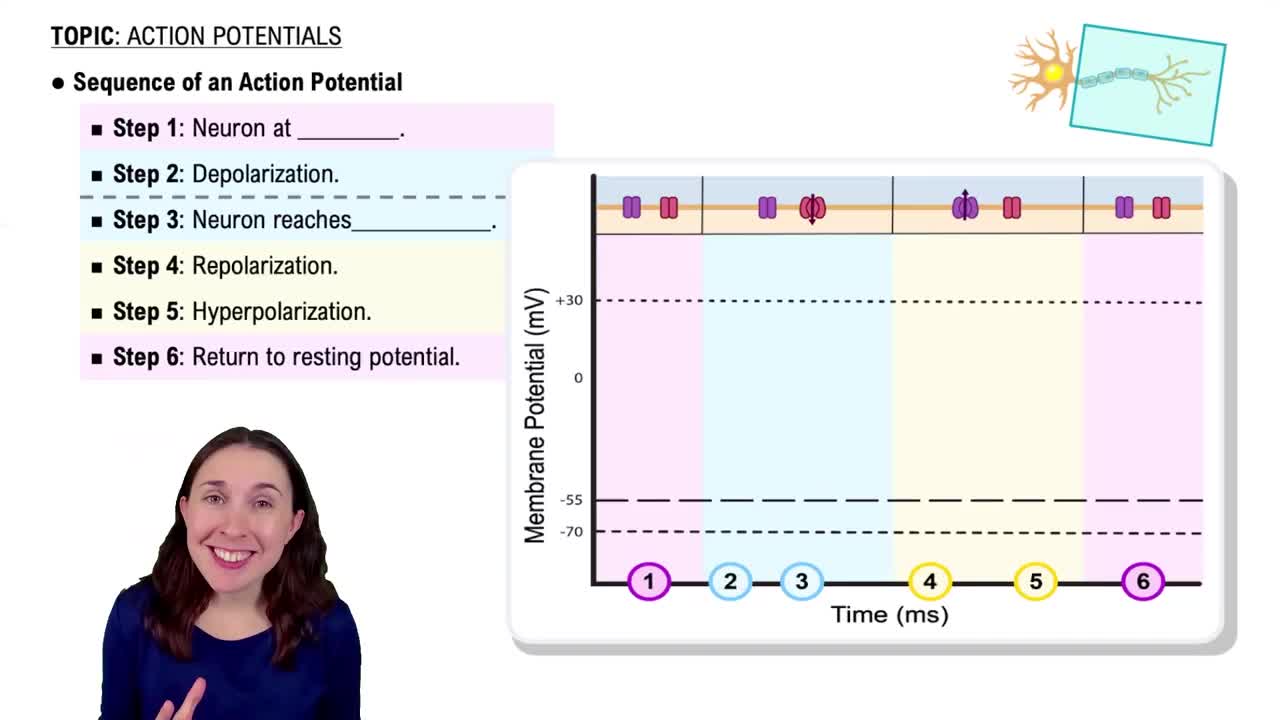
An action potential is a rapid electrical signal that travels along the axon of a neuron, triggered by a stimulus. It is essential for the transmission of sensory information from peripheral receptors to the central nervous system (CNS). The generation and propagation of action potentials are fundamental processes in neural communication, allowing for the relay of sensory information.
추천 영상:
03:53
Action Potential

Central Nervous System (CNS)

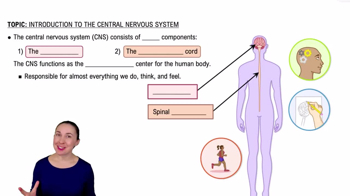
The central nervous system consists of the brain and spinal cord, serving as the main control center for processing sensory information. It interprets signals received from sensory neurons and coordinates responses. Understanding the role of the CNS is vital for comprehending how sensory information is integrated and perceived, leading to appropriate reactions to stimuli.
추천 영상:
1:32
The Central Nervous System